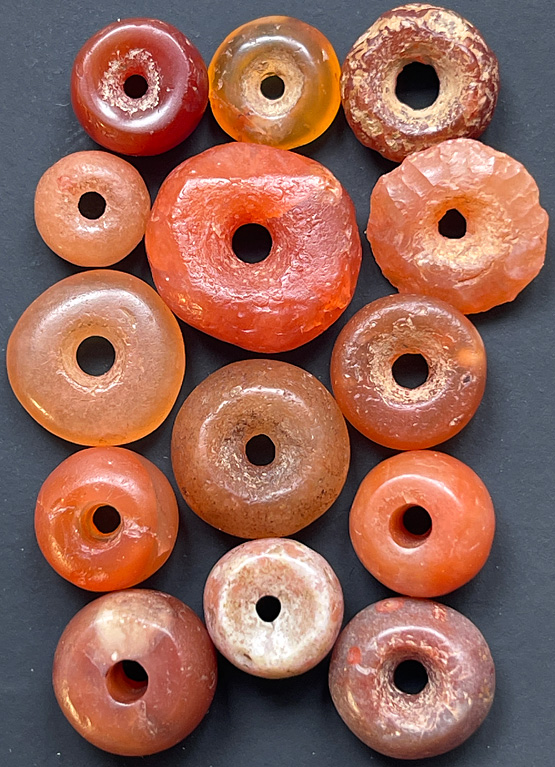
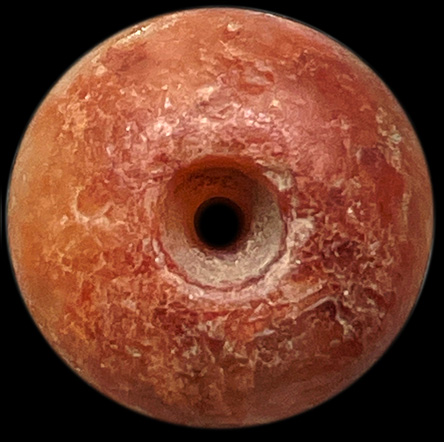
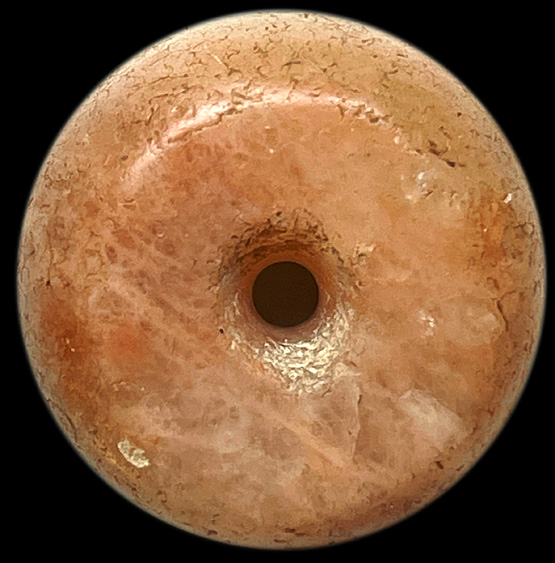
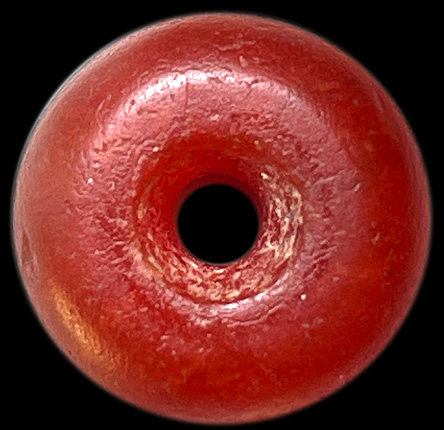
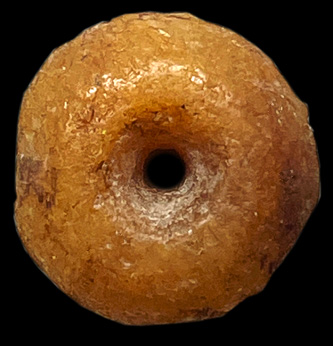
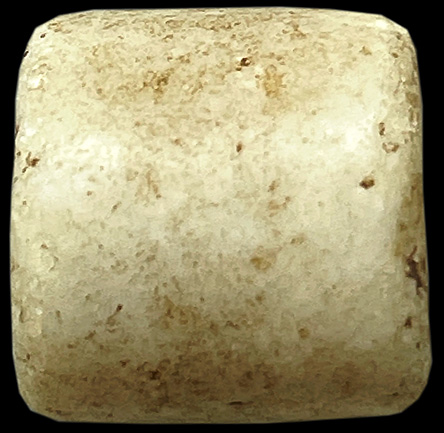
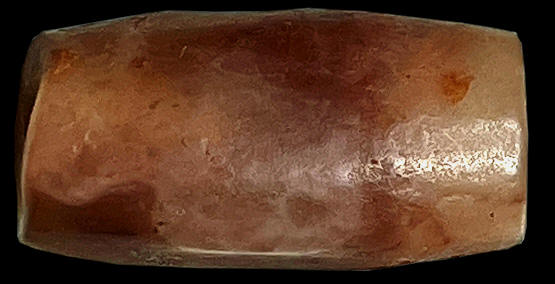
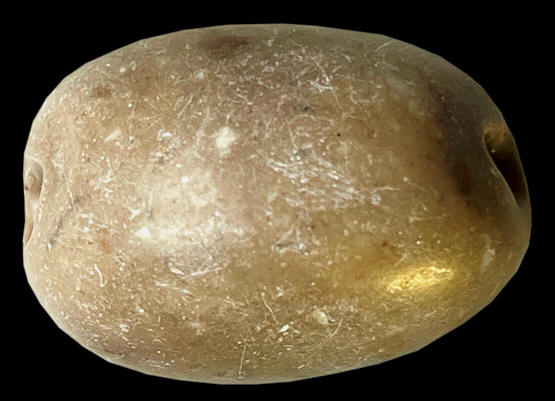
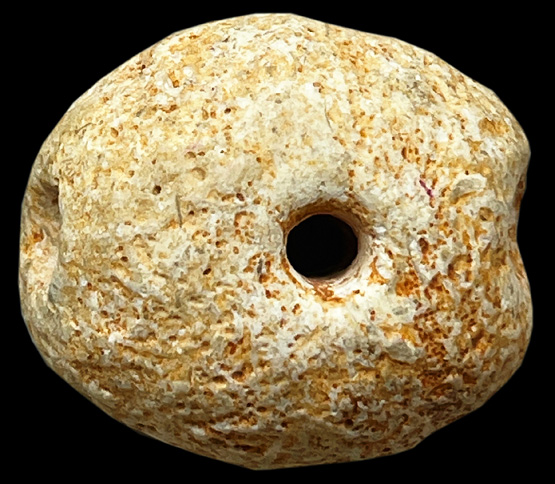
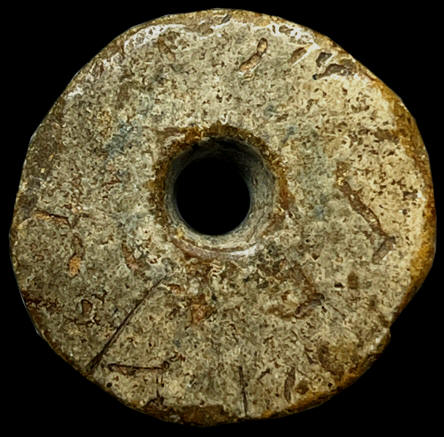
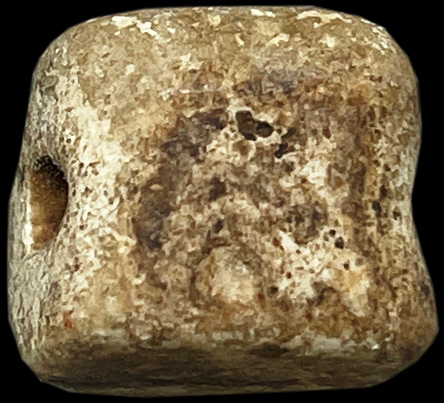
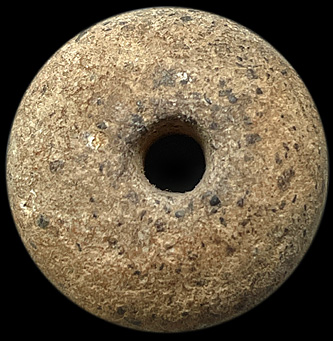
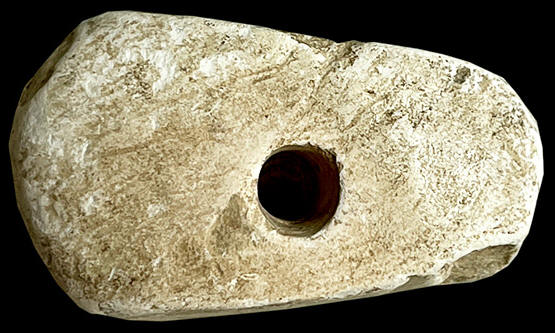
|
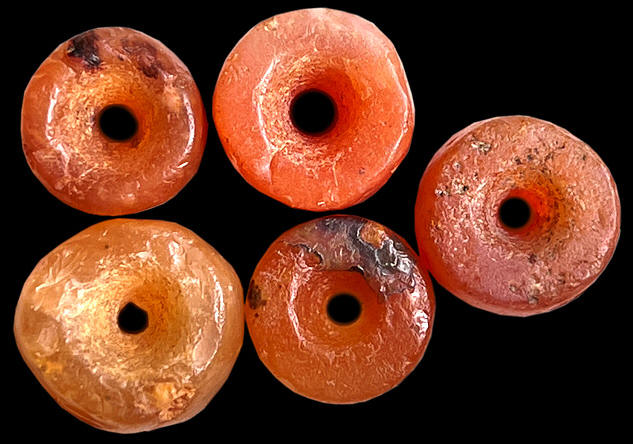
|
|
NEOLITHIC BEADS: ECHOES FROM AN ANCIENT TIME
Our journey takes us to the fascinating world of Neolithic stone
beads that have been unearthed from ancient settlements in the Moroccan
Sahara, dating back to around 5000 BC and lasting until approximately
1200 AD. These relics not only hold aesthetic appeal but also provide an
intriguing look into our past, and into a time when the Sahara was not
the vast desert we know today.
Around 3000 BC, the Sahara underwent a dramatic transformation from a
lush, green landscape filled with life, to the expansive, arid desert it
is today. However, this was not always the case. Prior to this
transformation, the Sahara experienced an extended wet period that can
be traced back to at least 8000 BC. It was during these wet periods that
the Sahara was home to Neolithic settlements, traces of which can still
be found scattered across the Moroccan Sahara today.
African Neolithic Age: a Flexible Cultural Phase
However, determining the age of beads from this area is often a complex and
context-dependent process. The term 'Neolithic', typically defined by
the emergence of farming, sedentism, and more advanced tool
technologies, is not tied to a fixed chronological window in Africa as
it is in regions like the Near East or Europe. In the African context,
the Neolithic is often more a qualitative designation than a strictly
time-bound one, referring to cultural practices rather than calendar
dates.
In fact, in some regions, aspects of a Neolithic lifestyle, such as
pastoralism and stone tool use, persisted well into later periods,
further blurring the lines of historical demarcation.
In this context, the patina - the change in surface appearance due to
age and exposure - is often the most reliable indicator of a bead's age.
Moreover, the method of production, the Neolithic technique of bead
making, remained in use for an extended period, perhaps even persisting
in some remote areas to this day.
NEOLITHIC PECKING TECHNIQUES |
The beads in
my collection
are now for sale
Inquire
through bead ID
for price
The Importance of Arab Trade
The 12th Century heralded significant changes in this regard. Arab
traders journeying to Africa brought with them advanced drilling tools
and techniques, enabling the creation of more sophisticated beads.
Furthermore, these traders didn't just bring new tools and techniques;
they also carried with them beads crafted in India and elsewhere.
During my travels through Morocco, I’ve encountered a remarkable variety
of ancient Indian beads, each bearing its own unique history. This, of
course, comes as no surprise. Beads have long held cultural significance
and are often among the earliest artifacts exchanged between
civilizations. Wherever evidence of cultural interaction is found, beads
are almost always present, serving as small yet powerful ambassadors of
their native traditions.
What is surprising, however, is that
I discovered a few Indus beads, even dating back to the early Mehrgarh
culture. I found them among collections claimed to
originate from Neolithic settlements. Their presence
raises fascinating questions about the extent and
timeline of early trade networks, suggesting cultural
exchanges that may have occurred far earlier, and across greater
distances, than previously assumed.
But before we venture into this intricate web of exchanged goods and
ideas, let’s first take a closer look at what truly defines a genuine
Neolithic bead. |
|
|

|
|
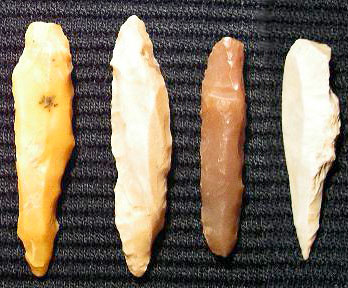
In the Neolithic age beads were crafted
using remarkably simple yet effective tools. The image above shows a set of
flint or chert drill points, typical of those used in the Neolithic
period for perforating and pecking beads.
These pointed tools were employed in a
technique known as pecking, where the artisan would repeatedly tap the
drill against the stone bead to slowly wear away a hole.
|
Notably, the drilling was usually performed from both
sides of the bead, meeting in the center to avoid
cracking the material. Though primitive in appearance,
these tools enabled precise, durable perforations in
even the hardest stones. Patience was essential in an
age when time had not yet been commodified as it is in our own.
Displayed below you can see a chain of pecked Neolithic beads.
|
|
|

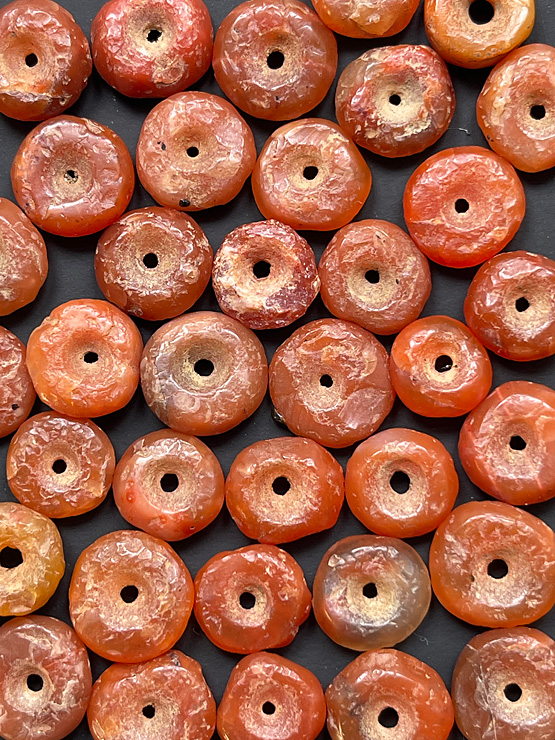
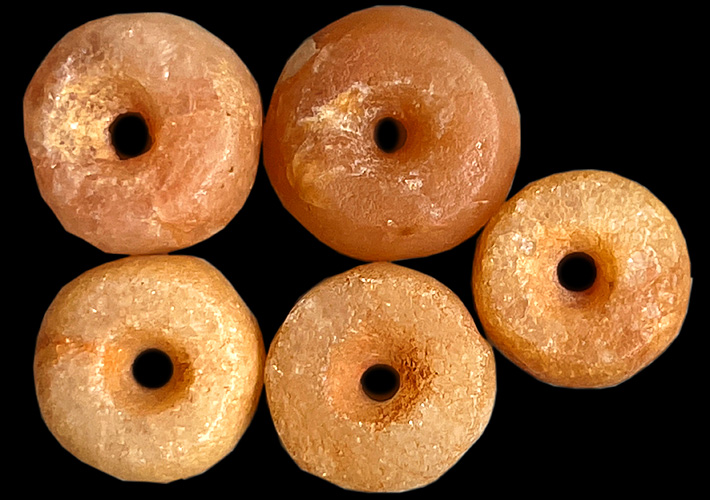
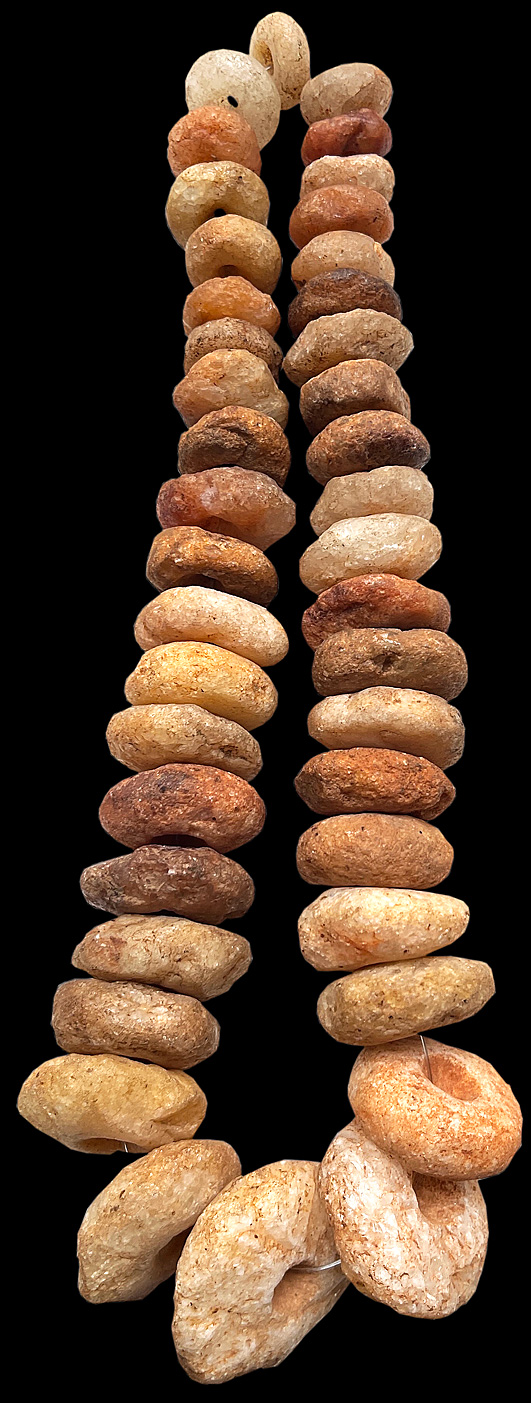
NEO NECLACE 1 -
Largest bead: 34 * 11 mm
Neolithic
Saharan Ring-Beads (North-West Africa)
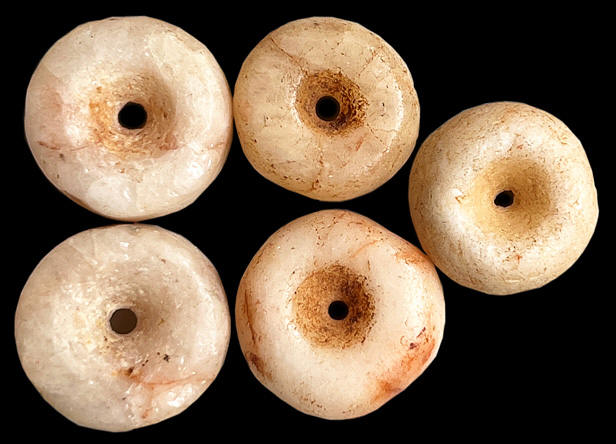
Strand of Neolithic annular ring-beads collected in
Marrakech, almost certainly from sites across the Saharan,
Maghreb belt (Morocco, Western Sahara - Mauritania/Adrar). The
beads are cut from quartz/chalcedony and quartzite, in warm
desert tones - honey, sand, ochre, umber - and display the
classic doughnut/torus profile used as spacers on early
necklaces.
Manufacture & wear
Perforations are biconical and peck-ground: tiny step-pits
and irregular cone walls converge toward the center, then flare
softly where ancient stringing rounded the lips. Faces show a
matte wind-worn polish with mineral accretions and
micro-pitting, not modern gloss. The beads vary slightly in
thickness and diameter, evidence of hand shaping with
hammer-pecking and sandstone grinding.
Date & context
At home among Saharan Neolithic / Pastoral Neolithic
assemblages, c. 6000–4000 BCE, comparable to material from
Tenerian (Aïr/Gobero), Tassili n'Ajjer, Fezzan, and the Western
Desert of Egypt. Such rings likely alternated with ostrich
eggshell, shell, or stone barrels, forming durable personal
adornment for mobile herders moving between oases and seasonal
pastures.
|
|
This strand is a textbook example of early African stone bead
production; a style commonly associated with cultures inhabiting the
pre-Saharan wetland zones.
|
|
|
|

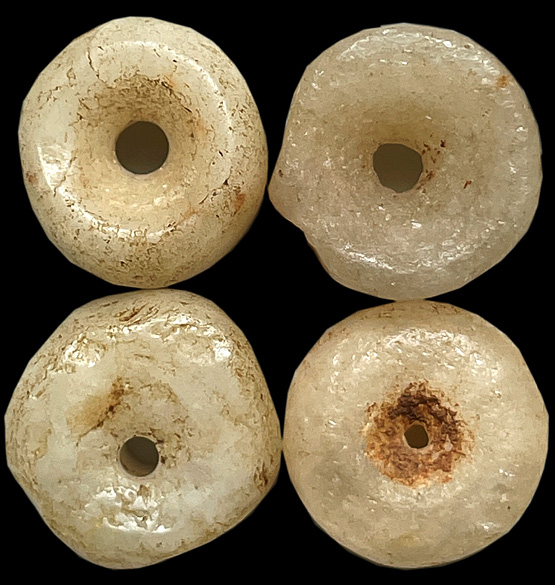
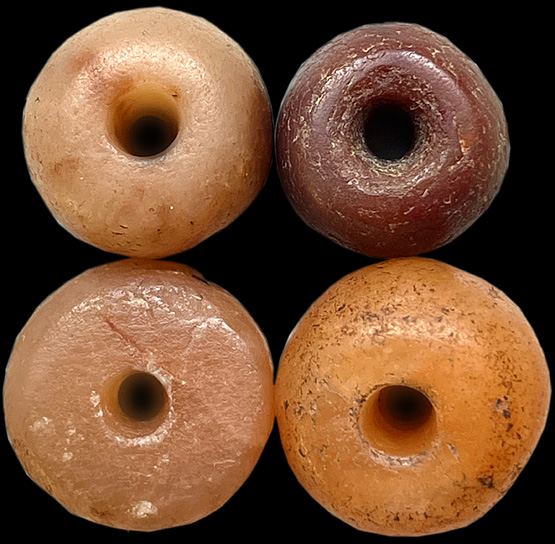
Pecked desk-shaped citrin beads - 12 * 5 mm
|
|
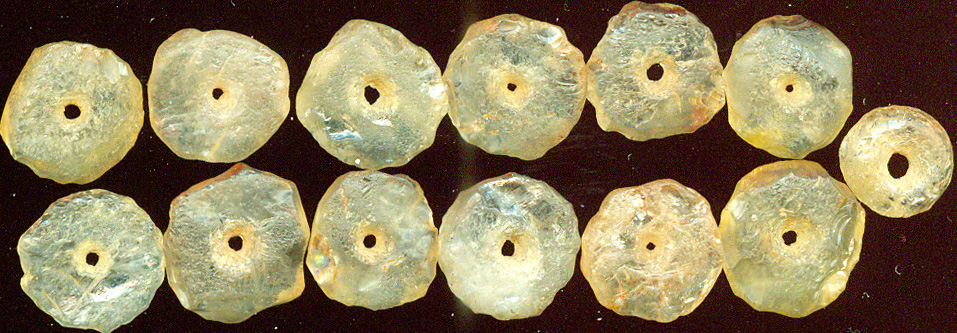
In the image above, you can see examples of some of the earliest known
beads from North-West Africa. These beads show no evidence of polishing:
Their holes and entire shape has been formed through meticulous micro-pecking.
Notice also their flat, disk-like form. This shape is not only stylistic
but practical: flat beads are significantly easier to peck and drill
using the types of tools displayed above.
This offers a clear and compelling example of how available technology
directly influenced the form and design of the objects it produced. The
shape of these early beads is not merely an aesthetic choice, but a
reflection of the technical possibilities and limitations of their time.
|
Now the question arises: Where did this bead-making
technology originate? Was it independently invented in
different regions and periods, or were ancient cultures
already influencing one another; even as far back as the
early Stone Age?
To explore this, we must take a brief detour to one of
the world’s earliest and most influential bead-producing
civilizations: India.
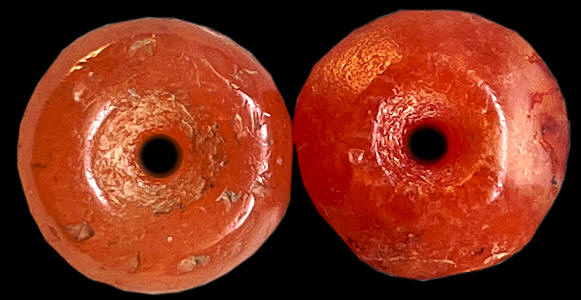
Now take a closer look at the Indian disk shaped carnelian beads below.
The similarity to the citrin beads above is obvious. |
|
|

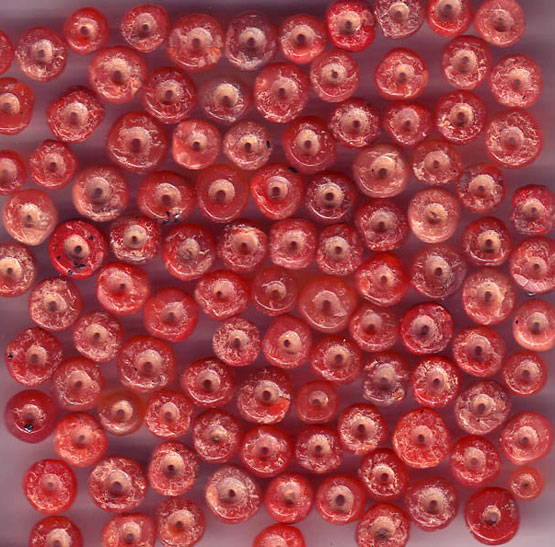
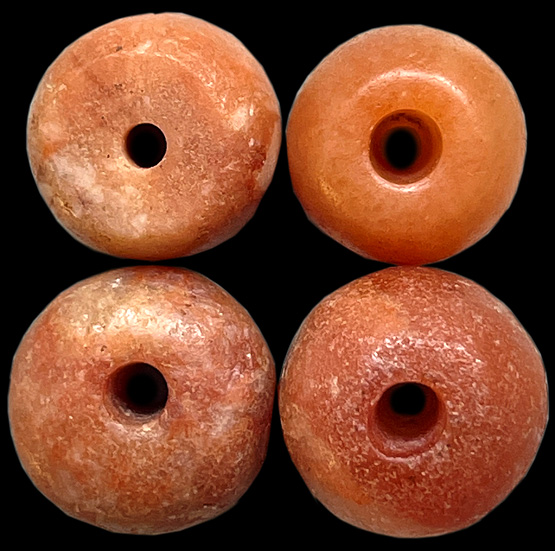
CARN
- OIV 3 -
Average size: 10 * 3 mm
Period:
Indus Valley Culture - Most probably the
Ravi Phase 3300-2800 BC
Origin: Harappa - Greater India (Now Pakistan)
The site
www.harappa.com, picture no.120 shows the same carnelian type of bead to the right.
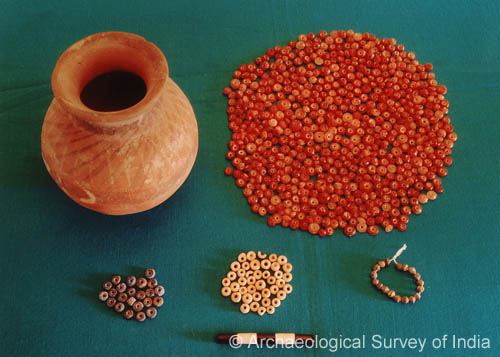
Here is a photo from an excavation find from Bhirrana where you can see the same disk beads.
(Archaeological Survey of India)
|
|
INDUS BEADS:
Between Stone and Bronze Ages
Among the earliest iconic bead forms of the Indus Valley are the tabular
carnelian disk beads displayed above. Characterized by their flat,
circular shape, these beads exhibit clear evidence of pecking—a hallmark
of early stone-working techniques. However, they also reveal a further
degree of refinement when compared to the Neolithic African citrine
beads shown earlier: their flat surfaces have been partially polished,
indicating a deliberate and skillful finishing process.
This fusion of rudimentary shaping and selective polishing reflects a
transitional phase in bead-making. This appeared in the moment when traditional Neolithic
methods were gradually being merged with the emerging technological
innovations of the early Bronze Age, around 3000 BCE. It shows how Indus
Valley artisans were not only preserving earlier techniques but also
pushing the boundaries of material manipulation, laying the groundwork
for a more advanced lapidary tradition.
|
Indian carnelian, a semi-precious gemstone, was highly valued in the ancient
world for its vibrant, fiery hues. The tabular disk beads presented here
are particularly remarkable for their uniform use of deep red,
high-quality carnelian; a visual and material testament to the skill and
selectivity of Indus bead-makers.
This adds yet another defining layer to Bronze Age bead technology: heat
treatment. The rich color and subtle translucency of these early
carnelian beads are not merely natural qualities. They are the result of
intentional alteration processes, such as controlled heating and
polishing. These techniques enhanced the visual appeal of the stone and
marked a significant leap in material knowledge and craftsmanship.
Rustic North-West African Carnelian Bead
Now let us have a closer look at the bead displayed below. |
|
|

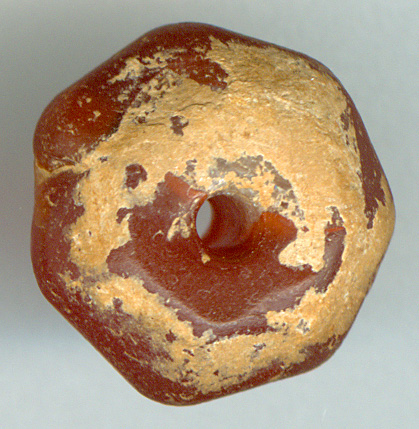
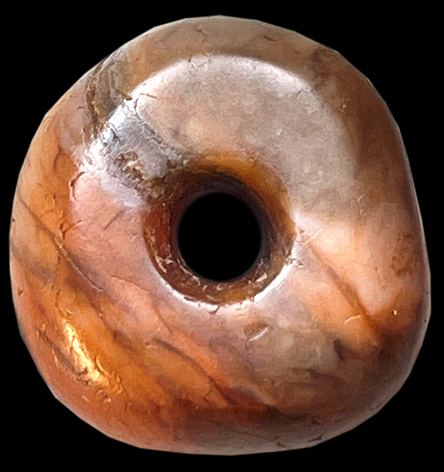
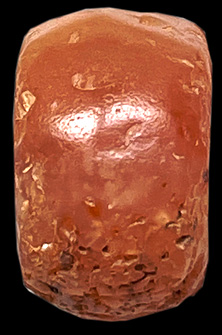
NEO 1 - 20,5 * 15 mm
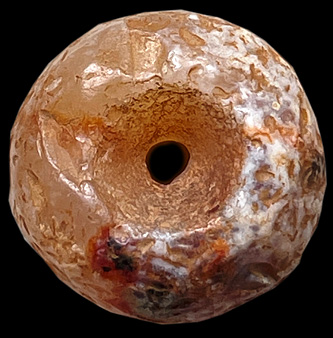
This
Neolithic bead from the Sahara is a remarkable example of early
local stoneworking. Rather than being drilled, both the
perforation and overall shape appear to have been formed through
careful pecking: a labor-intensive technique involving repeated
tapping with harder stone tools. Made from reddish agate, its
textured surface and irregular contours beautifully reflect this
method, offering insights into early bead-making traditions long
before metal tools or grinding techniques.
Observe how, in this remarkable pecked bead, the
indentations left by the pecking process gradually become
smaller as they approach the perforation. This suggests that a
variety of pecking tools, likely of differing sizes, were employed
during its shaping. Much like using a set of screwdrivers in
various sizes for precision work, ancient artisans appear to
have adapted their tools to different stages of the bead-making
process, allowing for greater control and refinement near the
more delicate central hole.
|
|
The bead shown above is a compelling example of a locally produced,
North-West African agate bead—crafted during the Stone Age using pecking
techniques. Made from untreated or naturally heated, locally sourced
material, its rustic appearance stands in stark contrast to the finely
polished, glowing translucent beads from more technologically advanced
centers. And yet, it speaks volumes.
What does such a bead reveal? It tells a deeper story of the early transmission of technology and cultural
influence. Beads, along with the techniques to make them, traveled along
ancient trade routes, flowing from regions with sophisticated lapidary
traditions to local communities. There, these methods were reinterpreted
through the lens of indigenous knowledge and shaped by the limitations
and qualities of available materials.
|
So why do I lean toward the theory that late Neolithic communities in
the shrinking wetlands of the Sahara acquired bead-making techniques
from external sources rather than developing them independently? After
all, could such techniques not have emerged organically in multiple
places?
While independent innovation is certainly possible, I favor the idea of
long-distance transmission for a compelling reason: I have personally
encountered beads from the Mehrgarh culture, one of the earliest
bead-producing societies in present-day Pakistan, as far west as
Marrakech. This remarkable find suggests that not only objects but also
the knowledge behind their production moved across immense distances,
bridging disparate regions and cultures over vast stretches of time and
landscape.
You can read more about this discovery [here].
|
|
|

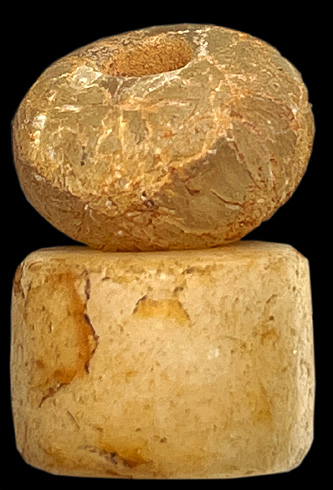
NEO 2 - 22,3 * 12,5 mm
The same pecking technique has been applied to this
local produced bead.
|
|
The beads displayed above embodies that exchange. They reflect a moment where external
inspiration met local interpretation. Here the idea of the bead, and the
technology behind it, were absorbed and reimagined within the
constraints and creativity of a different cultural and technological
setting.
INDIAN EXPORT BEADS IN AFRICA |
|
|
|

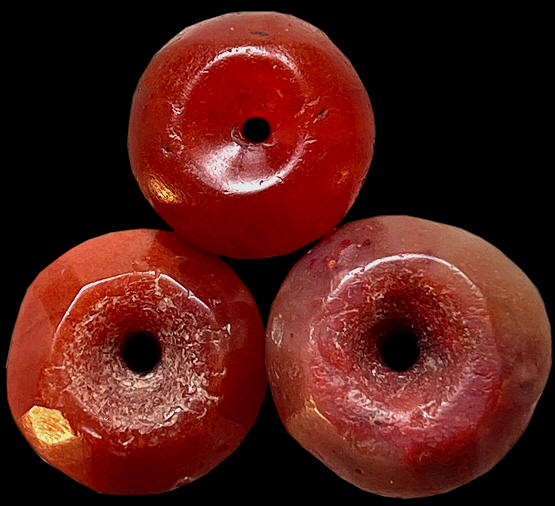
This partly calcified carnelian bead, originally crafted in the
Indus Valley, exemplifies the far-reaching trade networks of the
Bronze Age.
Intended for export to Mesopotamia,
it ultimately made its way to the Sahara, likely through
secondary exchange routes. The bead’s once-translucent surface
is now partially obscured by calcium encrustation, a result of
long burial in mineral-rich soils. Its angular shape, central
drilling, and carnelian core confirm its Indus origin, while its
Saharan context reflects the unexpected pathways of ancient
commerce.
|
|
The
facetted bead featured above, discovered in a Neolithic
gravesite alongside a trove of more rudimentarily shaped
locally produced counterparts, serves as a fascinating example of such
cross-cultural exchanges.
It is an Indian manufactured
bead, meant for export to Mesopotamia. Standing out in its refinement
and design, it is an apparent outsider among its
Neolithic peers.
Its presence here, in a setting dominated by more
crudely formed pieces, is intriguing and points to the
interaction and exchange between the Sahara's
hunter-gatherer societies and more agriculturally
advanced cultures.
This unique bead acts like a silent storyteller,
offering tantalizing clues about the interactions,
exchanges, and possibly, the barter practices between
distinct cultures and societies during the
late
Neolithic era.
You can explore more about the remarkable journey and
origin of this bead by
following the link provided.
AFRICAN
NEOLITHIC POST-MODERNISM
In summary, we can
conclude that the African Neolithic period contained a
mixed bag of bead types and what could be described as
time-traveling cultures:
THE HAND GRINDING STONE |
societies working with ancient techniques while
coexisting alongside or interacting with more
technologically advanced traditions.
One striking example comes from recent history: the San
people (Bushmen) of southern Africa, who, until quite
recently, made flat, round beads from ostrich eggshell
using stone tools. They would chip small pieces all the
way around to form the disk shape, drill a hole in the
center, and polish the edges, not to remove all texture,
but to soften sharpness while preserving a slightly
undulating edge that was both beautiful and expressive.
While ostrich eggshell is much easier to work with than
stone, the core technique is essentially the same. This
continuity across time and material speaks to a shared
logic of bead-making that stretches across vast spans of
history and geography.
In this sense, one might even describe the African Stone
Age as post-modern: a cultural patchwork where multiple
ages, technologies, and traditions coexist and
intertwine.
|
|
|
|
|
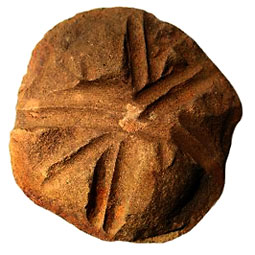
Displayed above is a typical ancient hand grinding
stone, used for shaping and polishing beads and small
ornaments. The radiating grooves carved into its surface
served as tracks where beads could be rotated back and
forth using sand or grit and water as abrasives.
In the late Neolithic age, beads were shaped using a variety
of techniques, reflecting the diversity of cultural
practices and available resources. One widespread method
involved hand-grinding on abrasive stones, such as the
grooved grinding stone shown here. These stones, carved
with radiating grooves, allowed artisans to shape and
polish hard materials like carnelian, agate, and quartz
by rotating the beads back and forth with sand and water
as abrasives.
|
While such grooved slabs are more commonly associated
with early South Asian and Near Eastern bronze age
bead-making traditions, similar tools have also been
found in African Neolithic contexts, particularly in
Saharan and sub-Saharan regions such as Niger and Mali.
However, early African bead-making cultures often favored
micro-pecking.
In contrast, the more refined bead, exhibiting a
higher degree of polish and sophistication, as you can
observe below, is likely to
be the product of more settled, agricultural societies
that were emerging during this period. These communities
had more stability and resources to dedicate to
craftsmanship, allowing for the creation of finer, more
polished objects.
|
|
|

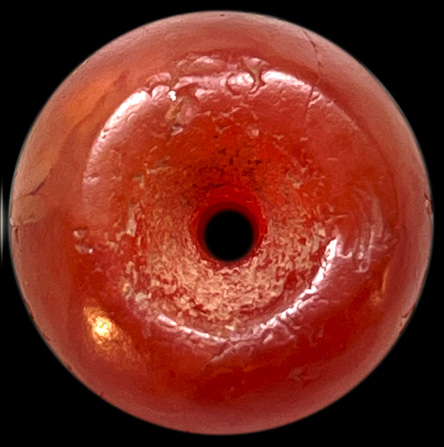
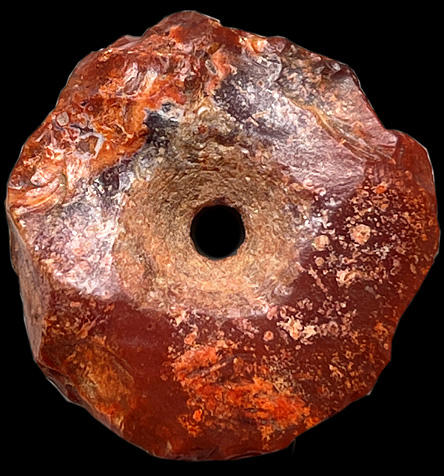
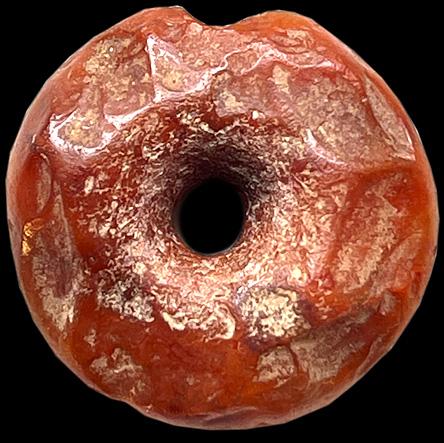
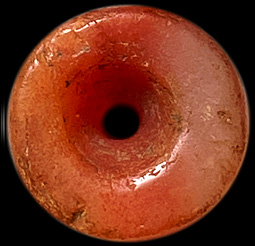
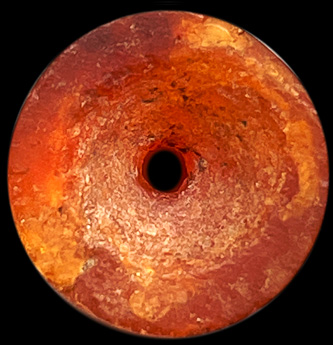
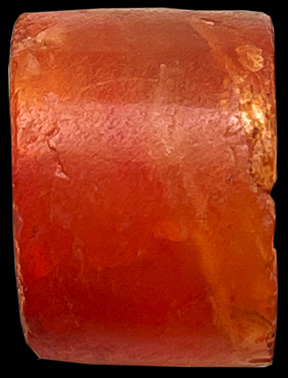
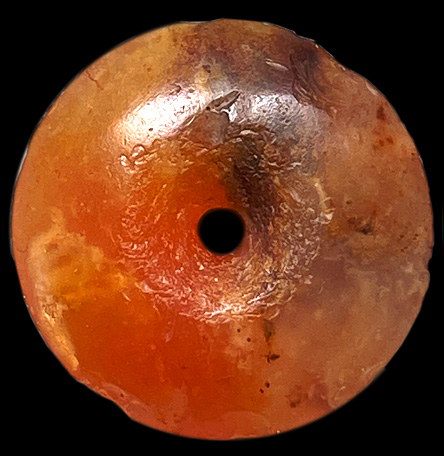
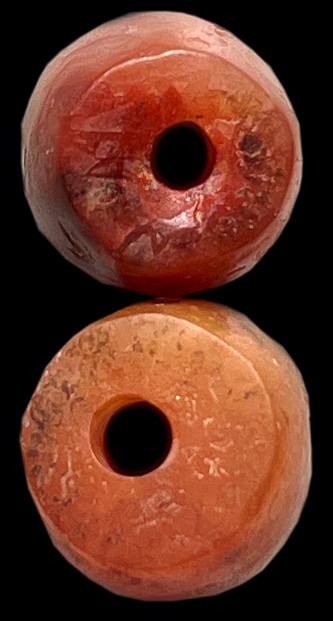
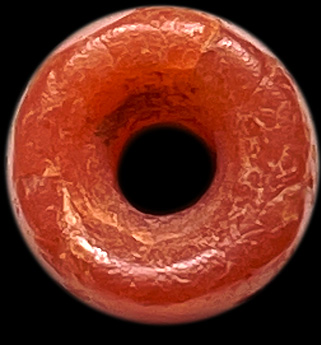
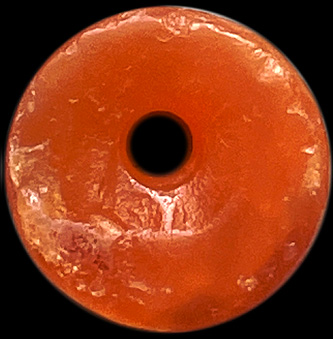
NEO 3 - 16,5 * 10 mm
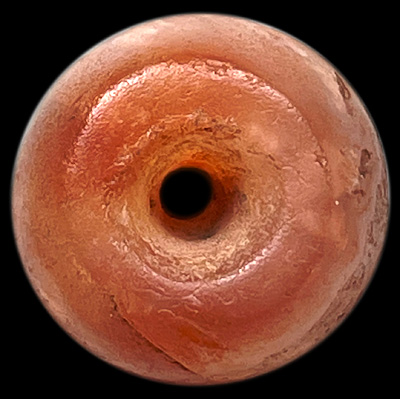
This red carnelian disk bead is sourced from Sahara. It beautifully illustrates the
transition from purely pecked to fully polished bead-making
techniques. While the body of the bead is skillfully polished to
a smooth, glossy finish, the area around the perforation remains
rough and unpolished: evidence that abrasives could not easily
reach the recessed hole. This contrast reveals a transitional
phase in Neolithic craftsmanship, where traditional pecking
methods were still used to create the perforation, but new
techniques of surface polishing were emerging. Also note how
fine the pecking around the hole has become. Measuring with
symmetry and care, this bead reflects both evolving technical
skill and aesthetic refinement in Late Neolithic or early
historic bead traditions.
When compared with the Harappan-phase beads shown in the
illustration below, we can observe identical bead technology in
both form and material. The same use of carnelian, the shared
disk-like shape, and the combination of pecking and polishing
all point toward a common tradition. These striking parallels
strongly suggest that the analyzed bead was not locally
produced, but rather imported from the Harappan sphere, where
such craftsmanship had already reached a highly developed level.

Illustration
taken from J.M.Kennoyer and D.Frenez:
Stone Beads in Oman during the 3rd to the 2nd Millennia BCE
|
|
|
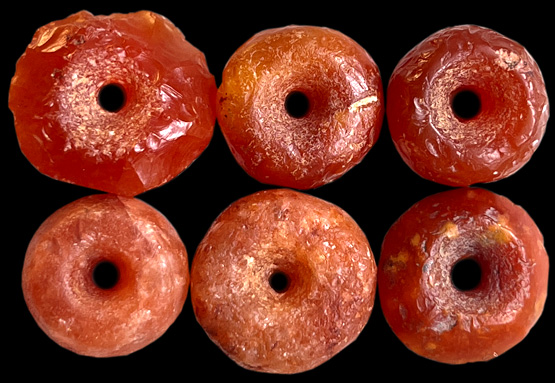
Beads from a Saharan Context: A Meeting of Worlds
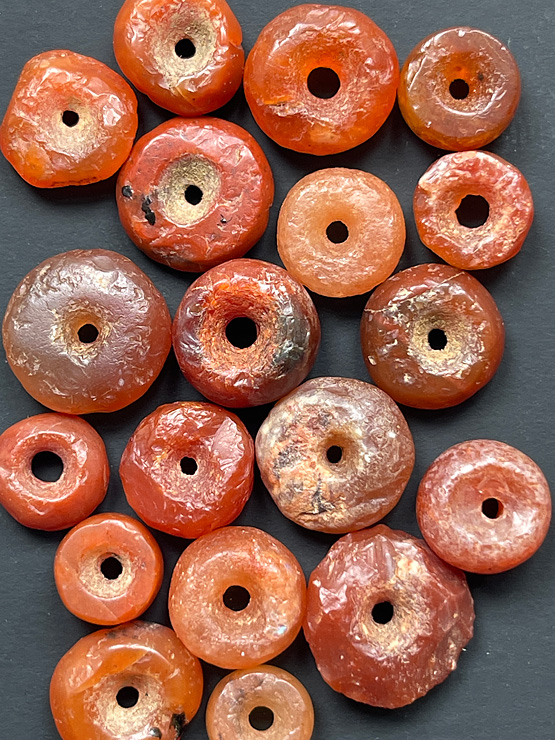
Now take a look at the image below. What makes the bead
assemblage
particularly compelling is that all the pieces were
discovered together at a single archaeological site in
the Sahara. This collection reveals a striking
juxtaposition: locally produced, more rudimentary forms
sit side by side with refined, carefully crafted beads -
most likely imported from India.
|
|
|
|
|
|
The presence of high-quality, non-local beads in this
context is yet another clear indicator of the vast reach
of Late Stone Age trade networks. These finely crafted
Indian beads likely reached the Sahara via
transcontinental routes that once connected the Indian
subcontinent with North and West Africa, crossing immense
distances, often without established roads, and linking
distant cultures across harsh and varied terrain.
The coexistence of both grinding and pecking techniques
within the same archaeological context illustrates the
diversity of technological approaches to bead
production. These methods were shaped by the
availability of regional materials, cultural traditions,
and varying degrees of specialization.
The frequent occurrence of locally made beads alongside
more refined, imported examples points to more than just
the movement of goods.
|
It reflects the exchange of
knowledge, craftsmanship, and aesthetic ideals. These
artifacts stand as tangible evidence of early
globalization, demonstrating that even in the Late Stone
Age, people and their creative practices were far more
interconnected than we often imagine.
FROM FLAT DISK-SHAPE TO ELONGATED BEADS
When observing the Neolithic drills above, it becomes
evident why early beads were predominantly tabular or
disk-shaped. These short, flat forms were significantly
easier to perforate using simple pecking and rotational
drilling techniques. It was ideal for the limited
toolsets of the time. |
|
|

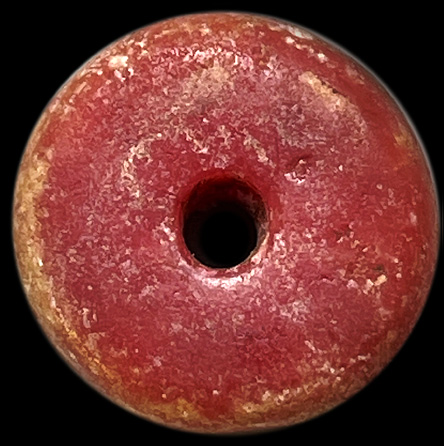
NEO 4 - 17,5 * 5,9 mm
This Neolithic disk-bead strongly
resembles heat-treated Cambay carnelian, a hallmark of
advanced Indus Valley lapidary craft. The rich, uniform
orange-red tone, subtle translucency, and smooth polish
are all characteristic of controlled heating, a
technique used to enhance the natural color of raw
carnelian. The precision of the central perforation and
the symmetrical form further support this
identification. Cambay (Khambhat), in western India, was
a major carnelian processing center supplying beads
across Asia and Africa. This bead likely originated from
such a workshop, reflecting both technical mastery and
wide-ranging trade connections that carried it far
beyond its place of origin.
|
|
A
Step Toward the Bicone: Form Follows Technique
Now compare this to the bead below. Here, we can observe
how the development of drilled holes is closely tied to
the emergence of the bicone form. Unlike the flat
disk-shaped beads, this more elongated shape required
access to the bead's central axis. This is something simple
pecking tools alone could not achieve.
Interestingly, the perforation still shows a
|
micro-pecked, hourglass-like profile, characteristic of
early techniques. However, in this example, pecking has
been combined with rudimentary drilling, likely using a
rotating motion with abrasive slurry. This hybrid method
allowed artisans to reach the deeper center of the bead,
marking a clear technological evolution in both tool use
and bead form. |
|
|
 
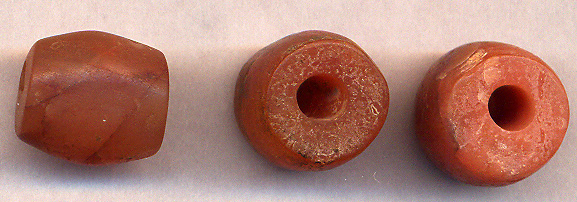
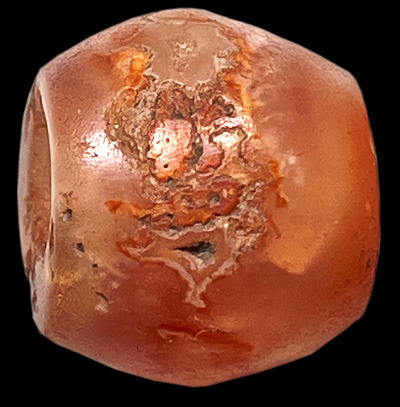
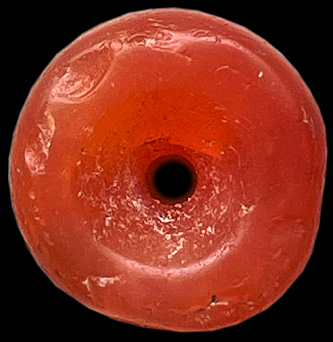
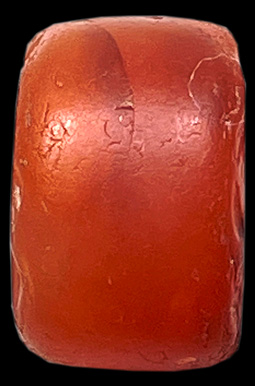
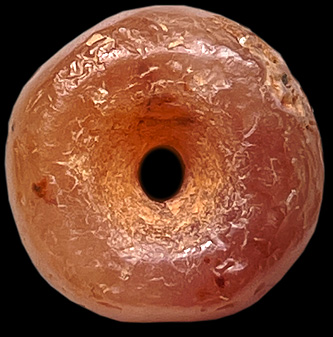
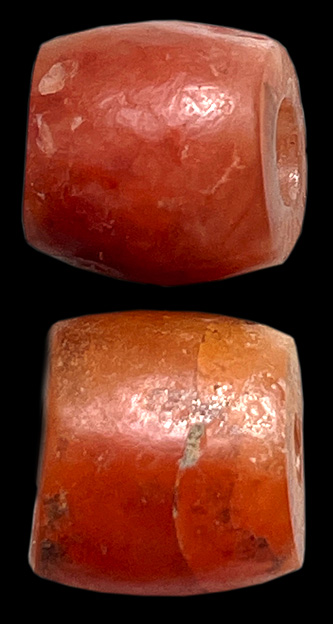
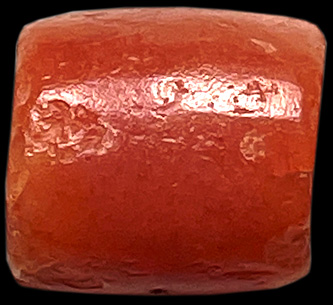
NEO 5 - 14,5 * 13 mm
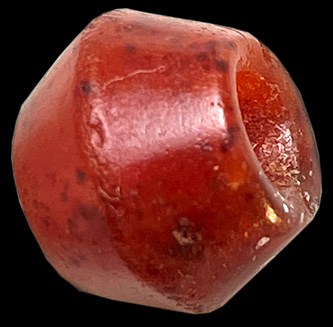
These two images show a typical
Indus Valley bicone carnelian bead, likely produced around 2600 BCE.
The bead’s symmetrical, barrel-like form and well-centered perforation
reflect the advanced drilling techniques of early Indus lapidaries, who
combined micro-pecking with bow drills and abrasive slurry. Its warm
orange-red hue is the result of heat treatment, a method used to enhance
the natural color of carnelian, especially from Cambay (Khambhat), a
major West Indian production center. Such bicones signaled status and
prestige, and have even been found in Egyptian tombs and Mesopotamian
contexts.

Egyptian neclace -
Walters Art Museum

Mesopotamian neclace from Ur -
British Museeum
|
|
As drilling techniques became more
refined in the bronze age, allowing for deeper and more symmetrical
perforations, artisans began shaping beads into
increasingly balanced and elongated, double-conical (bicone)
forms.
|
|
|
|

|
|
The creation
of
long, slender beads with deep perforations became
feasible during the Copper and Bronze Ages, particularly
in regions like West Asia and the Indus Valley, where
bead-making evolved into a specialized craft.
This
refined bicone agate bead exemplifies that advancement.
Unlike early disk-shaped beads made by pecking, its
elongated form required rotational drilling for a clean,
central hole. Its symmetry, polish, and use of natural
banding show technical mastery and aesthetic intent.
|
At Indus Valley sites, numerous broken bead preforms reveal
the difficulty of drilling such forms. This is evidence
of both technological ambition and the risks of
precision craftsmanship.
However, when we return to Africa, we find that
elongated beads are almost exclusively imported. As
shown in the many images below, locally produced beads
generally retained the traditional disk shape.
|
|
|

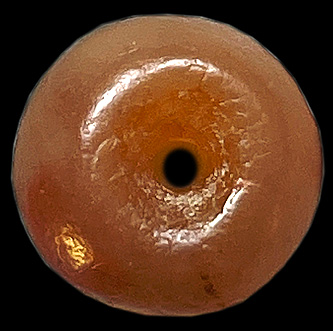
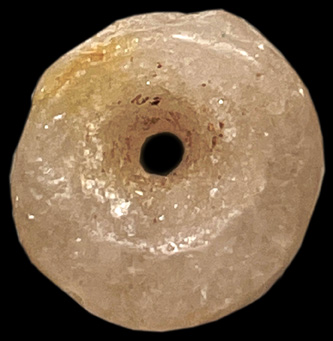
NEO 6 - 21 * 10,5 mm
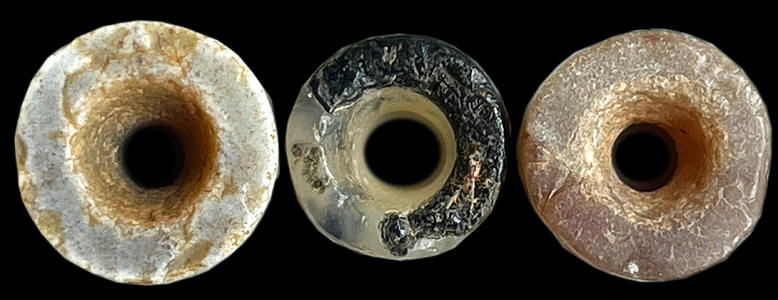
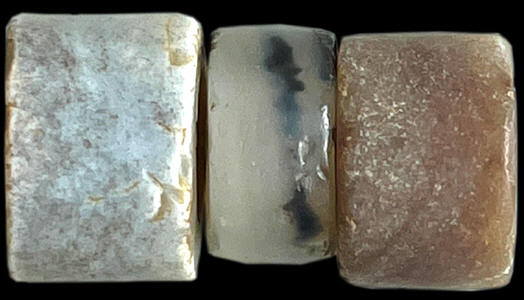
This disk bead, likely made from a pale orange to pinkish
cryptocrystalline quartz, presents an interesting example of
transitional bead-working techniques. Measuring symmetrically
with a central perforation, the bead shows clear polishing on
its flat faces, while the rounded edges remain rougher and less
finished. This contrast suggests a phase where polishing tools
or methods were selectively applied. My guess is that it was due
to limitations in technique or intention. While some surface
wear might occur from friction with adjacent beads on a string,
the evenness and deliberate finish of the flat sides suggest
intentional polishing rather than incidental abrasion. This bead
offers valuable insight into evolving Neolithic bead
craftsmanship, where newer surface treatments began to
complement traditional shaping and perforation methods. |
|
SOME THOUGHTS ABOUT STRINGS
It is likely that the generally large perforations in
ancient African beads were, at least in part, a response
to the type of stringing material available. Unlike in
regions such as the Indus Valley, where bead-makers
developed extremely fine, durable stringing materials,
possibly including twisted fibers, sinew, or even early
metal wires, African Neolithic cultures may have relied
on coarser, less durable string made from plant fibers,
leather strips, or sinew with less processing.
To ensure that beads could be restrung or repaired as
needed, larger holes would |
have been more practical, accommodating
thicker, stronger cordage that could withstand daily
wear and tear. This not only influenced the size of the
perforations but may have also shaped bead design
overall, encouraging wider disk shapes that could
structurally support large holes without cracking.
So, the large holes are not just a byproduct of the
tools used for drilling or pecking, but likely also
reflect a functional adaptation to the materials and
technological limitations of the time. |
|
|

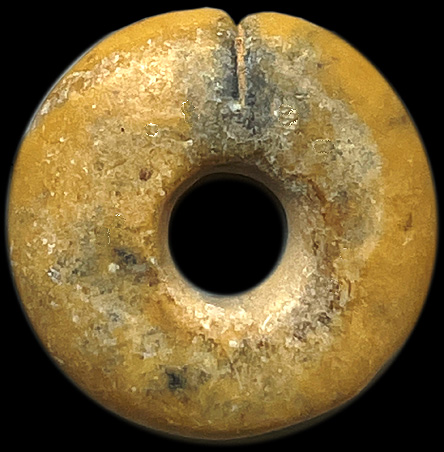
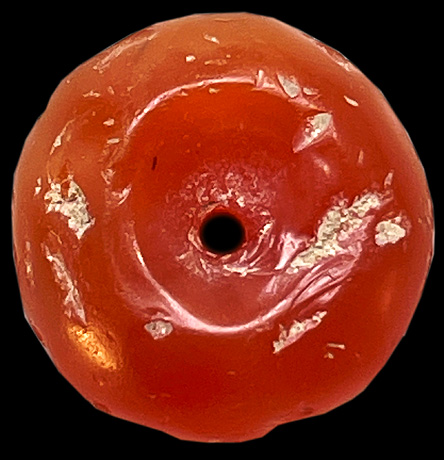
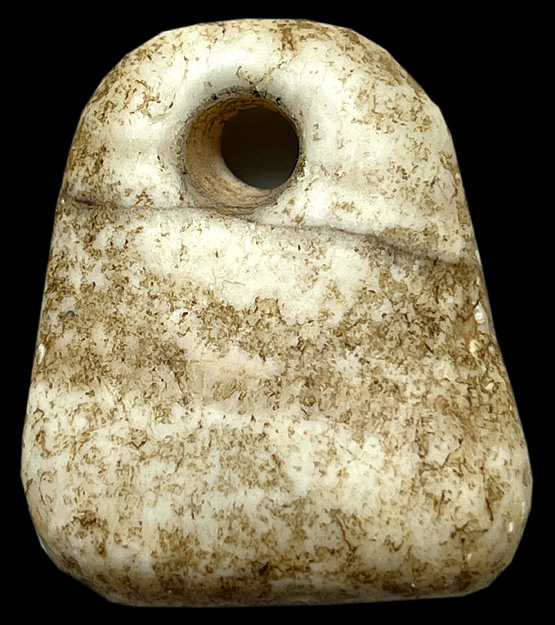
NEO 7 - 22 * 21,5 * 10,8 mm
This bead offers a compelling example of how stringing wear
can physically shape a bead over time. Notably, the top edge of
the perforation shows a distinct groove or channel, worn smooth
and slightly recessed. This indicates prolonged contact with a
string or cord, likely made of a relatively coarse or fibrous
material. The asymmetrical wear suggests the bead was
consistently strung in the same orientation, with tension
focused at the upper edge. Such wear patterns offer valuable
clues about how the bead was used, possibly on a necklace or
bracelet. It reflects both functional use and the limitations of
ancient stringing materials.
|
|
The Preferential Resting Point of a Bead
Even beads with perfectly centered holes will develop a
preferential resting position when strung, simply due to
the effects of gravity, weight distribution, and how the
bead interacts with the string. However, over time,
continuous friction and movement cause the string to
wear against a specific point along the perforation,
often at the top edge, creating a subtle groove.
This wear gradually amplifies the bead's tendency to
hang in a particular orientation. |
The result is a
polished notch that acts almost like a hinge or anchor,
guiding the bead into its most stable and consistent
resting angle. This phenomenon reveals how prolonged use
not only leaves visible marks on ancient beads but also
shapes how they were experienced visually and
functionally in daily life.
As seen below, artisans occasionally enhanced this
effect intentionally by placing the hole slightly
off-center, creating a deliberate and permanent resting
point.
|
|
|

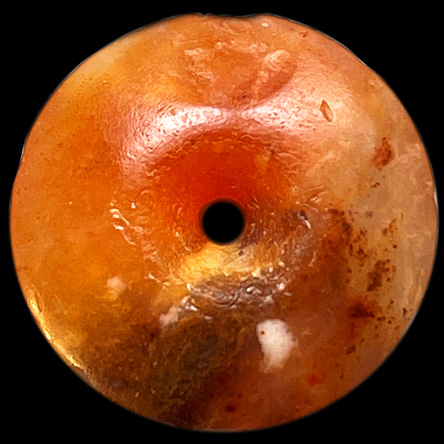
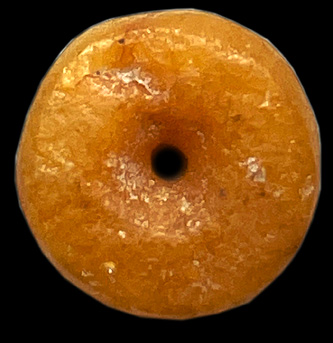
NEO 8 - 25,5 * 20,5 mm
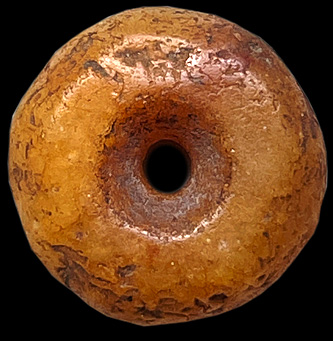
This yellowish carnelian bead, likely of local African
origin, displays a soft, warm tone with subtle variations of
golden and honey-like hues, suggesting minimal or no heat
treatment. It is unlike the deep orange carnelians from Cambay.
Its surface is smoothly polished, though still retains a
natural, somewhat granular texture indicative of hand-finishing
with basic tools.
What stands out is the hole placement, which is slightly
off-center and drilled into a slight depression. This is not a
flaw, but a deliberate choice, optimizing the structural
integrity of the bead or aligning with a natural indentation in
the stone. It reflects a pragmatic approach, balancing aesthetic
symmetry with the limitations and opportunities offered by the
raw material.
|
|
|
|

NEO 9 - 15,9 * 9,9 mm
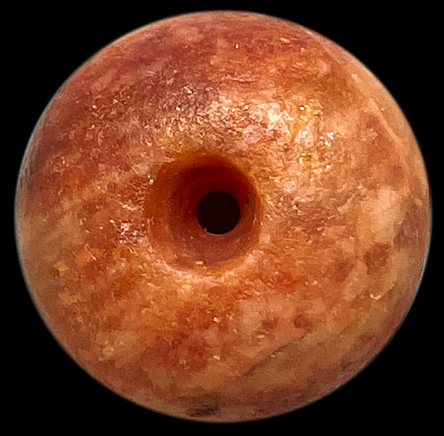
This carnelian bead, with its warm, mottled reddish-orange hue
and slightly cloudy translucency, likely originates from a local
African source rather than the well-known Cambay (Khambhat)
deposits in India. Its coloration lacks the deep, uniform
saturation, translucense, and heat-treatment signatures typical of Cambay
carnelian. The bead is well-shaped and moderately polished, with
a clean central perforation, suggesting skilled local
craftsmanship. Its texture and material quality are consistent
with naturally weathered or minimally treated carnelian,
possibly sourced from North or West African deposits. This piece
reflects a distinct regional tradition of bead-making,
demonstrating the use of locally available materials in the
production of ornamental objects during the Neolithic or later
periods.
|
|
|
|

NEO 10 - 19 * 7 mm
|
|
|
|

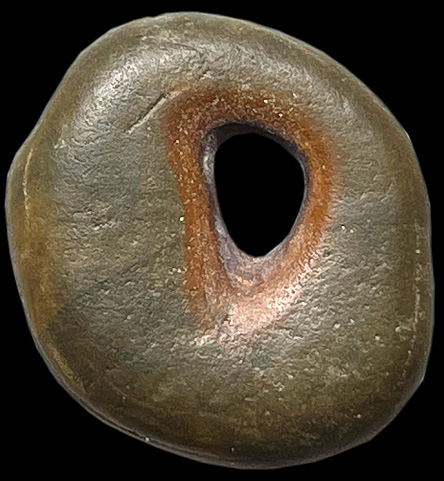
NEO 11 - 17 * 5 mm - sold
|
|
|
|

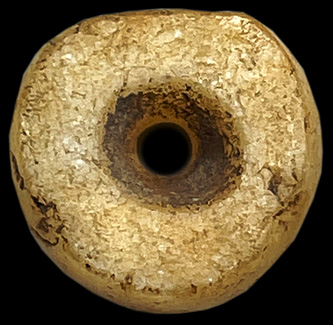
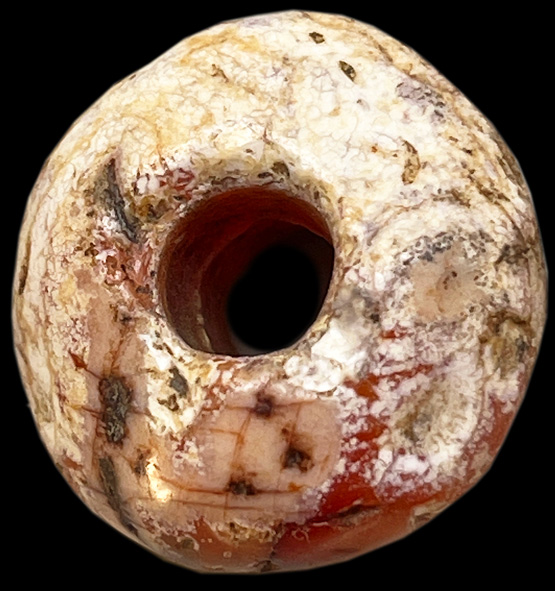
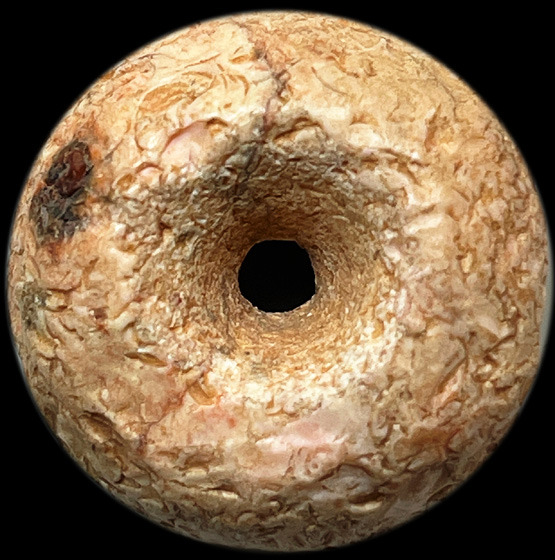
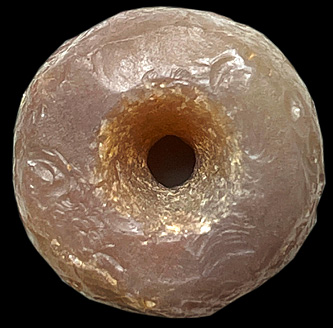
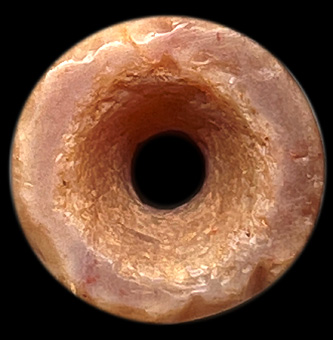
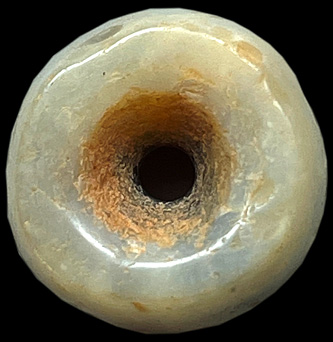
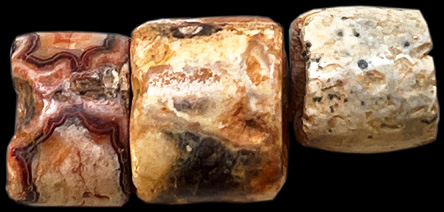
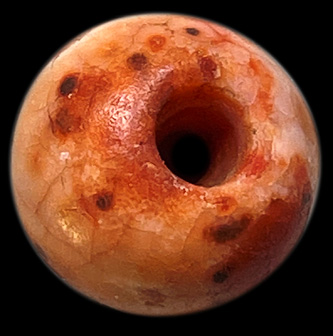
NEO 12 - 36,5 *32 * 19 mm
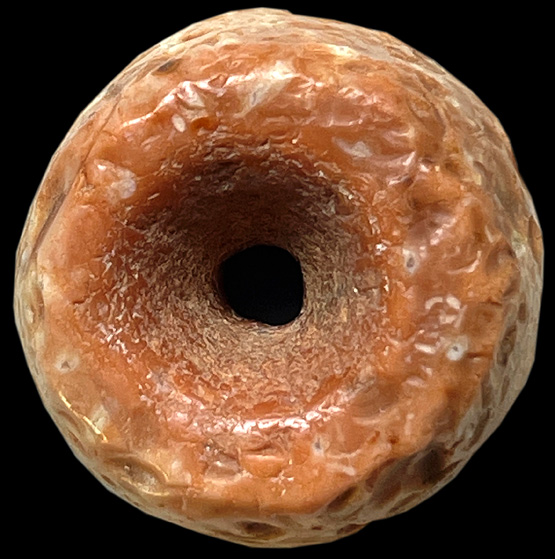
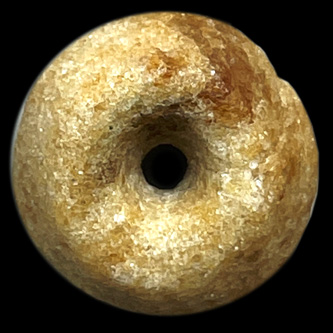
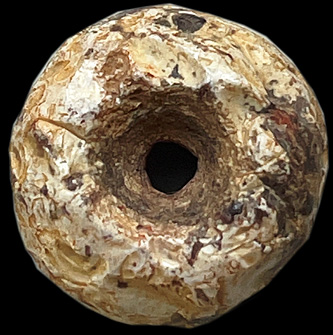
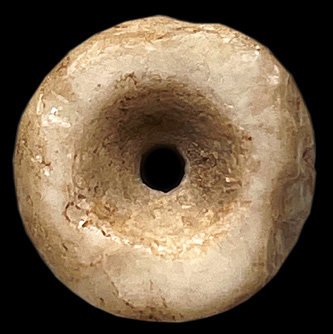
This
remarkable bead was once a centerpiece in a chain of otherwise
unremarkable beads stringed together by a shopkeeper in
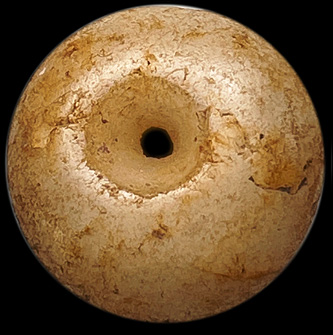
Marrakech. It stands out for its sculptural form and rich,
earthy coloration. With hues ranging from warm ochre to soft,
old ivory, the surface reveals subtle tonal shifts and a finely
textured patina, likely the result of age and handling. Its
exaggerated doughnut shape, with a deep, funnel-like
perforation, gives it a bold, almost architectural presence. The
craftsmanship suggests intentional shaping for both aesthetic
and symbolic impact. Rescuing it from the strand has allowed its
full beauty to emerge.
|
|
|
|

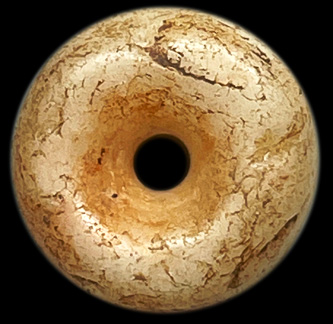
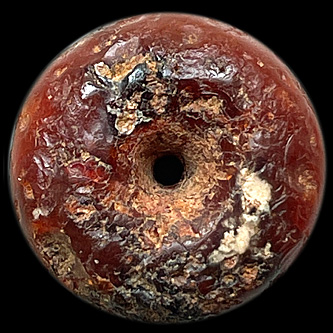
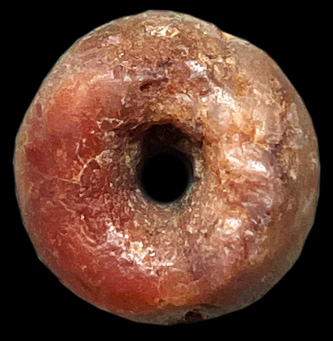
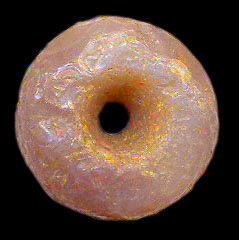
NEO 13 - 14,5 * 9,2 mm
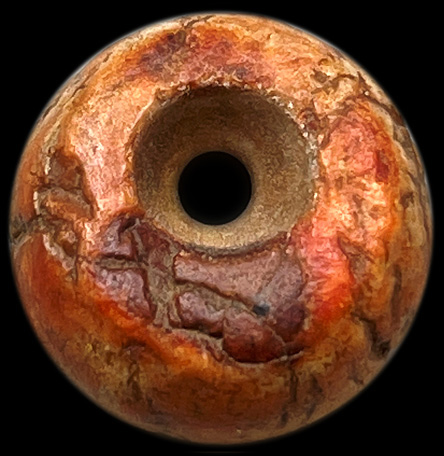
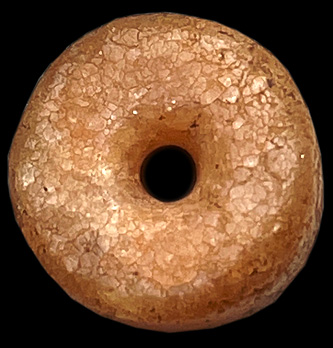
This ancient bead beautifully illustrates how wear and time
can transform utilitarian objects into pieces of abstract art.
Likely made from heat-treated carnelian, its surface has been
altered by centuries of abrasion, impact, and burial. The
once-polished finish is now marked by organic crack patterns,
flaked edges, and color shifts, creating a textured, almost
painterly surface. These irregularities, far from diminishing
its value, imbue the bead with a sense of history and
individuality. The deep, precise perforation remains intact,
highlighting the original craftsmanship, while the surrounding
surface tells a different story, one shaped by movement,
contact, and the slow erosion of time.
|
|
|
|

NEO 14 - 15 * 8 mm
|
|
|
|

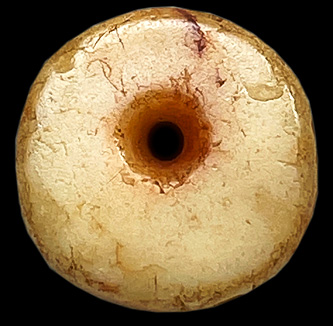
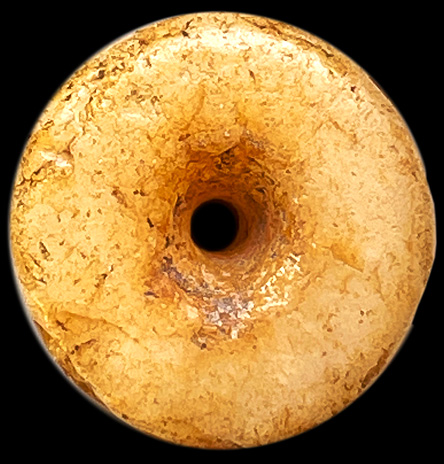
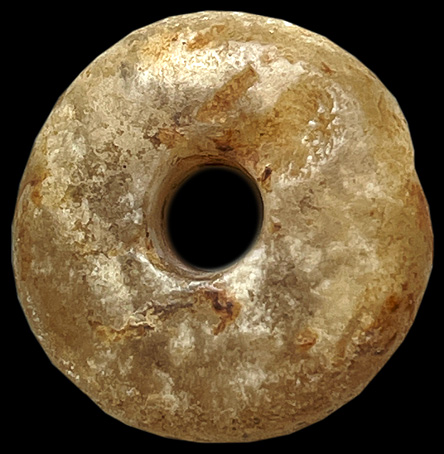
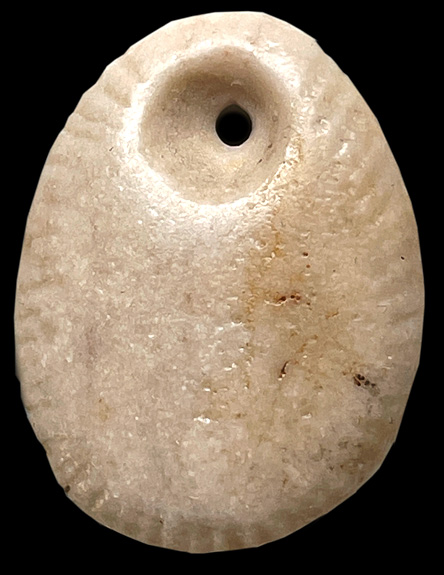
NEO 15 -
This bead stands out for its refined symmetry, creamy
coloration, and finely balanced proportions, all achieved in a
likely soft stone or dense organic material such as bone, fossil
shell, or calcite. Its perfectly centered, smooth perforation
suggests the use of rotary drilling, while the gentle concavity
around the hole reflects both shaping and long-term string wear.
What makes it special is its elegant simplicity. It is a
minimalist form that speaks to both functional design and
aesthetic sensitivity. The subtle surface texture and patina
hint at age and use, turning this modest disk bead into a
quietly powerful artifact created by both time and human
craftsmanship.
|
|
|
|

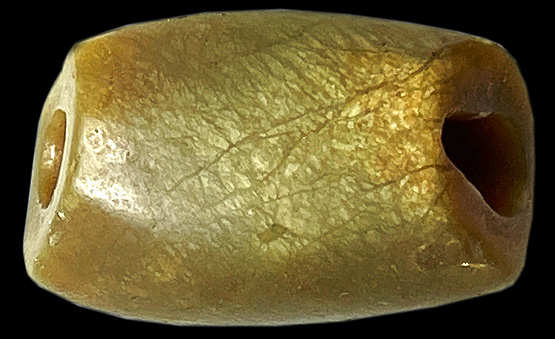
NEO 16 - 24,5 * 13,2 mm
This bead is made from a light, translucent stone, likely
quartzite or chalcedony, shaped into a symmetrical, elongated
oval form. Its slightly granular surface and soft glow suggest a
stone with moderate hardness, capable of taking a gentle polish
but retaining some crystalline texture. The drilling appears
clean and relatively straight, indicating rotary drilling with
abrasive slurry rather than simple pecking. Its uniformity and
material quality point to a more advanced lapidary tradition,
possibly linked to early trade networks.
|
|
|
|

NEO 17 - 15,5 * 5 mm
|
|
|
|

NEO 18 - 21 * 20 * 12 mm
|
|
|
|

NEO 19 - 13 * 10 mm
|
|
|
|

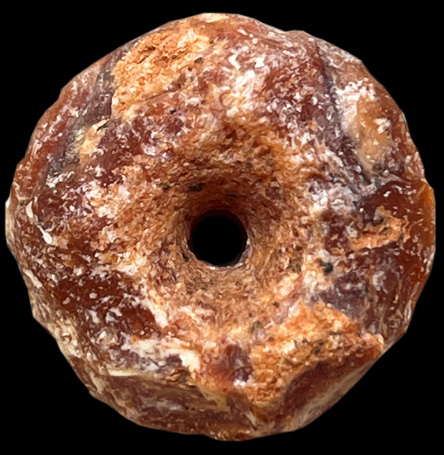
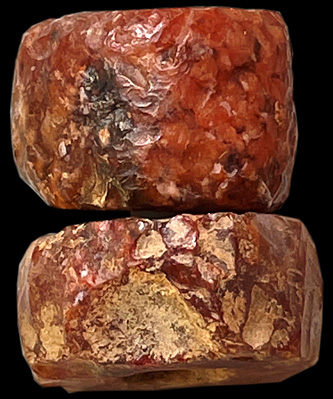
NEO 20 - 19 * 11,1 mm
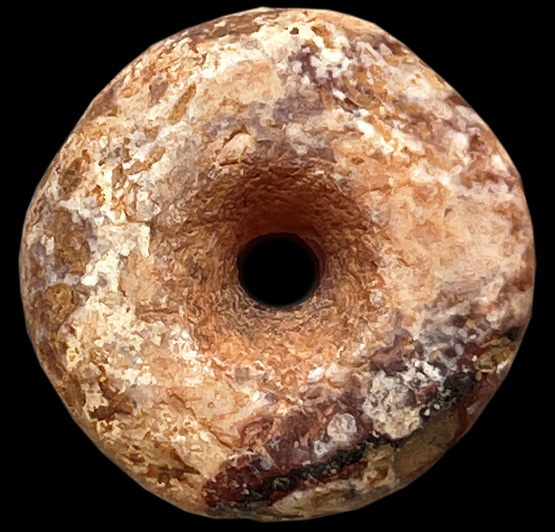
This bead is a striking example of calcified carnelian,
where the original translucent orange-red chalcedony has been
partially replaced or infiltrated by calcium carbonate deposits
over time. The result is a dramatic interplay between the deep,
fiery tones of carnelian and the chalky whites and creams of
calcification. Rather than diminishing its value, this natural
transformation enhances the bead's visual and tactile appeal.
The calcified zones create contrast, texture, and a sense of
antiquity, giving the bead a unique aesthetic rooted in both
mineral and cultural history. Such changes reflect both the
bead’s long burial and wear and tear.
|
|
|
|

NEO 21 - 21 * 7,5 mm
|
|
|
|

NEO 22 - 17 * 8,5 mm
|
|
|
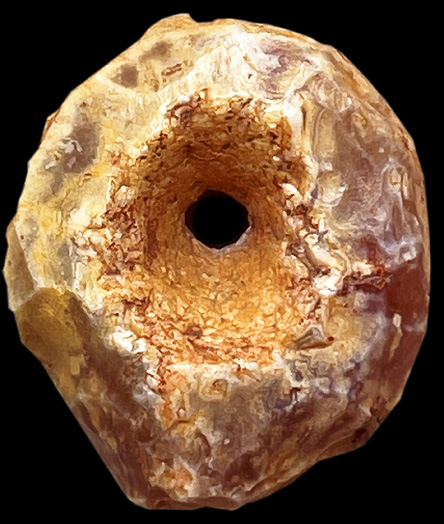
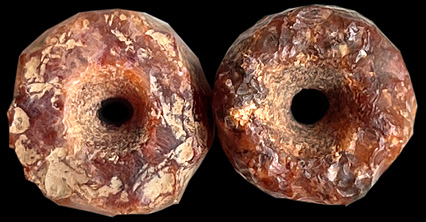
|

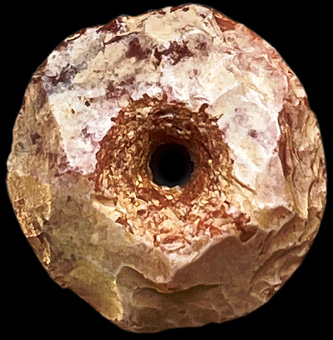
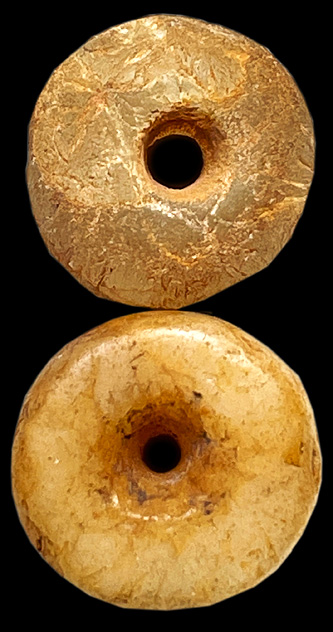
NEO 23 - 21 * 8,5 mm
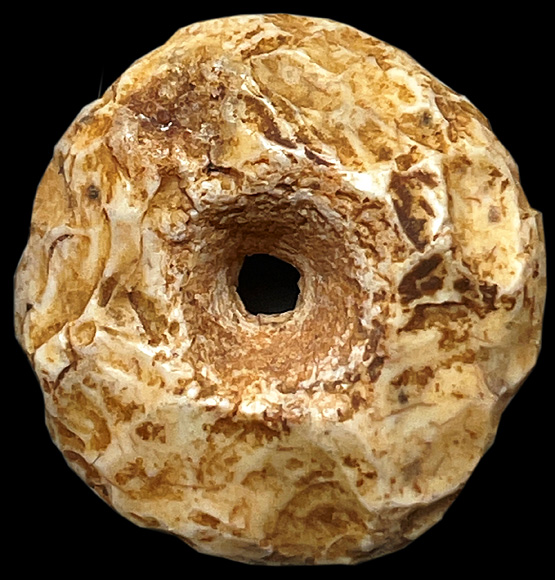
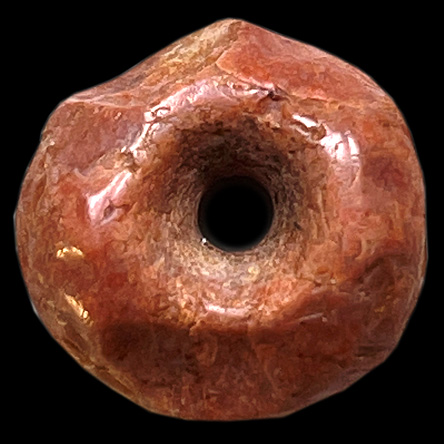
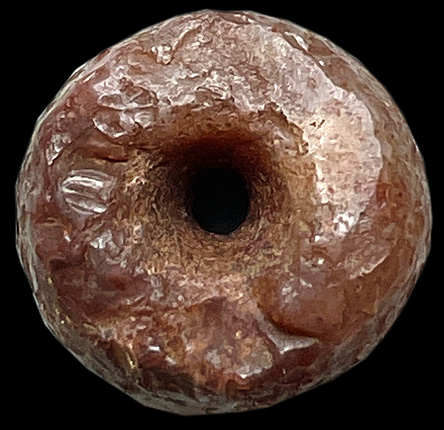
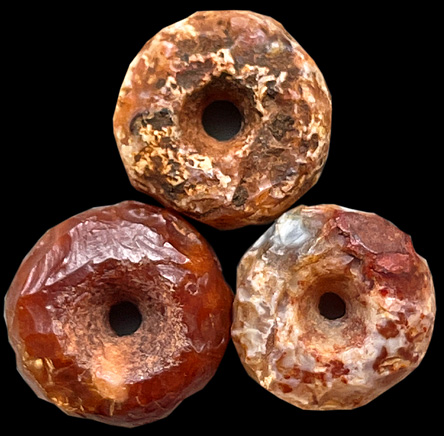
This bead showcases a striking contrast between fine
micro-pecking around the perforation and the crude yet
remarkably balanced picking used to shape the rest of the form.
The central hole is neatly executed, likely to ease stringing
and reduce wear, revealing the maker’s technical sensitivity. In
contrast, the outer surface is rugged and faceted, shaped by
deliberate, primitive strikes—yet it holds a pleasing symmetry.
What elevates this piece further is its marbled coloration, with
swirls of warm cream, ochre, and honey-brown. These natural
tones enhance the tactile, hand-hewn quality of the bead,
transforming it into a small, earthy work of art.
|
|
|
|

NEO 24 - 17 * 16 * 8 mm
|
|
|
|

NEO 25 - 18,2 * 6,1 mm
|
|
|
|

NEO 26 - 18,5 * 8,1 mm
|
|
|
|

NEO 27 - 14 * 7,4 mm
|
|
|
|

NEO 28 - 15 * 12,5 mm
|
|
|
|

NEO 29 - 14,4 * 7,2 mm
|
|
|
|

NEO 30 - 16 * 13 mm
|
|
|
|

NEO 31 -
|
|
|
|

NEO 32 - 15,5 * 11,2 mm
|
|
|
|

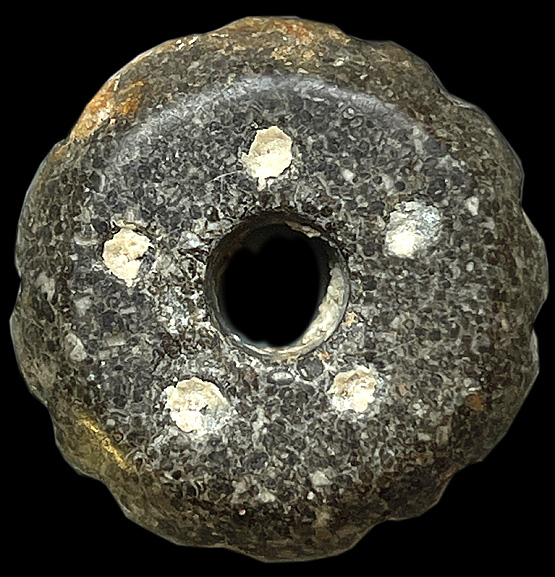
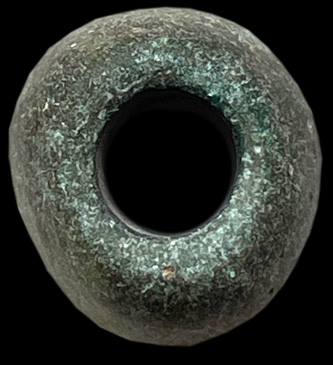
NEO 33 - 19,5 * 9,5 mm
This bead is an excellent example of early African lapidary
craftsmanship using coarse-grained igneous rock. Across the
continent, bead-makers worked with a variety of granite-like
materials, including true granite, diorite, granodiorite, and
tonalite. They were each valued for their hardness and
distinctive, speckled textures. The stone in this bead shows a
greenish-black matrix with light, feldspar-like inclusions, a
visual signature particularly suggestive of tonalite.
Tonalite, often sourced from the Precambrian shields of West and
Central Africa, contains abundant plagioclase feldspar, quartz,
and minerals like biotite or hornblende, giving it its
characteristic dark coloration and subtle shimmer. Though some
regions also used metamorphic rocks such as gneiss, the granular
structure and color balance here point more convincingly to
tonalite as the likely material for this beautifully worked
piece.
|
|
|
|

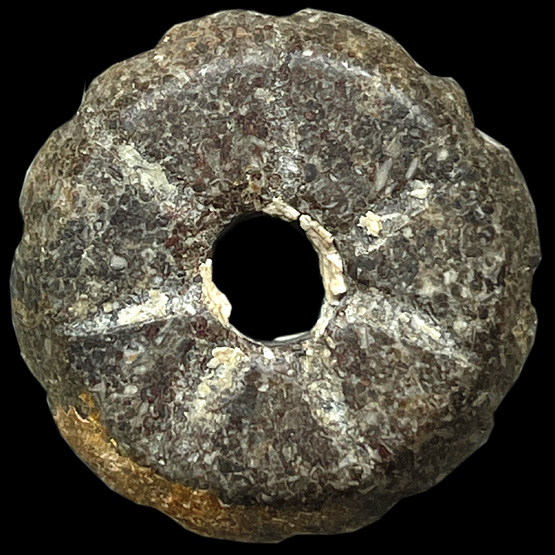
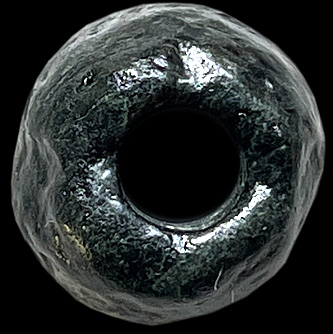
NEO 34 - 15,5 * 15 * 6 mm
This bead, like the previous example, is made from a
coarse-grained igneous rock, likely tonalite or a closely
related variant. However, it displays a finer polish and a
paler, more uniform greenish hue, with dark mineral inclusions
more sparsely distributed. The irregular triangular shape
contrasts with the more rounded form of the earlier bead,
suggesting a different aesthetic choice or functional use. The
perforation is also smoother, possibly indicating more advanced
or prolonged abrasion. Compared to the previous bead’s bold
contrast, this specimen feels more refined and subtle, yet still
rooted in the same African lapidary tradition using durable,
locally sourced tonalitic stone.
|
|
|
|

NEO 35 - 22 * 21,5 * 9,5 mm
This bead, like the previous two, appears to be made from a
tonalite-like stone, but it is less finely finished. The surface
is more matte and grainy, with a yellowish-green tone and darker
mineral patches that are less defined. Its perforation is
rougher and more irregular, likely pecked rather than ground
smooth, suggesting a more functional or earlier stage of
production. Compared to the smoother, more polished earlier
examples, this bead feels more rustic, emphasizing utility over
aesthetic refinement.
|
|
|
|

NEO 36 - 18,5 * 7,5 mm
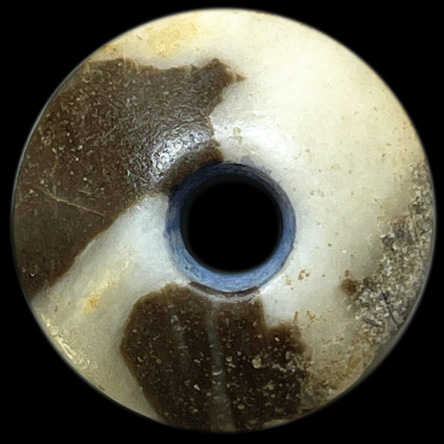
This
disk-shaped bead likely dates to the Late African Neolithic. It seems to be made from a brown-greenish
cryptocrystalline quartz, possibly tonalite. It exhibits a
fine-grained texture and subtle translucency. The surface has
been carefully ground smooth, indicating a shift from earlier
pecking techniques to more refined abrasion methods. Its
balanced, disk-like form and precisely centered perforation
reflect advanced bead-making skills, possibly from a higher
evolved local
cultural center.
|
|
|
|

NEO 37 - 18 * 6,5 mm
This bead is made from sard, a darker and slightly harder
variety of chalcedony closely related to carnelian. Known
historically as 'liver-colored carnelian,' sard is valued
for its deep reddish-brown tone and subtle opacity. The bead’s
smooth, slightly irregular surface shows signs of age, while its
carefully made central perforation reflects skilled
craftsmanship. Sard's higher density and muted elegance
distinguish it from the brighter orange-red carnelians more
commonly seen in trade. This bead likely comes from an earlier
or regionally distinct tradition and represents a refined,
earthy aesthetic in ancient bead-making.
The gemstone sard derives its name from Sardis, the ancient
capital of Lydia in present-day Turkey. Known for its wealth and
trade, Sardis likely served as a source or key trading center
for the dark reddish-brown chalcedony. The name reflects its
ancient association with this region’s gem trade.
|
|
|
|

NEO 38 - 15 * 9 mm
|
|
|
|

NEO 39 - 18,9 * 8,2 mm
|
|
|
|

NEO 40 - 24 * 13 mm
This bead is
likely made from a local African jasper, distinguished by its
creamy beige-green base and mottled brown patterning,
reminiscent of landscape or picture jasper. The material is
opaque and finely grained, with a smooth, polished surface that
highlights its natural, earthy tones. Unlike the jaspers
commonly seen in Eastern contexts, this variety is likely
sourced from North or West Africa, where diverse and visually
striking jasper types occur naturally.
|
|
|
|

NEO 41 - 23 * 16 mm
|
|
|
|

NEO 42 - 50 * 15 * 14 mm
This remarkable elongated carnelian pendant bead was rescued
from serving as the centerpiece in a strand of otherwise
forgettable beads. Its elegant form and subtle craftsmanship set
it apart. The surface displays a beautifully worn smooth patina,
a testament to age and long use, while the rich, reddish-brown
hues shift with the light, revealing areas of semi-translucent
glow characteristic of fine carnelian. The small, off-centered
perforation suggests early drilling techniques. This bead is not
only a visually striking piece but also a quiet witness to the
refined aesthetic and enduring value placed on carnelian in
ancient ornament traditions.
|
|
|
|

NEO 43 - 15 * 8,5 mm
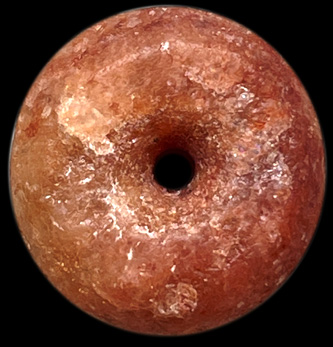
This bead,
crafted from a deep red, almost ruby-like carnelian, stands out
for its rich, opaque coloration and well-balanced disk shape.
The surface bears the marks of careful polishing, though its
slightly matte texture hints at age and prolonged use. The
central perforation is clean and symmetrical, reflecting a high
level of bead-making skill. Unlike the more common orange-red
carnelian associated with Cambay, this bead’s saturated hue
suggests either an exceptionally iron-rich variety or an
alternative source, possibly Yemen, which is known for its deep
red, uniformly colored carnelian. While red carnelian does occur
in Africa, it is rarely as homogenous and fine-grained as seen
in this example.
Once again, I was lucky enough to rescue this exceptional piece
from a strand of otherwise forgettable beads.
|
|
|
|

NEO 44 - 19 * 18 * 5 mm
|
|
|
|

NEO 45 - 15,5 * 6,1 mm
|
|
|
|

NEO 46 - 17 * 10 mm
|
|
|
|

NEO 47 - 18 * 13,5 mm
|
|
|
|

NEO 48 - 16 *8 mm
|
|
|
|

NEO 49 - 28 * 5 mm
|
|
|
|

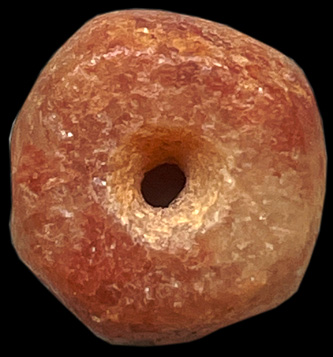
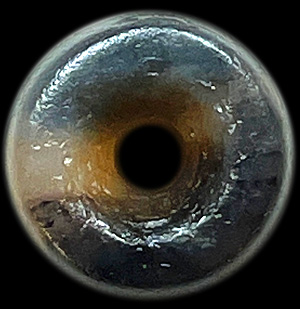
NEO 50 - 14,3 * 13,3 mm
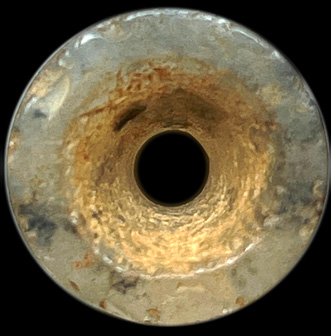
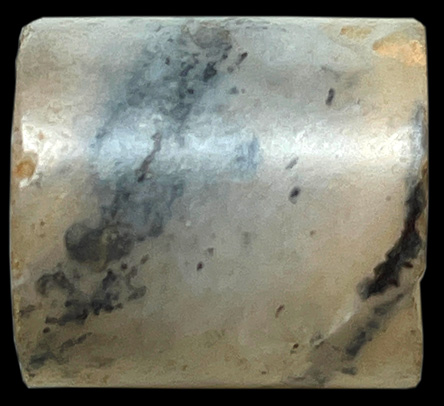
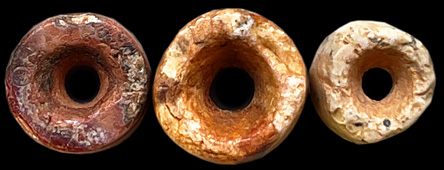
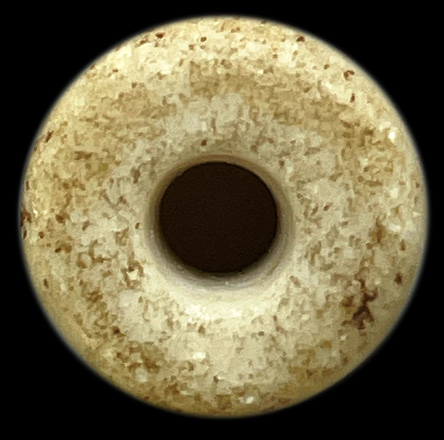
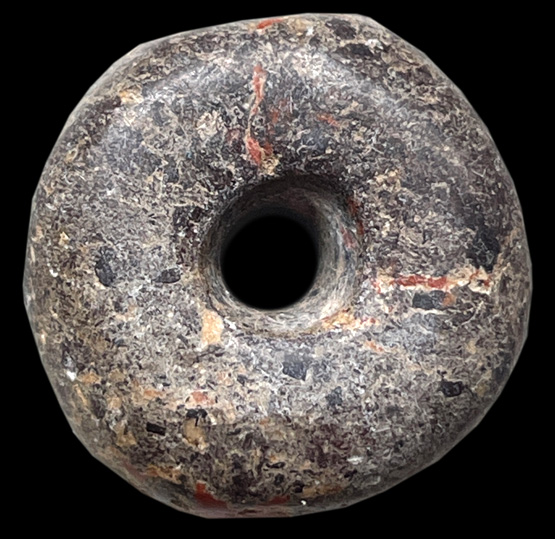
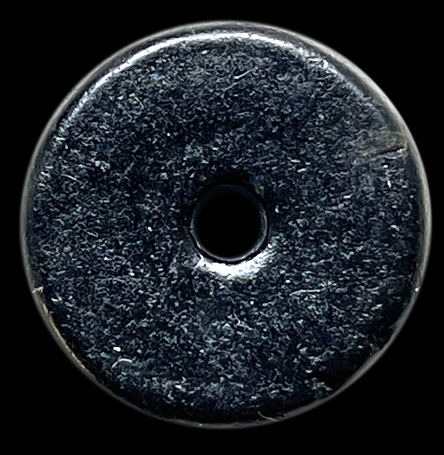
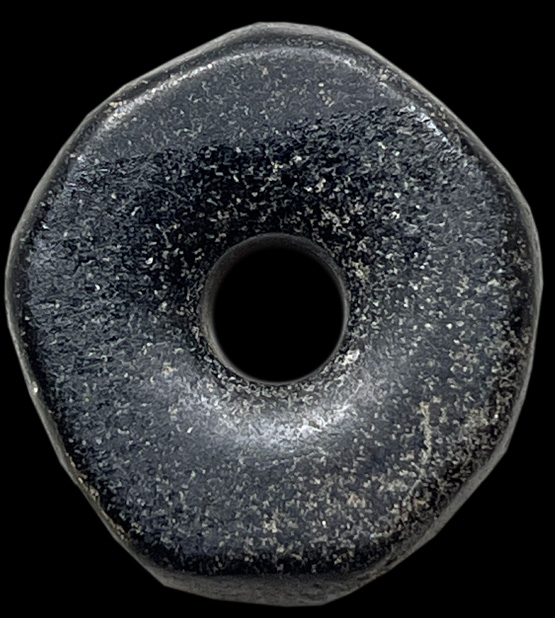
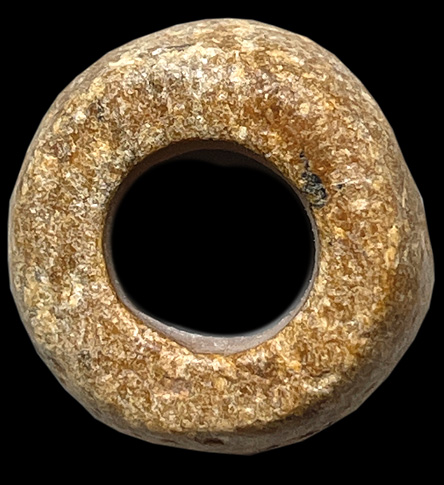
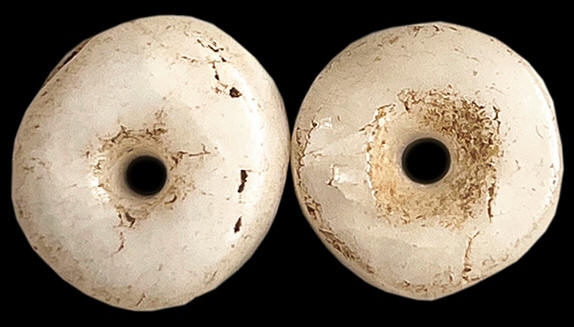
This bead presents a striking contrast between its finely
shaped, cylindrical outer form and the rough, conical micro-pecked
perforation. The exterior is remarkably even and symmetrical,
with a smooth polish and carefully shaped tubular proportions,
evidence of skilled lapidary work, likely through grinding on
stone slabs. However, the interior hole, viewed from the face,
shows a rough, granular texture and uneven tapering, typical of
pecking techniques where the hole was laboriously created by
hand with a pointed tool.
This juxtaposition reveals a transitional stage in bead-making:
while the outer shaping had reached a high level of refinement,
drilling technology still relied on older methods,
illustrating both the ingenuity and limitations of the time.
|
|
|
|

NEO 51 - 30 * 14,5 mm
|
|
|
|

NEO 52 - 19 * 13,5 mm
|
|
|
|

NEO 53 - 18,5 * 7,5 mm
|
|
|
|

NEO 54 - 13,5 * 10 mm
|
|
|
|

NEO 55 - 14 * 10.5 mm - sold
|
|
|
|

NEO 56 - 14,5 * 8 mm
This ancient bead is fashioned from moss agate, a
translucent chalcedony enlivened by dark greenish-brown,
filamentous inclusions that appear suspended within the stone
rather than painted on the surface. Unlike dendritic agate,
where branch-like patterns lie along a flat fracture, the
inclusions here weave through the bead in three dimensions,
creating a moss-like depth. The wide, slightly irregular
perforation bears the rounded lips of early rotary drilling with
abrasive slurry, while the surface shows a mixture of frosted
weathering and glossy islands of the original polish. Rust-toned
iron stains accentuate its organic appearance, giving the bead
both geological and archaeological character.
|
|
|
|

NEO 57 - 15 * 13,2 mm
|
|
|
|

NEO 58 - 18 * 14 * 6 mm
|
|
|
|

NEO 59 - 17,9 * 11 mm
|
|
|
|

NEO 60 - 18,5 * 16 mm
|
|
|
|

NEO 61 - 15,9 * 9,9 mm
|
|
|
|

NEO 62 - 13,5 * 9 mm
|
|
|
|

NEO 63 - 13,5 * 8,5 mm
|
|
|
|

NEO 64 - 18 * 8 mm
|
|
|
|

NEO 65 - 14 * 11,2 mm
|
|
|
|


NEO 66 - 22 * 12 mm
|
|
|
|

NEO 67 - 22 * 19 * 6 mm - sold
|
|
|
|

NEO 68 - 23,5 * 21 * 8 mm - sold
|
|
|
|

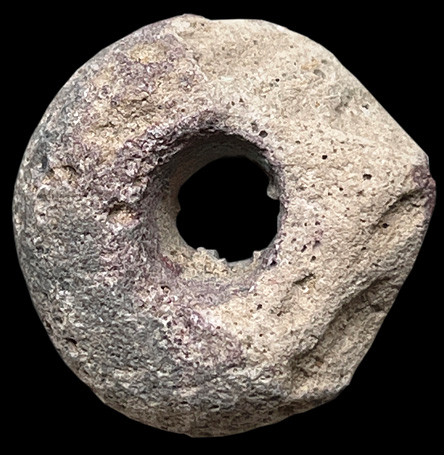
NEO 69 - 20 * 11,5 mm
This bead likely originates from a softer material, possibly
shell, fossil shell, or calcite-based stone, rather than
hardstone like chalcedony or agate. The unusually smooth,
rounded perforation lacks the sharp peck marks or fractures
typical of harder materials. Its gently tapered hole and soft,
silky luster further suggest a low-Mohs hardness, allowing tools
and string wear to shape the bead over time. Such
characteristics are consistent with non-nacreous marine shell or
organically derived materials.
|
|
|
|

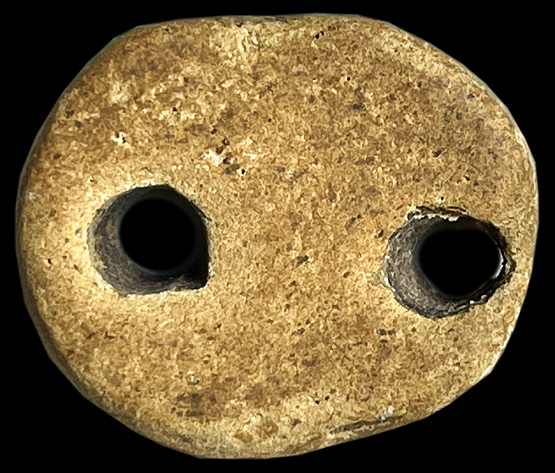
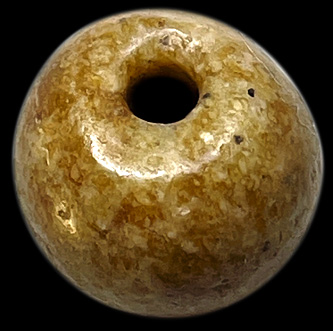
NEO 70 - 22,5 * 15 * 6 mm
This bead is crafted from a fossiliferous stone, likely
containing ancient marine inclusions such as coral or shell
fragments embedded in a darker sedimentary matrix. Its
asymmetrical, organic shape and polished surface suggest a
deliberate aesthetic choice that highlights the natural contrast
within the material. The central hole, likely made using rotary
drilling with abrasive slurry, is clean and well-executed,
indicating skilled craftsmanship. The visible fossil patterns
give the bead a unique, almost symbolic appearance, perhaps
valued as much for its geological history as for its form.
|
|
|
|

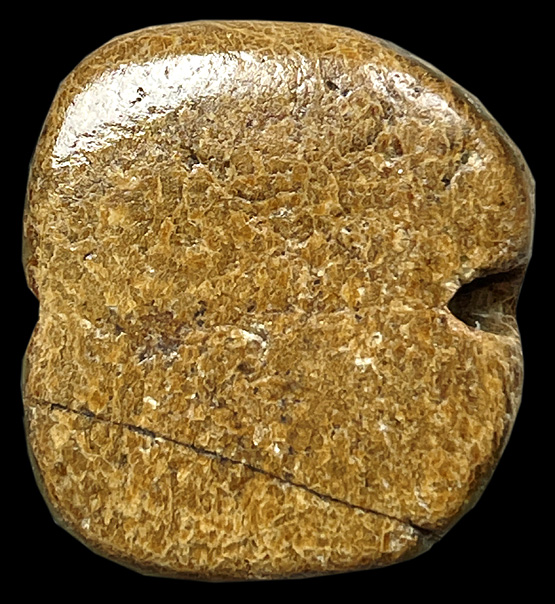
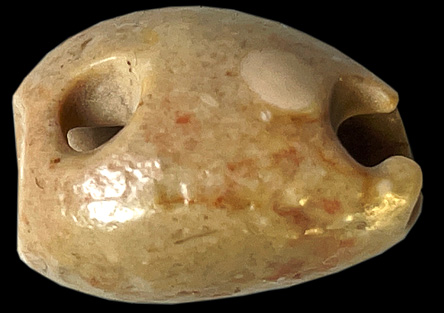
NEO 71 - 21 * 15 * 13 mm
This bead is likely crafted from a soft, dense organic
material in an early stage of fossilization. Its smooth surface,
creamy coloration, and subtle red flecks suggest biological
origin, and the soft luster supports this conclusion. The
material has been carefully shaped and polished, with two
opposing perforations angled for functional stringing or
attachment, perhaps as a toggle or ornament. The bead’s size and
wear indicate long-term use. The softness of the material, along
with the clean finish, sets it apart from stone beads and points
to a more workable medium, valued for both its tactile qualities
and ease of shaping.
|
|
|
|

NEO 72 - 31 * 26,5 * 7 mm - sold
|
|
|
|

NEO 73 - 28 * 20 mm
|
|
|
|

NEO 74 - 21 * 18,3 * 12,9 mm - sold
|
|
|
|

NEO 75 - 21 * 4 mm
|
|
|
|

NEO 76 - 16 * 9,5 mm
|
|
|
|

NEO 77 - 15 * 9,5 mm
|
|
|
|

NEO 78 - 15,9 * 12 mm
|
|
|
|

NEO 79 - 19,3 * 17 * 4,9 mm
|
|
|
|

NEO 80 - 25,2 *19,2 * 7,9 mm - SOLD
|
|
|
|

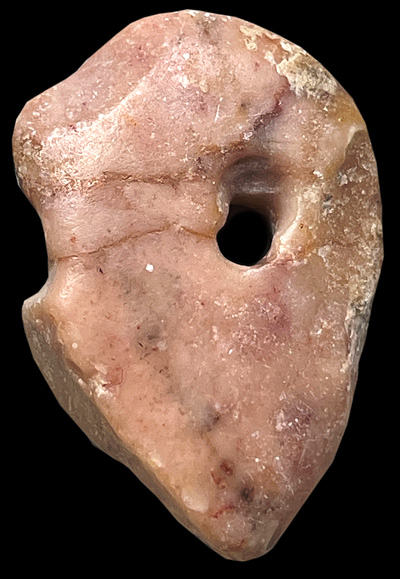
NEO 81 - 31 * 20,9 * 9,5 mm
This bead is likely made from a soft, fine-grained stone
such as pink limestone or dolomite. Its smooth surface, mottled
pink tones, and subtle veining suggest a carbonate-based
material, workable with basic abrasion techniques. The bead’s
asymmetrical form hints at intuitive shaping, possibly
repurposed from a broken fragment.
|
|
|
|

NEO 82 - 18 * 5,9 mm
|
|
|
|


NEO 83 - 23 * 15,9 mm
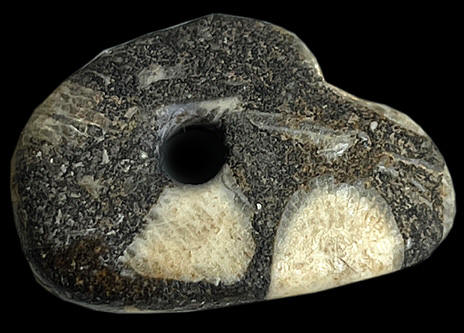
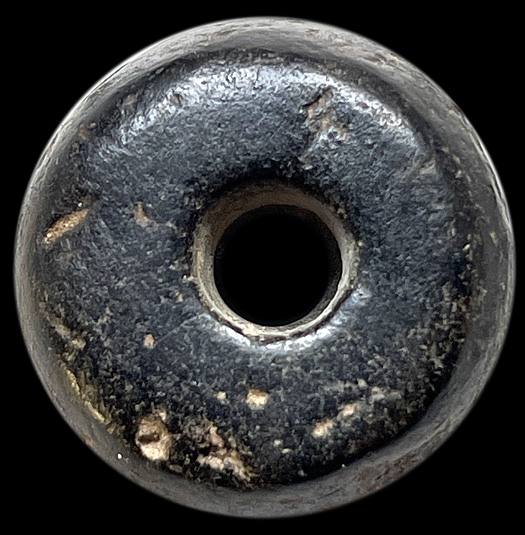
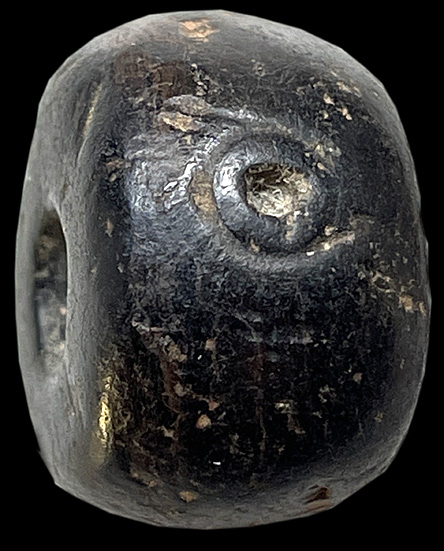
This bead, likely carved from a dense, dark stone such as
magnetite or burnished steatite, features the characteristic
“eye” motif associated with ancient South Asian bead traditions,
especially those of the Indus Valley. Such beads were not only
decorative but also held symbolic or protective meanings.
Remarkably, examples like this have been found far from their
origin, including in Africa, where they arrived via early
transcontinental trade routes. Its presence on the African
continent testifies to the far-reaching exchange networks of the
early Bronze Age, through which not only goods but also artistic
motifs and cultural meanings traveled vast distances.
|
|
|
|


NEO 84 - 26,1 * 18,9 mm
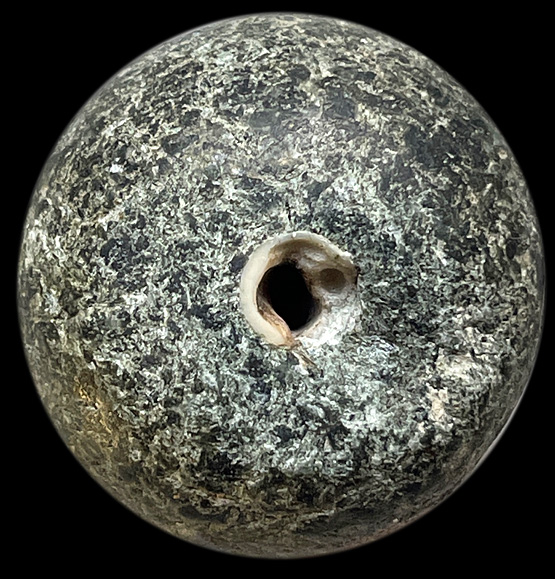
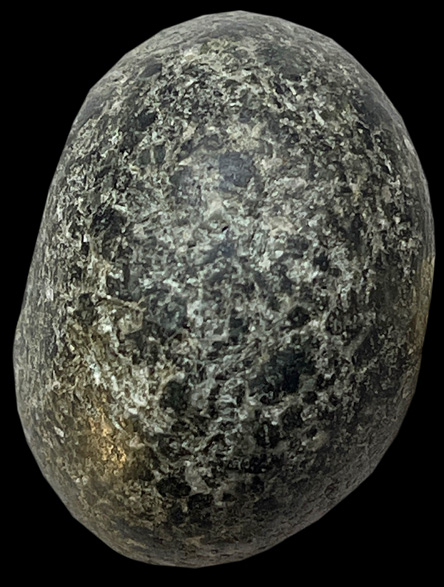
This bead is likely crafted from gneiss, a coarse-grained
metamorphic rock known for its speckled appearance and
durability. Composed of interlocking crystals of quartz,
feldspar, and dark minerals like biotite or hornblende, gneiss
offered early artisans both aesthetic appeal and resilience. The
bead's rounded form and smooth surface reflect skilled
workmanship, while the irregular perforation hints at the
challenges of drilling through such tough material with
rudimentary tools. Gneiss was locally available across many
parts of Africa and used for both utilitarian and symbolic
objects.
|
|
|
|

NEO 85 - 25 * 9,9 mm
|
|
|
|

NEO 86 - 17,1 * 5,3 mm
|
|
|
|

NEO 87 - 21,5/21 * 6,3 mm
|
|
|
|

NEO 88 - 19 * 11,9 mm
|
|
|
|

NEO 89 - 14,5 * 8,9 mm
|
|
|
|

NEO 90 - 12 * 5,9 mm
|
|
|
|

NEO 91 - 20 * 9 mm
|
|
|
|

NEO 92 - 13,5 * 13,2 mm
|
|
|
|

NEO 93 - low right: 16 * 6,5 mm
|
|
|
|

NEO 94 - low right: 16,2 * 8,5 mm
|
|
|
|

NEO 95 - lr: 12 * 6 mm
|
|
|
|

NEO 96 - low right 15 * 7 mm
|
|
|
|

NEO 97 - low left: 12 * 5 mm
|
|
|
|

NEO 98 - right: 14 * 5 mm
|
|
|
|

NEO 99 - low right: 13 * 8 mm
|
|
|
|

NEO 100 - low right: 12,2 * 5 mm
|
|
|
|

NEO 101 - up right: 14 * ,5 mm
|
|
|
|

NEO 102 - low right: 15 * 9,1 mm
|
|
|
|

NEO 103 - low right: 13,9 * 7 mm
|
|
|
|

NEO 104 - low right: 14,5 * 6,5 mm
|
|
|
|

NEO 105 - low right : 13 * 4 mm
|
|
|
|

NEO 106 - low right
15 * 5,9 mm
|
|
|
|

NEO 107 - low righ: 13 * 6,9 mm
|
|
|
|

NEO 108 - low right: 14,9 * 7 mm
|
|
|
|

NEO 109 - low right: 12,5 * 5,5 mm
|
|
|
|

NEO 110 - low right: 11 * 4 mm
|
|
|
|

NEO 111 - 12,8 * ,8 mm
|
|
|
|

NEO 112 - low right: 10,5 * 3,5 mm
|
|
|
|

NEO 113 - low right: 13,1 * 6 mm
|
|
|
|

NEO 114 - second up right: 12 * 9 mm
|
|
|
|

NEO 115 -
biggest middle down: 13,5 * 8 mm
|
|
|
|

NEO 116 - barrel bead: 10,9 * 7,1 mm
|
|
|
|

NEO 117 - down right: 13,9 * 7,9 mm
|
|
|
|

NEO 118 - biggest barrel bead: 14,1 * 11,1 mm
|
|
|
|

NEO 119 - left below: 19 : 12 mm
|
|
|
|

NEO 120 - left below: 12,5 * 11 mm
|
|
|
|

NEO 121 - down: 10,5 * 6,5 mm
|
|
|
|

NEO 122 - barrel bead left: 11 * 8,5 mm
|
|
|
|

NEO 123 - down left 11 * 6,9 mm
|
|
|
|

NEO 124 - down left: 10.1 * 9,2 mm
|
|
|
|

NEO 125 -
up left: 11,9 * 10,9 mm
|
|
|
|

NEO 126 - left down: 14,1 * 13,9 mm
|
|
|
|

NEO NECLACE 2 - biggest down: 25 * 20 * 10,9 mm
|
|
|
|
|
|
|
|
|
|
|