|

|
 |
|
|
|
Who am 'eye'? |
|
THE ALLURE OF META-MODERN BEAD
MAGIC
Have you ever pondered whether you could discern the
distinction between wearing an authentically ancient
bead and a modern factory-made counterpart? Would it
make a significant difference to your experience? I
surmise it would... Otherwise, you wouldn't be engrossed
in these lines, drawn into the intriguing world of
ancient bead artistry.
Beads: The World's Primordial Art Form
Beads hold the honor of being the world's most
primordial art form. Their story intertwines with the
very roots of human civilization, tracing a lineage that
stretches back to the dawning of human consciousness.
Our distant ancestors, even before they felt the urge to
illustrate their experiences on the walls of caves,
adorned themselves with stone beads.
These early humans, including our Neanderthal cousins,
utilized beads not just as decorative elements, but for
ceremonial purposes in burial rites, hinting at a deeper
significance that transcends mere aesthetic appeal.
Ancient Beads: More than Adornment
For the individual who has realized that it
potentially dwells in a boundless ocean
of possibilities, unshackled by the rigid constraints of
conventional belief systems, an ancient bead can serve
as more than just an artifact. It can become an
invaluable instrument for focus, introspection, and
exploration of the inner self. The tactile and visual
experience of these beads can bridge the chasm of
millennia, forging a connection with the emotions,
beliefs, and lives of our ancient ancestors.
Invitation to a Personal Experience
I invite you to immerse yourself in the enchanting world
of these ancient artifacts. Take a moment to admire
these vibrant red
Yantra
Pentagram Star Beads. Engage with them visually, let
your mind wander across their surfaces, tracing the
contours and grooves shaped by long-forgotten hands.
Feel their weight, their texture, their energy. Allow
yourself to be drawn into their story, to feel the
echoes of ancient cultures, and perhaps, to discover
something new about yourself in the process.
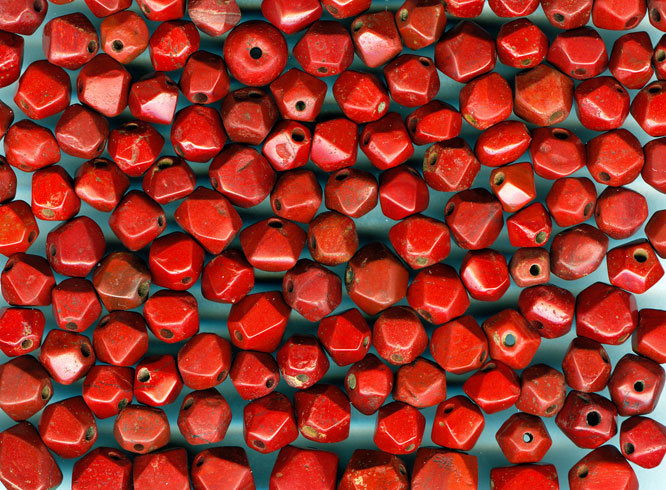
Magic Tantric pentagon shaped Star Beads
Beads as Catalysts for Meditation
A healthy mind, when mindful and crystal-clear, radiates coherence akin
to laser light. It's within this mental clarity that we can
decode the intricate patterns of existence, the interference
structures inherent in human life, which might otherwise seem
like a random array of chaos.
For a consciousness intent on cultivating a heightened sense of
wakefulness, an ancient bead can not only possess, but also
accumulate, 'amuletic' power. This power
is, of course, a placebo, but even then, as we shall see, it
will work.
The Ancient Bead: A Rechargeable Talisman for the Modern Age
In the grasp of a focused mind, an ancient bead can transform
into a meta-modern talisman, rechargeable much like a battery.
In this role, it offers the bearer a profound connection to
their own roots and reality. This ancient bead, thus, becomes a
magic mirror reflecting the bearer's unique energy, emerging as
the ultimate symbol of personal power. Contrary to the need for
a string of 108 beads in a Buddhist prayer mala, just a single
bead is sufficient in this context.
The Bead: A Timeless Signature
A bead serves as an ancient signature, an assurance that despite
the overwhelming tide of big data and the impending singularity,
your unique identity endures. You are not a mere simulacrum; you
are an individual, distinctive and authentic.
Reconnecting with Your Past
The etymology of the word 'religion' traces back to the Latin
term 'religare', which signifies re-connection or re-tying to
one's past. The clarity offered by a coherent consciousness can
open a channel to archetypal dreams, perhaps even those
inherited from great civilizations long forgotten. Through this
channel, these dreams can be acknowledged, 'awared', and
integrated into your present consciousness, thus forming a link
between past, present, and future.
|
|
 |
|
The Symbolic Brain & The Bead: A Dialogue Across Millennia
Our brains house dormant operating systems, layered constructs
of archaic biological survival mechanisms that operate beyond
the realm of language. These hidden survival systems navigate
the world through feelings, instincts, intuition, symbolic
comprehension, and analog thinking.
Meditative concentration on a bead can act as a doorway to these
ancient parts of our biological heritage. It rekindles a
connection with our deep historical and biological past - a past
that stretches back further than the first time a prehistoric
human adorned themselves with a bead. This practice can be
perceived as a form of spiritual archaeology.
This is why holding an ancient bead can evoke profound feelings
of abstract symbolic recognition. The textures, the weight, the
silent history resonating from the bead communicate with these
ancient, language-less parts of our brain.
The Authentic Talisman: A Bridge to the Archaic Self
In this context, the ancient bead assumes a magical quality. It
serves as a symbolic link, a bridge between your conscious self
and the archaic, instinctual systems otherwise inaccessible to
your control. These ancient components of your identity, deeply
embedded within your mind, are oblivious to reason or verbal
language. Here, the bead becomes your language, your means of
communication with these archaic systems. It begins to
communicate to you, to resonate within you as your authentic
talisman, connecting you with the ancient past and the
primordial aspects of your own self.
|
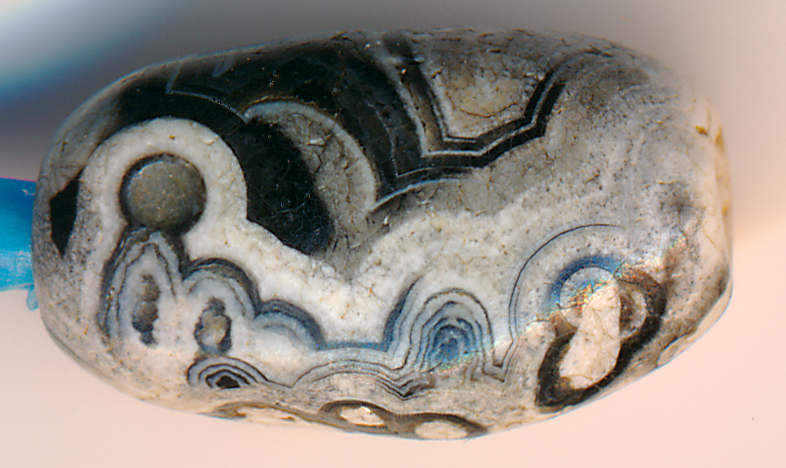
Mystery
bead from Afghanistan -
SOLD TO
FAHAD A. |
Don't be mistaken into thinking that
your entire being is governed solely by logic and reason. Even
if you are an atheist, adhering strictly to the principles of
positivist science, there are aspects of your psyche that are
much older, far more primitive, that will not heed to your
logical arguments.
These ancient constituents of your brain are akin to a
million-year-old software, programmed for survival in a world
vastly different from the one we inhabit today. They are like
the genetic equivalent of an outdated computer program, stubborn
and resistant to contemporary updates.
This is why many of our well-intentioned plans, particularly
those related to lifestyle changes and weight loss, often meet
with failure. Our genes, ingrained with survival instincts from
a time when food was scarce and physical exertion a daily
necessity, are not easily aligned with a modern world of
abundance and sedentary lifestyles.
Take, for instance, the reused genetics from the roundworm
living within you as a part of you. It is influencing your eating
patterns. This primitive creature is not governed by reason or
the conscious desire for health and well-being. It's driven by
an ancient, unyielding biological directive to eat and survive.
"Our unique attributes evolved over a period of roughly
6 million years. They represent modifications of great ape
attributes that are roughly 10 million years old, primate
attributes that are roughly 55 million years old, mammalian
attributes that are roughly 245 million years old, vertebrate
attributes that are roughly 600 million years old, and
attributes of nucleated cells that are perhaps 1,500 million
years old.
If you think it is unnecessary to go that far back in the tree
of life to understand our own attributes, consider the humbling
fact that we share with nematodes [roundworms] the same gene
that controls appetite. At most, our unique attributes are like
an addition onto a vast multiroom mansion. It is sheer hubris to
think that we can ignore all but the newest room." (David Sloan Wilson, Evolution for Everyone,
2007)
The stark contrast between our modern rational selves and the
ancient instinctual elements within us underscores the
elaborate, multi-layered nature of our existence - a vivid
testament to the complexities of evolution. Grasping and
maneuvering this internal dichotomy forms part of the
captivating challenge of the human experience. In this respect,
the pursuit of authenticity is tantamount to the quest for a
progressively deeper equilibrium between the conflicting
biological systems within us. We are, in a sense,
engaged in an evolutionary struggle with our own selves,
where genuine individuality is equivalent to an authentic
balance point between systems separated by millions of years.
|
|
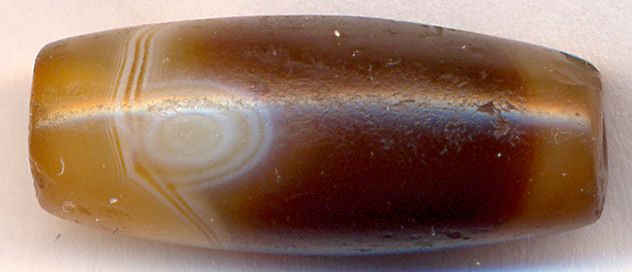
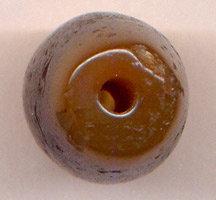
24 * 10 mm
Translucent eye
bead
An ancient signature from the
cradle of civilization
|
|
A Vision of Symbiosis: The Modern Human and the Inner Caveman
Herein lies my vision, glimpsed through the symbolic lens of an
ancient bead: a modern, rational human in tune with their inner
caveman.
Scientific studies have illustrated an interesting dichotomy:
religious individuals tend to demonstrate higher empathy, but
lower analytical skills compared to those who are
scientifically-minded. The latter, while more analytical, lean
towards a less empathetic, more psychopathic profile.
However, based on my own experiences, I believe that we are now
in an era where this divide between the 'feeling' systems of our
archaic brain and the 'language and rational thinking' systems
of our evolved cognition can be bridged.
Super Wakefulness
This reconciliation occurs in a state of enhanced consciousness,
or super wakefulness, where the most advanced regions of your
brain, the frontal lobes, orchestrate your life. From this
state, the importance of achieving synchronicity between the
various operative systems within your brain, some as ancient as
our caveman ancestors, becomes evident. If these components are
not in harmony, you find yourself at war with your own nature.
Placebo You: The Power of Meditation with a Bead
The practice of meditating with a bead in your hand is an act of
placebo. Emerging scientific research has unveiled the
remarkable influence of the placebo effect. Studies from
institutions like MIT have even shown that the placebo effect is
more potent when associated
with a brand name.
Applying this to ancient beads, one could argue that these
artifacts, steeped in history and symbolic value, could enhance
the placebo effect. However, it's worth noting that the motives
behind promoting this practice extend beyond mere financial
gain.
Under the scrutiny of super awareness, a profound realization
emerges: You are the
placebo.
In this state of heightened consciousness, you can choose to
engage in symbolic thinking, leveraging different regions of
your brain to access your emotions, immune system, and other
facets of your being. This meta-awareness allows you to
self-regulate and harmonize the diverse cognitive systems within
you, thereby fostering a more balanced, integrated self.
|
|
|
|
The
Dawn of
Meta-Modern Bead Magic
In a post- or rather meta-modern context, the ancient bead emerges as a talisman
or an amulet with renewed significance. It serves as a bulwark
against the disconcerting unreality spawned by our increasingly
digital society, grounding us in an unbroken lineage of human
history.
Intimate Sensing
An ancient bead demands a tactile relationship. It should be
cradled by your skin, cherished by your touch. You, as a living,
breathing, perspiring entity, should form a direct connection
with it. As a meditation technique you
can 'aware' the subtle sensation of the bead's presure on your
skin as often as possible. We tend to forget what is konstant.
Meditation is to remind ourselves about what is always there.
Ideally, let it nestle close to your heart. This direct
interaction transforms both parties: your touch alters the
bead's surface over time, while the bead subtly reshapes your
inner essence. Consider the bead below in this context - observe
it, feel it, sense it.
Yet, this interaction extends beyond mere touch. Vision plays a
crucial role too. As you gaze at the bead below, you may feel as
though it's gazing back at you. If you can sense this reciprocal
observation, you are shielded by the ancient Eye - an emblem of
protection, wisdom, and omnipresence. This interaction unveils a
novel dimension of bead magic, one that not only transcends time
but also bridges the gap between the physical and the spiritual.
|
|
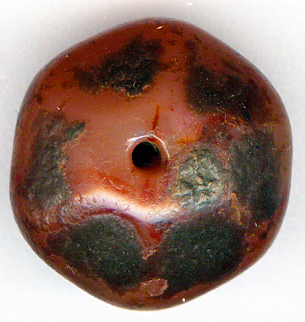
Hexagon - 18 * 13 mm
This super ancient bead has been shaped,
not only by its makers,
but also by thousand of years of time
and by contact with human skin.
|
|
THE POWER OF CONSCIOUS BELIEVING IN BELIEVING
Even as civilizations
advanced, pre-agricultural, shamanistic interpretations of
'reality' have held their ground, particularly in the East. Not
only has magical thinking survived the evolution into more
modern societal structures, but it has also flourished and
morphed into novel forms.
The Resilience of Conscious Belief in Ancient Wisdom
This evolution is profoundly evident within the tantric systems
of India, prevalent in both Buddhism and Hinduism. Here,
mystical traditions and metaphysical principles are fused
seamlessly with everyday life, transcending the realm of the
purely spiritual.
The Intersection of Science and Symbolism
It's crucial to recall that not too far in the past, even our
Western scientific rationality was framed within a context of
magic. Ancient Greek science, for instance, was heavily steeped
in symbolic and analog thinking. The segregation of symbolic
thinking from scientific reasoning only truly occurred during
the Age of Enlightenment in the 18th Century.
There's no disputing that this collective shift to a belief in
'facts' has emancipated the Western mind from certain mental
constraints - we no longer fear what we understand. However,
progress is invariably a dialectic process: while we gain
certain aspects, others are inevitably lost. The capacity to
perceive the world as a magical place is, in itself, a
remarkable gift.
In countries like India, the stark demarcation between reason
and magic never truly materialized. It's not uncommon to
encounter highly educated Indian scientists who harbor beliefs
in astrology and reincarnation. Even in the ultra-modern Cyber
City in Gurgaon, outside New Delhi, the young, tech-savvy
denizens often exhibit a fascinating blend of magical and
rational thought. This amalgamation underscores the enduring
power of conscious belief in ancient wisdom, even in a rapidly
modernizing world.
The Renaissance of Magic Thinking
As consistently maintained on Ancientbead.com, I truly believe we're on
the precipice of a 'renaissance' of magical-symbolic thinking. This
resurgence, however, must take place in an entirely novel context. A
meta-modern perspective enables us to believe in the power of the
placebo, while simultaneously acknowledging it as such. This 'quantum
position' allows us to transcend traditional 'binary' thinking.
|
SRI YANTRA
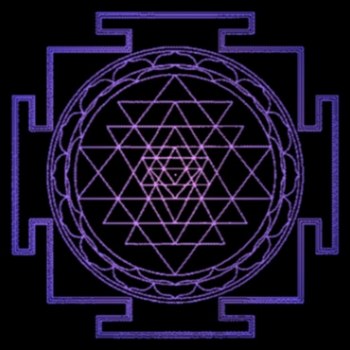
Tantric-Pythagorean sacred geometry
used for spiritual rituals and Meditation
|
|
PENTAGON BEADS
In this light, I interpret the polygon-shaped beads displayed below
through the lens of animistic magical thought, but with a contemporary
perspective that permits me to appreciate the enriched reality of
'superposed states' of belief and disbelief co-existing.
In this context, I wholeheartedly recommend Sting's recent song,
"I Can't Stop Thinking About You". The insightful lyrics, to my
ears, echo this same enlightened path of spiritual navigation,
transcending the dated dualistic divisions of reality into 'either-or'
scenarios.
The Symbolic Potency of the Pentagram
Beads have been imbued with various mystical properties since
antiquity. This has been accomplished through their distinct geometric
shapes, patterns, and the materials themselves. Among these, I find
pentagon-shaped beads particularly intriguing.
The pentagram has
been utilized in spiritual practices across myriad cultures since the
dawn of civilization. The earliest known use of the pentagram dates back
to 3500 B.C. at Ur in Mesopotamia. However, it also features prominently
in ancient European Celtic culture. The temporal and geographic
separation of these cultures suggests that the adoption of identical
symbols cannot be solely attributed to cultural exchange. Rather, it may
also be explained by the presence of archetypal behavior and patterns of
understanding residing within human subconsciousness. In this context, I
highly recommend delving into the writings of C.G. Jung, which serve as
enlightening gateways to new 'realities' from which
especially
scarred ancient beads can be appreciated. |
|
|
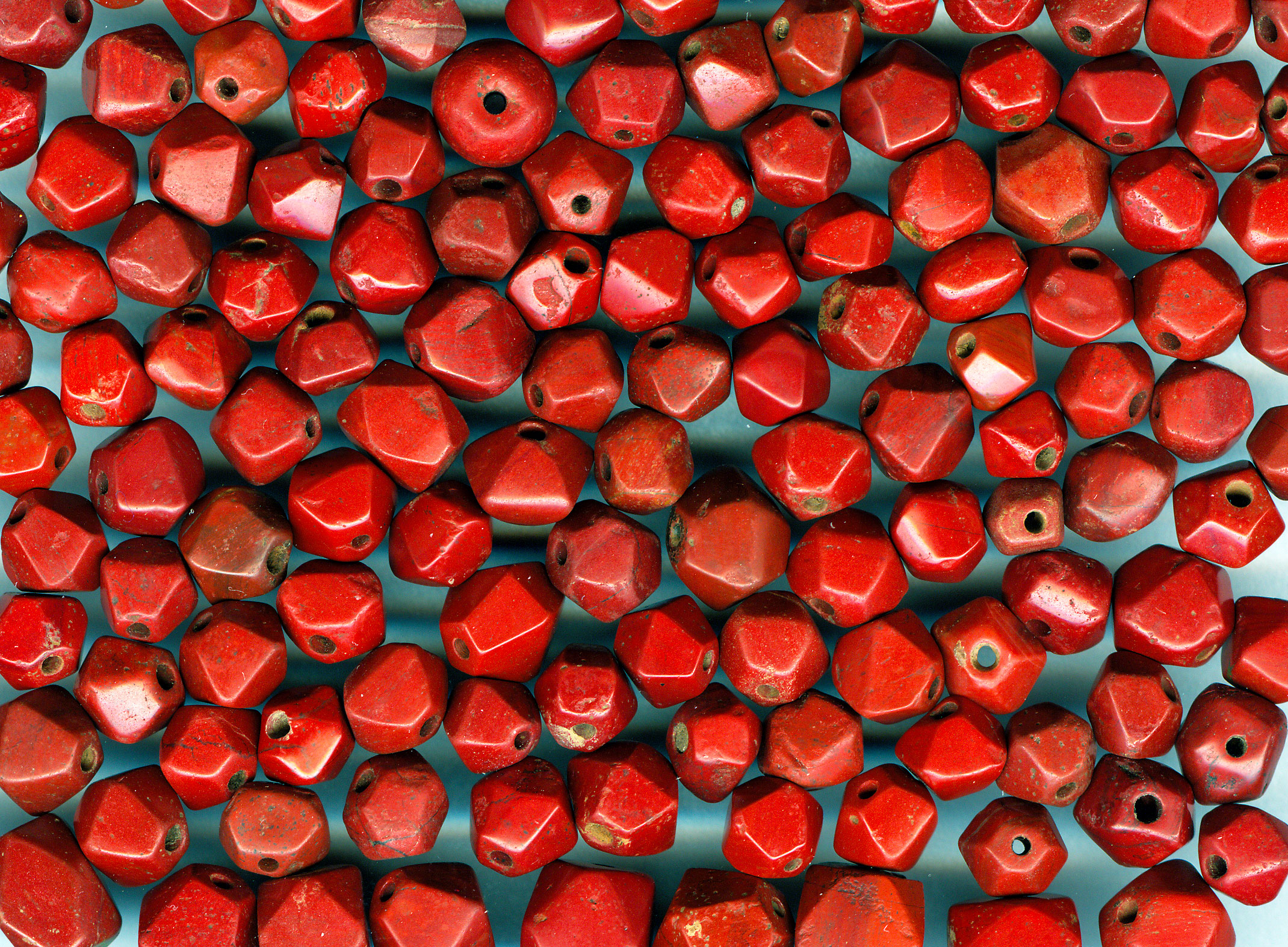
MAGIC PENTAGON YANTRA STAR
BEADS
RB 5
-
Average size 8 to
9 mm
Click on picture for larger image
Gorgeous beautiful Ancient
polygonal Yantra beads in blood red jasper of the highest quality!
Most of these beads are shaped as pentagons depicting stars.
Classical
Period: From the times of the Buddha up to around 200 A.D.
NOTE - The beads are slightly more brownish than the scan shows.
In fact, they corectly match the color of blood.


|
The captivating brownish blood-red pentagram
jasper beads displayed above hail from India,
dating back over 2000 years. It is highly
plausible that they were utilized in a Buddhist
or Hindu tantric context.
The Tantric-Greek Synthesis
I posit that the tantric comprehension of divine
geometries blossomed in Northwest India, as a
melding of ancient Indian animistic ideologies
with the 'modern' Seleucid Greek geometric and
mathematical knowledge.
Indeed, Indian tantric texts make reference to
the 'Yavanacharya', signifying a Greek
teacher. Cultural exchanges and influence are by
no means recent phenomena. Pythagoras (586-506
B.C.), revered for his mathematical and
philosophical wisdom, extensively traversed the
known world. On his journeys, he disseminated
his knowledge, while also drawing inspiration
from exchanges with like-minded intellects.
While it is improbable that Pythagoras himself
visited India, the fusion of Greek and Indian
philosophies likely occurred during and after
the reign of Alexander the Great. This synthesis
began with the emergence of the
Seleucid Empire and its amicable relations
with the Mauryan Empire and later, Ashoka's
Buddhist India. Later, it reached reached a
zenith with the
Bactrian Kingdom and the
Indo-greek Kingdom further East.
For
centuries, both Buddhism and Tantrism in
Northwest India were profoundly shaped by Greek
intellectual traditions. Even today, one can
find remnants of
Yavana, or Greek medicine, practiced in
Punjab. This crucial historical connection has
largely been overshadowed, primarily due to the
partition of Greater India into India and
Pakistan. The Muslim-majority Pakistan chose to
downplay its Buddhist history, while India
emerged as the officially designated homeland of
Hindus. What is now known through scant
fragments of Greek-Buddhist history in the form
of Gandhara art was, in actuality, a sprawling
and advanced Indo-Greek Buddhist culture that
spanned from Syria to India for over 800 years!
SYMBIOTIC UNION OF THE SPIRIT STAR AND MOTHER
EARTH
The essence of fivefold symmetry is most
fundamentally exhibited in the geometric figures
of the regular Pentagon and the five-pointed
star. These two figures stand as symbolic
representations of the harmonious interplay
between the celestial and the terrestrial, the
ethereal and the tangible.
In the philosophical lineage of Pythagoras, the
'pentagram five' was revered as hieros gamos,
a sacred marriage that metaphorically unites the
heavens with the earth. The pentagram, derived
from straightforward geometric observations, was
intrinsically associated with the celestial body
of a star.
The geometric manifestation of a star, in this
context, was perceived not merely as a
mathematical or scientific concept, but rather,
it was imbued with symbolic meaning. It was
considered a conduit that channeled the ethereal
and transcendent qualities of heavenly stars,
making these qualities tangible on earth through
the rituals involving pentagrams.
Therefore, the geometrical star served as a
symbolic emissary, a celestial ambassador if you
will, that brought the intangible qualities of
the heavenly stars into the tangible realm of
the earth. The rituals involving the pentagram,
then, were not mere ceremonies. They were
symbolic acts of communion, acts of drawing down
the divine into the domain of the human, a
process of transforming the abstract into the
concrete through the power of symbolism and
belief.
|
|
|
|
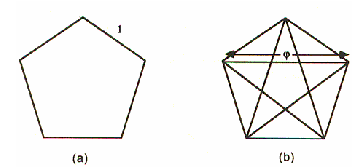
A star 'caught' within a pentagon
|
The Star-catcher
The early Hindu and Buddhist Tantric writings seem to share Pythagoras' view
of the star and its symbology. The
ancient Indian Tantrics also saw the Pentagram as a 'star-catcher,' as a way
to 'bring down' a Star in Heaven to unify it with Mother Earth.
The Pentagon within the Star within the Pentagon within the star
Furthermore, these two geometric forms seem to interact with each other in
most beautiful and infinite ways.
The Pentagon and the five-pointed star, viewed as objects in the
2-dimensional Euclidian plane, have ten-symmetry
operations (five rotations and five reflections). Both these objects are
related; each Pentagon contains a star, and each star
contains a Pentagon. As illustrated below the central
area of the star has the shape of the Pentagon which
again contains a star.
The
Star-catcher and the infinite Interplay
The perception of the star and its symbology
seem to transcend cultural boundaries, as
evidenced by the parallels found in early Hindu
and Buddhist Tantric writings. These ancient
Indian Tantric traditions also viewed the
Pentagram as a 'star-catcher'. For them, the
Pentagram served as a symbolic tool to 'catch'
or 'bring down' a Star from Heaven, fostering a
spiritual unification with Mother Earth.
This belief is a testament to the universal
human aspiration to bridge the gap between the
celestial and the terrestrial, between the
abstract divine and the concrete human
experience.
The infinite Dance of the Pentagon and the
Star
The beauty of these geometric forms lies not
just in their individual shapes, but in the way
they interact and intermingle with each other.
The Pentagon and the five-pointed star, when
observed as objects in the 2-dimensional
Euclidean plane, display a tenfold symmetry
operation. This includes five rotations and five
reflections, representing a rhythmic dance of
symmetry between these two geometric forms.
What's more intriguing is the intrinsic
relationship between these two objects; within
each Pentagon resides a star, and conversely,
within each star, a Pentagon is found. It's as
if these two forms are perpetually nested within
each other in an infinite loop, creating an
endless interplay of geometric symbolism. The
central area of the star mimics the shape of the
Pentagon, which in turn contains another star,
thereby repeating the cycle.
As above, so below
This dynamic interplay between the Pentagon and
the star symbolically encapsulates the perpetual
cycle of the cosmos, the ceaseless dance of
creation and destruction, and the infinite
interplay of the divine and the earthly realms.
It's a beautiful metaphor of the fractal nature
of the universe where each part reflects the
whole, an echo of the age-old hermetic axiom, "As
above, so below".
|
|
|
|
That which is above is as that which is below
That which is below is as that which is above
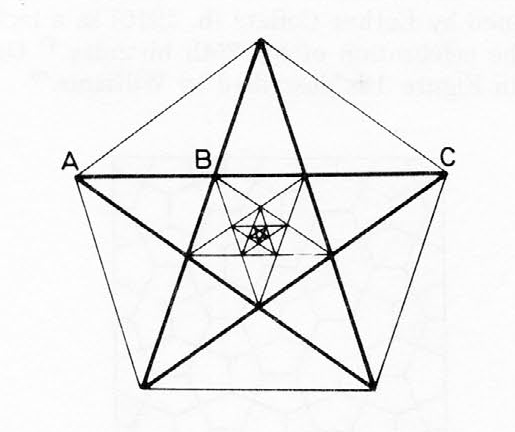
The infinite play between heaven and earth.
What is above repeats itself below and vise verse.
| |
The occult interpretation of this mathematical
proportion (the pentagram) is sometimes expressed in the
maxim: ‘Nature is to man as man is to God.’ The
proportion itself is often called the Golden Section of
Pythagoras, and is associated with the Hermetic axiom:
‘That which is above is as that which is below, and that
which is below is as that which is above.’
Paul Foster Case
In this sense, the Pythagoreans viewed the pentagram as a geometric
representation of a dynamic cyclic transformation allowing the
'logos,' the spirit to ascend into the human body.
|
|
|
PENTAGRAMS: BRIDGING RELIGION, MYSTICISM, AND
MATHEMATICS
In this section, I aim to spotlight the
pentagram within an array of contexts - from
imaginative mathematical mysticism to various
religious interpretations, and simple analog
symbolic thinking. What you'll find is just a
fragment of the myriad examples accessible to
those who seek. How you interpret and utilize
this information is entirely your prerogative. I
am here merely to present this intriguing
material, to inspire and foster exploration in a
new reality of psychological sampling within a
cross-cultural open-source environment.
The golden proportion
The geometric dimensions of a pentagram align
perfectly with the Golden Ratio - a mathematical
principle that has fascinated artists and
mathematicians since ancient times. It's found
in diverse works of art worldwide and is still
considered aesthetically pleasing to the eye.
The Golden Ratio is a direct offshoot of the
Fibonacci sequence.
The Fibonacci sequence
The Fibonacci sequence, characterized by
five-fold symmetry, is a signature of nature.
Known as Nature's numbering system, Fibonacci
numbers pop up almost everywhere - from the
configuration of a single cell, the design of a
flower, the structure of a grain of wheat, to
the proportional sections in a human finger.
The five Elements
In Western tradition, dating back to the days of
the Greek philosopher Empedocles, the universe
was believed to be composed of four elements:
earth, air, fire, and water. However, in the
ancient Indian tradition, these four were seen
as part of the material realm, all governed by a
quintessential fifth element: the Spirit. From
the Indian perspective, the Spirit was the
foremost element, with earth being the fifth and
final element.
The Five Senses
Humans are endowed with five senses: sight,
hearing, taste, smell, and touch. Within this
context, the pentagram can be seen as a symbol
of the five sense portals. When connecting with
ancient beads, I recommend engaging all five
senses. It's even possible to taste a bead - a
direct, intimate connection with a piece of
history!
The Christian Pentagram
The pentagram, known for its usage by Germanic
and Celtic tribes before the spread of
Christianity, initially found a place in early
Christian symbolism, representing the five
wounds of Christ on the Cross. However, as
Christianity institutionalized, the cross became
the dominant symbol. The pentagram's association
with various 'pagan' practices likely posed a
challenge to the Church's attempts to monopolize
its use within a Christian context.
The Pentagram in modern Symbolism
Over time, the Christian usage of the
pentagram not only diminished but also gained a
somewhat demonized reputation. This unfortunate
trajectory mirrors that of the ancient swastika
- both beautiful symbols that were appropriated
by inappropriate institutions for misguided
purposes. It is time to reclaim these symbols,
restoring their original significance.
In this process of reclamation, it's also
important to respect certain pagan perspectives
that honor our human-animal nature and our
'dark' sides. The occult thinking of
Aleister Crowley deserves a mention here.
By inviting a rethinking of the pentagram, I aim
to advocate for its use in an open meta-modern
context. If individuals feel compelled to
reconnect with their animal nature through
darker rituals, challenging perhaps the
oversimplified dichotomy of light versus
darkness in some interpretations of
Christianity, I'd recommend exploring the works
of C.G. Jung as a source of inspiration. His
understanding of the human psyche could provide
a much-needed balance and depth to these
explorations.
The Five
Pillars of Islam
In Islam, the number five holds a prominent
position. Followers of the faith pray five times
a day, aligning their lives with the rhythm of
these daily rituals. Furthermore, the core
beliefs and practices of Islam, known as the
Five Pillars, are:
Shahada:
The declaration of faith that "There is no god
but God, and Muhammad is the Messenger of God".
Salat:
The practice of performing ritual prayers in the
proper way five times each day.
Zakāt:
The requirement to give alms, or charitable
donations, to assist those in need.
Sawm:
Observing the fast from dawn to sunset during
the holy month of Ramadan.
Hajj:
Making the pilgrimage to the holy city of Mecca
at least once in a lifetime, if it is within the
person's means.
The Hamsa's protective high Five
The fascination with the number five extends
beyond religious practices and is often
connected to more tangible, everyday realities.
For instance, consider the human hand, with its
five fingers, which has been a potent symbol
across cultures and eras.
|
|
|
|
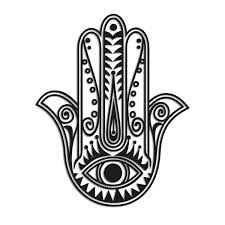
Hand of Fatimah or Hamsa
|
One such symbol is the Hamsa, a palm-shaped
amulet popular throughout the Middle East and
North Africa. Often depicted with an eye in the
center of the palm, the Hamsa is believed to
provide defense against the evil eye and bring
its owner happiness, luck, health, and good
fortune.
Just as the five fingers of a hand work together
to perform tasks, these various cultural and
religious representations of the number five all
contribute to a greater understanding of the
world and our place within it. As such, they can
serve as a source of unity, bridging gaps
between different cultures and faiths.
Indeed, the Hamsa
amulet, also known as the Hand of Fatima in
Islamic traditions or the Hand of Miriam in
Jewish ones, is a powerful symbol whose roots
extend deep into history. It's a prime example
of how the number five and the imagery of a hand
have transcended cultural and religious
boundaries, becoming a universally recognized
symbol of protection, power, and blessing.
The Hamsa, which does indeed mean 'five' in
Arabic, is typically depicted as a symmetrical
hand with three fingers pointed straight out and
the thumb and pinkie finger curved slightly
outward. Often, an eye is depicted in the center
of the palm, signifying the watchful gaze that
wards off the evil eye or ill intentions.
Historically, the Hamsa is believed to have
originated in the ancient civilizations of the
Middle East, possibly the Phoenicians or the
Egyptians, and it was subsequently adopted by
many other cultures. In Buddhism and Hinduism,
the mudras, which are symbolic hand gestures,
also hold significant meaning and are used in
meditation and yoga.
It's fascinating to observe the legacy of the
Hamsa, or the protective hand, all the way from
the ancient Indus Valley Civilization, through
Buddhism and Hinduism, to its widespread use in
contemporary Middle Eastern cultures. It serves
as a testament to the universal human desire for
protection, blessing, and the warding off of
harm.
|
|
|
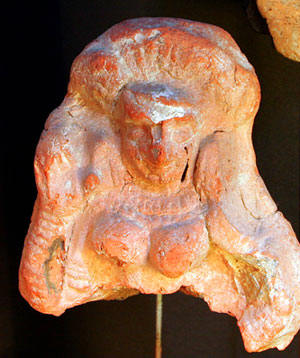
Blessing hand of late Indus Goddess
|
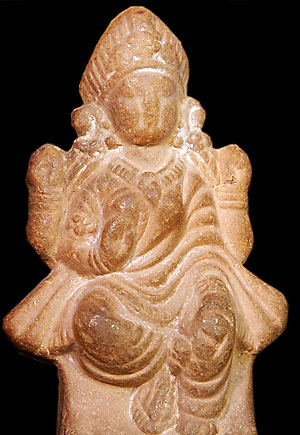
Blessing hand of Indus Goddess |
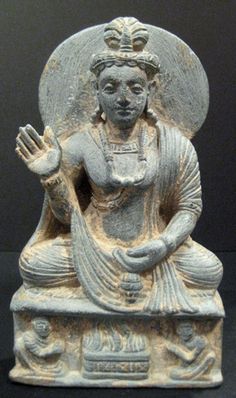
Ghandaran schist Buddha |
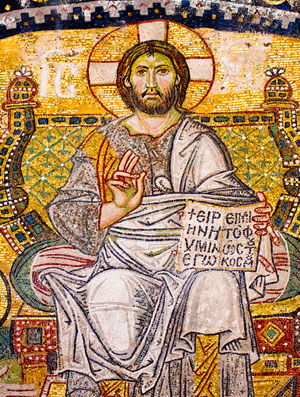
Jesus with blessing hand/mudra
Hagia Sofia mosaic |
|
The pentagram, a five-pointed star interwoven
with mathematical and geometric properties
related to the Golden Ratio, symbolizes a
profound interconnectedness deeply rooted in
spiritual symbolism. Originating from ancient
Buddhist and Hindu practices, it was an
influential talisman, offering protection and
serving as a bridge between the spiritual and
the physical realms.
The five points of the pentagram represent the
spirit and the four elements—earth, air, fire,
and water. Thus, it signifies the unity of the
spiritual and physical realms, encapsulating the
divine within the material world.
In essence, the pentagram symbolizes the divine
'Logos' manifested within the human form,
embodying the potential for spiritual
transformation and our ability to manifest
spiritual essence in the material world. It
stands as a powerful symbol of our inherent
divinity and our capacity to intertwine the
spiritual 'star' within our everyday 'earthly'
reality. The pentagram is indeed a testament to
the power of spiritual symbolism fused with
mathematical and geometric elegance.
|
|
|
|
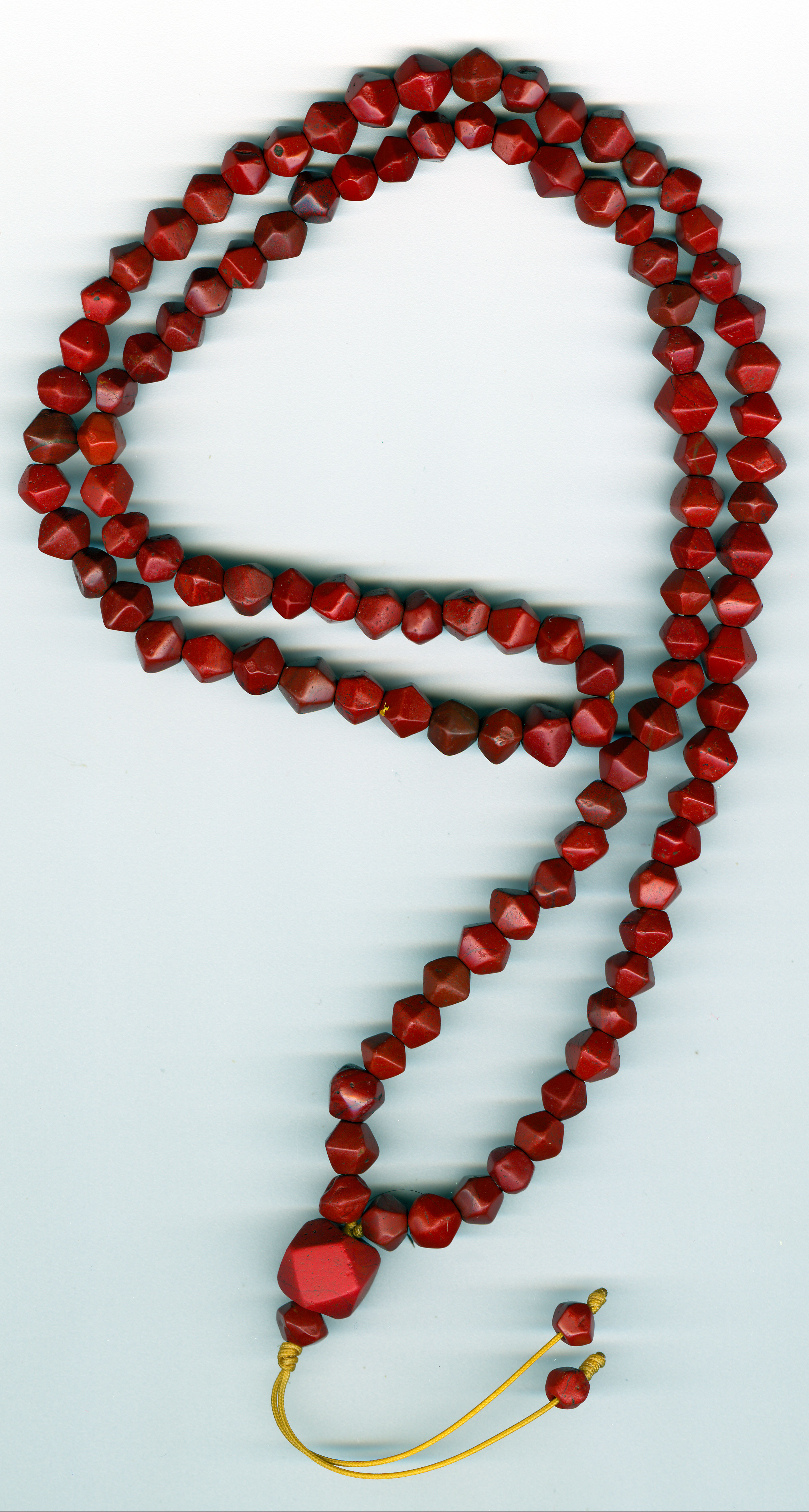
THE STAR-CATCHER
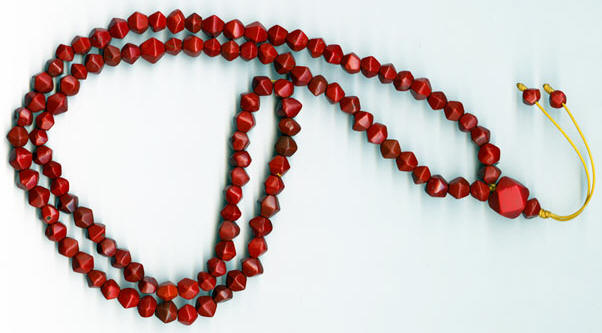
A powerful Tantra
Mala with 108 magic
pentagon beads
Made by Mads Kornerup -
Shamballajewels.com
One of my favorite Malas.
I call it
THE STARCATCHER
|
THE SYMBOLIC MEANING OF EYE BEADS
The
(w)hole in the Eye - The Zero and the Soul
The eye you see is not
an eye because you see it.
It is an eye because it sees you.
Antonio Machado
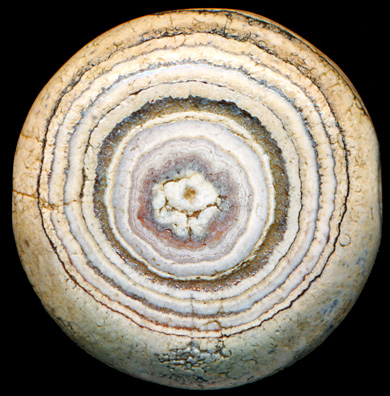
The concept of the 'eye' as a
symbol of protection and spiritual vision is a deeply ingrained
aspect of human spiritual history. This notion has its roots in
the shamanistic and animist traditions that preceded established
world religions. Shamanism and animism attributed spiritual
significance to natural elements, including animals, plants, and
even geographical features. Within these traditions, the eye
often symbolized perception beyond the physical realm and
offered protection from negative forces.
The 'eye' has been notably represented as the 'Third Eye'
in Hinduism and Buddhism. In these contexts, it represents a
state of enlightenment, a gateway to higher consciousness, and
spiritual insight. The Third Eye is said to 'see' beyond the
physical and into the spiritual realm, granting the ability to
perceive truths that transcend ordinary perception.
Theravada Buddhism and the unique blend of Vajrayana Buddhism
and Bön in Tibet still uphold these ancient animist and
shamanistic notions of the spiritual eye. This spiritual eye
continues to symbolize a heightened state of awareness and a
protective force against negative energies.
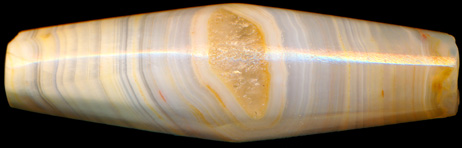
Interestingly, the symbolism of the eye extends far beyond these
religions and can be found across different cultures worldwide.
Beads crafted to resemble eyes, symbolizing protection,
spiritual vision, and wisdom, have been discovered in
archaeological sites dating back to the Neolithic period. This
widespread and enduring symbolism reflects a shared human
fascination with perception, protection, and the potential for
transcendence.
The significance of
ancient beads, both in modern times and millennia ago, is deeply rooted
in the animistic context of their creation and usage. A fascinating
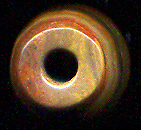
interpretation can be seen in the hole that's present in these beads. In
this perspective, the bead hole can be viewed symbolically as a "Magic
Eye."
|
|
The bead as zero
|
|
At first glance, this analogy between a bead hole and an eye might
appear far-fetched. However, when we delve into the past, we find that
much of ancient reasoning and search for higher meaning were not
grounded in evidence-based logic but rather in the persuasive power of
symbolic and analog thinking. In fact, I'd venture even further into the
realm of analog thinking and propose the following:
The hole can be considered as the first conceptualization of emptiness
in world history - it symbolizes shoonyo, the zero. It can be said that
consciousness itself is the absolute zero, the fundamental emptiness.
Zero
Is where the Real Fun starts.
There's too much counting
Everywhere else!
Hafiz
This perspective gains particular significance when we consider that it
was the Indians who introduced the concept of zero. The term for
zero in Hindi is "shoonya," which is an old Buddhist term for the
fundamental emptiness of existence. The bead, with its hollow center,
serves as a physical representation of this profound concept, embodying
the idea of emptiness or void at the heart of existence.
|
|
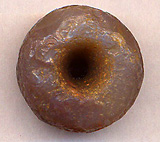
Neolithic bead from North Africa
Interestingly, it appears that the oldest beads, characterized
by their large, pecked holes and flat disk shapes, bear the
closest resemblance to the human eye. This is clearly
exemplified in the Neolithic bead displayed above.
|
|
In the Indus Valley culture, there is ample evidence of the use
of the symbolic eye. In the Indus bead displayed below one can clearly observe the circular etching, that in the most simple symbolic form shows an Eye.
|
|
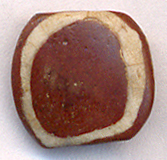
13 * 12 * 3,5 mm
Magic Indus Valley
Eye Bead - 1500 BC
You can see the same
bead displayed on this link
|
|
AN ORIGINAL FOR AN ORIGINAL
How to story tell a bead
Invoking the essence of
storytelling, let's embark on a journey with the meta-modern
mind, aiming to elicit those serene gamma waves in the frontal
lobes:
Often, ancient beads have lain dormant within the bosom of
Mother Earth for centuries. They haven't always been in the
constant presence of human touch or gaze. But a profound
transformation occurs when they are finally discovered and held.
When your gaze meets the bead, it awakens from its long slumber,
and a silent dialogue ensues.
To quote Nietzsche, with a slight modification to suit our
context:
"When you gaze long into the
bead, the bead also gazes into you."
This statement encapsulates the profound exchange that occurs.
It's not merely a physical observation of an object, but an
interaction that connects you with the history, culture, and
spirituality that the bead embodies. In this silent exchange,
the bead is not just an inert artifact but becomes a living
testament to the past, and you become a part of its ongoing
story.
|
This bead is
original |
|
You become original |
Here's a 'meta modernized' narrative that you can tailor to your
unique perspective. In India, beads often go by the name
Baba Ghoria, or "Holy
Man's Bead." Typically, such beads were adorned by spiritual
leaders or used for sacred purposes, such as relics in burial
caskets or in Buddhist stupas.
Megasthenes, a Greek historian who resided at the court of
Chandragupta Maurya, recorded that, in his experience,
Indians were among the kindest, most honest, and most helpful
people he had encountered. It's crucial to remember that the
expansive region of India was once a peaceful, non-violent
Buddhist empire. Prior to that, it was the homeland of the Indus
Valley civilization, known as the only ancient culture that
resolved social conflicts through means other than violence,
evident in their toy-like weaponry. The spiritual teachings of
Mahavir and the Jains attest to this ancient culture's enduring
legacy. Perhaps... just perhaps... the peaceful vibrations of
these golden eras have imbued the ancient bead you behold with
their energy, as pious Jains, Buddhists, and Hindus kept these
amulets in close contact with their skin, close to their hearts.
We can align ourselves with the positive intentions and deeds of
the past by choosing to perceive this connection.
The ancient bead, in this sense, has been instilled with the
energy of noble intentions and compassionate hearts for many
generations. And perhaps... just maybe... it has come into
contact with an enlightened being. This narrative, if you choose
to embrace it as part of your personal reality, has the power to
positively impact your well-being, even as far as affecting your
blood pressure.
Meta
Modern Bead Magic & Poetic Quantum Physics
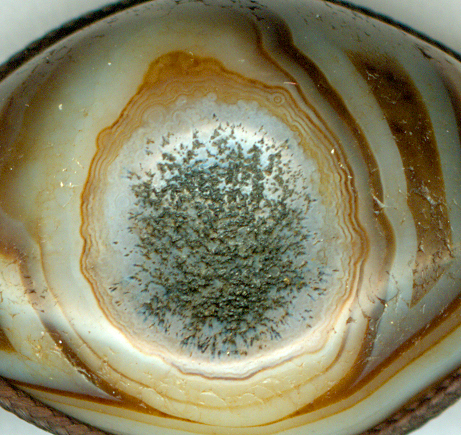
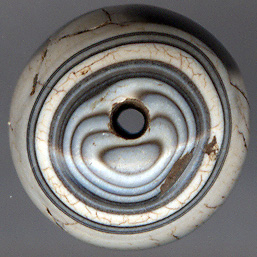
Here is one of my favorite beads. A wonderful
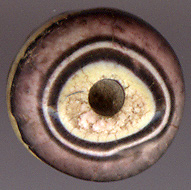
Buddhist prayer bead with a natural crystalline eye. This Eye Bead is one out of a million!
When you stare at this eye it will stare back at you ... And seen
by this old eye you become the original.
It takes an eye to know an eye - an original for an original.
|
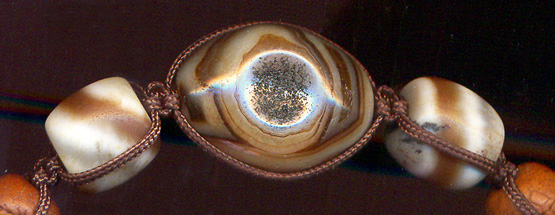
28 * 19 mm
Click on picture for
close up of eye
The allure of this bead is so
potent that it harmonizes perfectly with my intentional
and self-fashioned belief in its power. In this moment,
I wouldn't trade it even for the much sought-after
nine-eyed Zee-bead! (Of course, from a purely aesthetic
point of view, I wouldn't, but considering the
significant difference in their monetary value, I might
reconsider.)
|
This concept, I believe, encapsulates what I refer to as
Meta-Modern Magic. Meta-modern magic incorporates a conscious
meta-level of understanding, recognizing that it is our beliefs
that essentially create the magic. Imagine a scenario in which a
placebo medicine cures you, despite your cognizance that it is
indeed a placebo. This phenomenon might be aptly named Magic
Realism.
Magic Realism & Synchronicity
My interpretation of Magic Realism is an extension of these
thoughts and has been shaped by a lifetime of experiences,
punctuated by events where my intentions seemed to orchestrate
situations that extended beyond what could be explained by mere
logic or statistical probability.
C.G. Jung used the term 'synchronicity' to describe these
seemingly inexplicable, yet deeply interconnected occurrences.
In a slight poetic nod to quantum physics, it sometimes appears
as if a focused human consciousness can create minor disruptions
in the fabric of space-time.
Naturally, this doesn't imply that one could catch the moon
merely by wishing for it. However, on a subtle level, there does
seem to be some form of manipulation of time and space occurring
through clear, directed thought that's "awared" within a clear
consciousness. With these reflections in mind, I return to the
ancient bead.
The real inside your Self
An ancient bead can respond like a microphone held close to a loudspeaker.
A feedback is created between your intentional and directed willpower and the bead, or should I say your knowledge of the bead as being a representative of the ancient and the essential inside yourself. A magic bead is in this way like a meditation device helping you in the constant 'self-remembrance' of your own true
Buddha nature.
KINGS OF THE THIRD EYE & THE ZERO OF CONSCIOUSNESS
To the left
below we have a photo of a Harappan
King and/or High Priest. To the right, there is a photo of a
Seleucid Greco-Bactrian head in stucco depicting an Indian Buddhist King from the
Mauryan Empire.
It might be the great Buddhist
King Ashoka
who formed an
alliance with the Seleucid Empire and converted many of
Macedonians living there to Buddhism.
These photos show similarly designed headband eye-symbols.
The Kings are linked through the headband ornaments they wear; displaying what probably is a symbolic
all seeing eye. These eyes are made in the most minimalistic way possible, consisting of two concentric circles.
|
|
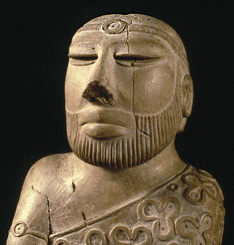 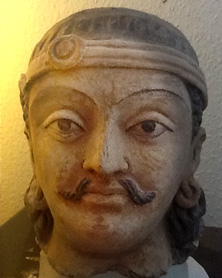
Harappan King Indian Buddhist King
|
|
The Indus Beads displayed below are ornamented with similar designed eyes as one can observe in the Kings head bands.
They show the same double concentric circles
|
|
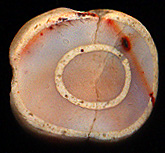
13 * 12 * 4 mm
Etched eye Bead
|
|
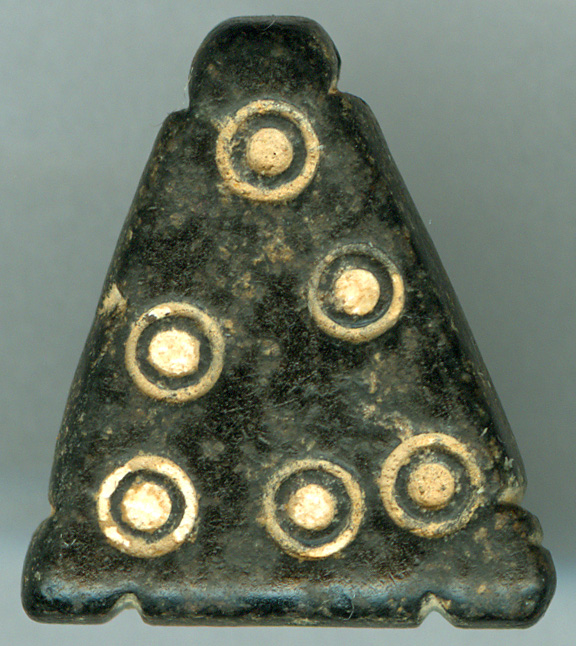
In the Afghan second millennium B.C. bead displayed below, we
again find the same eye-logo consisting of two concentric
circles etched into the stone.
These ancient beads clearly show the similarity in the design of eye-symbols right from the Indus Valley Civilization and up to the Indian classical time.
|
|
|
|
This points, as much other evidence, at the cultural link connecting the Indus Valley Civilization to the Indian classical time, especially the Indian, Ashokan
Imperial Buddhist civilization. As mentioned, the Indus Valley with its elitarian and
spiritual culture with extreme ideals, as still seen in its surviving form, the Jain religion, became popularized in the form of the middle way seeking Buddhism from
around 400 B.C.
The all seeing Eye of God, King, and State
Seen in the royal or priestly context, the headband with the Eye was likely to be a symbolic ornamental item of royal or imperial insignia.
The King/priest represents the divine order manifested on earth.
The King of Consciousness
It was most probably a manifestation of the all seeing Eye of the King and the state, with either the ability to administer spiritual blessings or punitive actions, delivered according to the law of karma, not only seen as an abstract spiritual force but also as the 'will' of the Empire. The
Priest King, as Ashoka indeed was, was the personification of the
omnipresent consciousness that 'awares' everything.
|
|
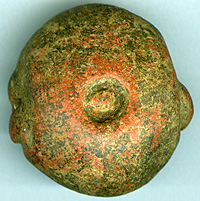
Ancient Buddhist terra cotta
Eye Bead from Sri Lanka
|
|
The Third Eye as the Magic Eye
In the case of an enlightened and just Emperor like the great
Buddhist King Asoka, it would, therefore, be more fitting to talk
about the good Eye than the more in folklore typical, evil eye.
It is also natural to relate the headband insignia Eye to the Indian notion of the spiritual all seeing Third Eye.
Seen from that perspective, it is interesting to observe the
seemingly casual way the Buddhist King to the right has put his all seeing Third Eye; not in the center, but to the right side.
This asymmetry makes together
with the king's almost sorrowful, deep, subtle and peculiar individual face expression to an almost too human king; too aware of the
enormous responsibility it is to rule an Empire. By putting the headband eye to the side, he also is putting himself aside, making way for a spiritual power greater than his own human and frail assessments; namely the all-pervading compassion and knowledge of Lord Buddha himself.
I cannot help seeing the similarity between this face and later
constructions of the suffering Jesus.
Seen in comparison the Harrapan
Priest/King looks more introvert. He has almost closed his eyes
to the world. Only his third eye of God is wide open. He leaves
it to God to take of his Kingdom, while he himself is absorbed
in introspection.
|
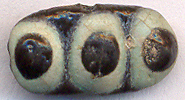
15 * 7 * 3 mm |
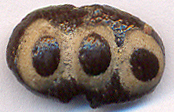
13 * 8 * 3 mm |
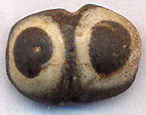
11 * 8 * 4 mm |
Super ancient Eye Beads
with a high content of iron.
Mesopotamia 3.300 BCE
These beads are extremely rare!
|
|
|
The Shield of Consciousness
To summarize the central
thesis, the Eye has historically represented a symbol of regal
and spiritual protection. Just as a King or High Priest cared
for his people during times of war, famine, or spiritual
assaults from predatory animistic forces, so are you safeguarded
from the Evil Eye when you come into possession of the
all-seeing Third Eye of the King/Priest.
This protection is rooted in consciousness, which is intimately
tied to sight and light. Consequently, we often use the term
'enlightenment' to denote higher states of consciousness.
In essence, you are shielded by your conscious awareness.
Absence of this awareness might cause you to stumble and falter
in life's journey. It's your conscious vigilance that serves as
a protective layer, guiding your path and warding off any
negative influences. Therefore, cultivating awareness becomes
paramount, acting as your personal guardian against unseen
adversities.
|
|
Eye Beads made of Glass
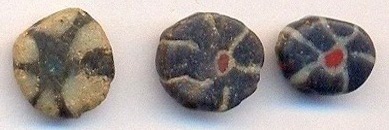
9 * 2 mm -
9* 7 * 2 mm - 8 * 5 * 2
mm
These rare Eye
Beads are from the early historic time -
Most probably
from the Taxila period 300 BC- 100 AD
|
|
Guarding against Malicious Intent
The symbolic eye can be perceived as a manifestation of
thought-intentions projected from one individual to another. In
the day-to-day existence, whether it was 2000 years ago or in a
contemporary Buddhist Newari household in Patan, Nepal, a
neighbor's envious gaze can be harmful.
When you focus your awareness on them and their actions, they
become cognizant that you understand their thoughts and
intentions through your metaphorical third eye. This realization
often leads them to reconsider their actions or, at the very
least, weakens their negative thought energy to a certain
degree.
The power of the 'protective eye' here is in the awareness it
represents, acting as a deterrent to harmful intentions. This
awareness, symbolized as the 'third eye', lets others know that
their thoughts and intentions are not hidden, thereby reducing
the potential harm they might cause. It serves as a reminder of
the social and spiritual implications of our thoughts and
actions, promoting a more mindful and harmonious interaction.
|
|
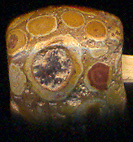
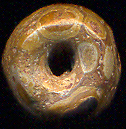
Magic eye bead
in
orbicular jasper from the
Indus Valley Civilization
|
|
Eye Symbols as Charms
for Fortune
Eye
symbols are often associated with warding off misfortune or unfavorable
destiny. Eye-beads appear to have been used from the Middle East to the
Far East as a means to deflect the energies of the evil eye. This
practice spans cultures from Egypt, where eye-beads were placed in royal
tombs, to India and China, where possessing an eye-bead served as a
personal talisman against negative forces.
The mystical logic behind this use of eye-beads can be encapsulated in
the familiar saying: "an eye for an eye". The striped patterns or
eye motifs on the Dzi bead were crafted to repel adverse energies. The
protective eyes on the bead functioned as a metaphysical shield, akin to
an antibiotic defense against harmful influences.
The bead's design itself played a significant role. A bead's smooth
roundness, much like a totem, was believed to ward off evil forces. This
attribute, tied to the design of the beads, extends to all types of
beads: a beautifully crafted bead, even without eye motifs or magical
stripes, was believed to act as a repellent against malicious thoughts.
Beyond our secular Western societies, it seems that this animistic
perspective on reality persists in various cultures. This may explain
why the magic eye bead still occupies a prime position in the hierarchy
of bead collectors. The belief in its protective and luck-enhancing
properties remains alive in many parts of the world.
|
|
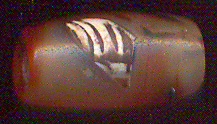
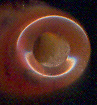
15 * 8 mm
A strange fossil eye bead from the Indus Valley Culture
|
|
Talismanic Concentration
In
conclusion, any object can function as an amulet if one believes
it to be so. The amuletic power of beads, therefore, cannot be
separated from the belief system that the bead's owner
subscribes to.
This perspective posits that the world is a construction of
collective minds subscribing to a shared narrative of reality.
To perceive the world as a projection of thoughts aligns closely
with the philosophy of Indian religions. In Western thought, we
often differentiate between realities crafted by the mind,
deemed as 'unreal', and positivist science, regarded as 'real'.
However, ancient Indian philosophy advanced the notion that the
observer is instrumental in creating the observed, a concept
that echoes the principles of quantum physics, long before the
advent of these modern scientific theories.
|
|
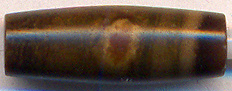

19 * 6 mm
Magic eye bead is from the
Indus Valley Civilization
|
|
Thus, the initial assertion that
beads hold power when one believes they do isn't a statement
rooted in skepticism or positivism. In fact, it's an
acknowledgement of the extent to which consciousness shapes our
world - a concept that science has yet to fully embrace. Through
the lens of biocentrism, ancient beads indeed possess power.
They carry the charge of your conscious thoughts and intentions,
as well as those of countless generations before you. The energy
they hold is a testament to the enduring interconnectedness of
human consciousness throughout history.
|
|
24 * 10 mm
Translucent eye bead
Indus Valley civilization or
early classical period
|
|
Beads as amulets
- A strong and focused mind attracts a powerful bead
Ancient eye beads indeed serve as
true amulets. Their power amplifies with their beauty and the quality of
their artistic design. The bead's form plays an integral part in its
potency. The reason is simple: an extraordinary, well-crafted bead
garners more attention and willpower than a poorly made, insignificant
one.
In essence, it's only a resolute, unwavering mind that truly merits a
magical bead. The bead's magic originates from the field of awareness
itself, becoming an impeccable focal point for attention and
concentration. This dynamic uncovers the deeper animistic psychology
behind ancient amulets. Metaphorically, consciousness has often been
associated with light, hence the term 'enlightenment' to describe the
blossoming of consciousness.
|
|
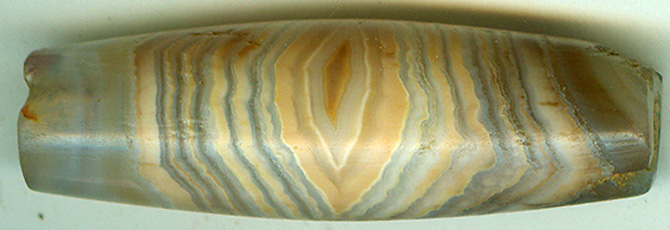
This beautiful
translucent natural eye bead is from the
Indus Valley Civilization
|
|
The design of a magical bead,
often crafted as an Eye Bead, is purposeful. It both receives
and reflects your own conscious light, amplifying and focusing
it back through the bead's eye, similar to how ordinary diffused
light is transformed into focused laser light when projected
through a ruby.
Just as precious stones like rubies and diamonds have this
transformative quality, so too does the Eye Bead in the realm of
consciousness.
Viewed through the lens of this third eye, the bead holds the
distinction of being the world's most ancient tool of amuletic
magic.
|
|
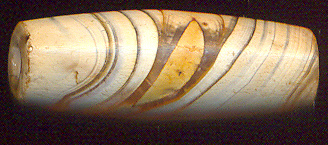
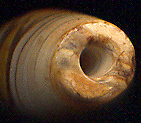
25 * 10 mm
A mysterious colored agate Eye Bead.
|
|
Today, the
understanding of the power of the Indus Valley Eye Beads seems
to be largely forgotten. Most recognize only the Tibetan Dzi-beads
as potent amulets. Yet, the Indus beads are dormant treasures
from a culture far older than the Tibetan. These beads are akin
to sleeping power plants. All they require is your conscious
recognition to awaken from their millennial slumber.
|
|
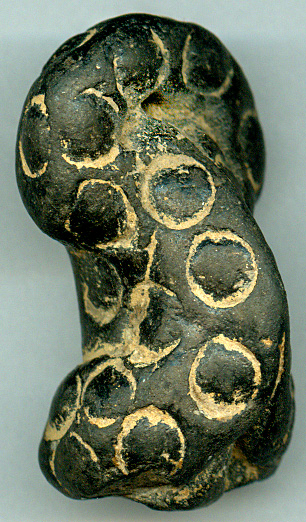
Strange Indus Valey
Snake Eye Bead
|
|
|
|
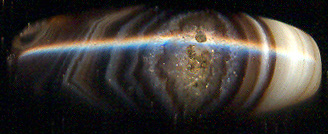
In this old bead the eye is
made of crystal
Period: Around 1000 A.D.
|
|
A NEW EYE BEAD
The eye bead displayed below is not very old. It has a modern
shape. However, it has an
incredible and rare eye design!
It takes several thousand kilos of agate and
good luck to produce such a bead.
The bead is most probably made in Taiwan.
Still, I love it, because a really rare and beautiful design can in my
opinion substitute for age.
|
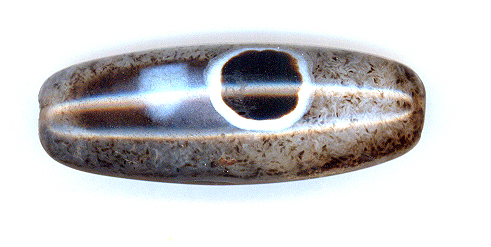
32 * 11 mm
|
|
Buddhist beads as cultural ambassadors
In Tibetan Buddhism, beads serve as powerful cultural
emissaries, with Dzi-beads representing the zenith of their
artistic expression. These beads, recognized for their
commanding allure and dramatic visual appeal, have effectively
popularized Tibetan Buddhism worldwide. Their impact is
particularly pronounced in the Far East, where they've become an
iconic representation of Buddhism.
The enchanting aspect of Dzi beads emanates from the subtle
influence of Bön, an ancient Tibetan spiritual tradition, within
Tibetan Buddhism. Intriguingly, the spread of Buddhism in
regions like China and the broader Far East has been facilitated
more by the undercurrents of magical thinking than by the formal
teachings of Buddha.
The captivating influence of Dzi-beads isn't limited to the
East, however. They've also found their way into Western
culture, with celebrities like Sting frequently seen sporting a
revered 9-eyed Dzi-bead during performances.

In recent times, there's been a
marked upswing in the West's interest in Buddhism. Affluent
Western societies are increasingly finding the tenets of
Buddhism more congruent with their modern lifestyles than
traditional Christian doctrines. Hollywood has consistently
shown a fascination with Tibet and the Dalai Lama, a fascination
that has only been amplified with the growing interest in
meditation and mindfulness practices.
In contrast, Hinduism, with its rigid caste structure and
pantheon of deities, struggles to resonate with the Western
mindset. Buddhism, on the other hand, with its emphasis on
compassion, mindfulness, and logical reasoning, presents a
narrative framework that, with some contemporary adjustments,
aligns well with the principles of a post-modern world.
|
|
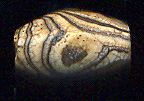
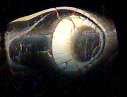
Solomons agate Eye Beads
|
|