|
THE HIDDEN STRING BETWEEN THE INDUS VALLEY BEAD CULTURE AND THE BUDDHIST BEAD CULTURE Often you are led to deep insights in places where you are confronted with contradictions. One of these contradictions is that no zoomorphic horse bead figures are found in India in spite of the fact that the horse is a common animal in India. All other animals have received the honor of being represented in amulets, but not the horse:
It is surprising that the horse, so commonly represented in Indian sculpture and already a familiar animal from the earliest time in India, is scarcely represented among Indian amulets. (Indian Beads, A cultural and technological Study, Ahantaram B. Deo p.85 ) For the time being I will leave this mystery uncommented and go straight to the next interesting contradiction.
In the streets of Delhi I stumbled upon a group of tribal people with remarkable tattoos. These tattoos had the same patterns as I have observed on the etched beads.
Once again I will leave this observation uncommented and move on in my effort to pile up mysteries. The above mentioned teasers are just meant as an overture to the main mystery theme. Here we go:
No one wears stone beads in one of the world's most famous bead countries
What is surprising is that the contemporary people in one of the most famous stone bead producing countries, India, do not wear stone beads at all.
One could argue that there are also other great stone bead producing countries where the tradition of wearing them has died out.
However India is a country of traditions. Rituals from almost every period of the Indian history are still kept alive. India is a time machine!
Indians are great traditionalist and have kept traditions alive that date so long back that a western historic analogue would be a Socrates still teaching his students under the pillars of Acropolis! India is a culture that still has living segments of all its previous cultures right down to the Bronce Age.
Not even the Sadhus, the holy men of India, are wearing stone beads. Only among the tribal communities one ocasionally meets stone bead people. Also in the Himalayas, where buddhism never had a clash with hinduism, one can find still living stone bead cultures.
Recently the newly rich middle class people of India have begun to collect ancient stone beads, but that does not count in this context.
This is indeed a lovely mystery!
A country that is famous for the greatest production of stone beads does not have a tradition of wearing them, inspite of the fact that all its historic cultures are still somehow alive... or maybe almost all?
The Brahmanization of Indian history
India today is dominated by a Hindu-Brahmin culture. This Hindu culture began in the Vedic period around 1500 BC where Europeans of Caucasian origin slowly penetrated and setled in India. The Hindu culture is spiritually managed by the first cast: the Brahmin priests. Where Europe from the renaisance began a process of secularisation, State power in India became a priestly affair. With the first attack on Buddhism around 100 AD, the Brahmins in the Sunga period slowly started refeudalizing the Buddhist Mauryan city and trade based Empire. After 500 AD the clashes between Buddhists and Hindus became more fierce and the result is that the motherland of Buddhism today is entirely dominated by Vedic Hinduculture.
The Indian Hinduism overwrites the history of Buddhism
In contemporary India many so called Hindu God men advocate the Indo European scriptures, the Vedas, as carriers of a secret devine language that only they can interprete... This has been a Brahmin-political power stategy in more than 1500 years.
Brahmin scholars and intellectuals have since the the beginning of the colonial scientific interest in Indian history had the 'luck' to influence the very western way of seeing Indian history as a history of the Hindus. The rise of western interest in Gandharan art in the middle of the nineteenth century is a good example. It became an artform, not expressing Buddhism in Grater India, but an artform connected entirely to the region of Afghanistan. The brahmins alienation with regard of Buddhism, a religion that their ancestors had actively opposed, was even greater when it came to the great influence Greek Buddhism had on Buddhism in whole India. The fact that the first writings on the Gandharan art was made in french language further enstranged the indian intellectuals from the field of Gandharan studies. The final split between Hindu-Vedic India and the Buddhist culture in the Western part of Greater India came with the partition of India in 1947.
This has obscured the fact that India was a Buddhist Empire for more than 1000 years. When I use the term Greater India, I primarily refer to India when it was a Buddhist urban trade Empire reaching from from Iran to Burma.
Hindutva dreams
Even the otherwise informative and neutral Wikipedia is dominated by brahmin political interst when it comes to the description of India as a (grecco) Buddhist culture, including the information of the greatest King India ever had, King Ashoka. Today Ashokas wheel is in the center of the India flag. He has become a symbol of the Indian dreams of national unity and greatnes. The fact that he was a Buddhist, actively oposing the Brahman caste monopoly is not going well down with the hindutva dreams of a great Hindu nation with solid roots in Indian soil since the beginning of time.
The Mauryan-Ashokan Empire is in the hindutva version described as basically a Hindu empire where the buddhist elements and the actual cast and class conflicts between brahmins and buddhist is wastly ignored. Buddhism seen as a social revolt against the ruling Brahmin caste
At the time of the great Maurian dynasty around 250 BC, Ashoka the Great ruled an enormous Indian empire in the name of the compassionate Buddha.
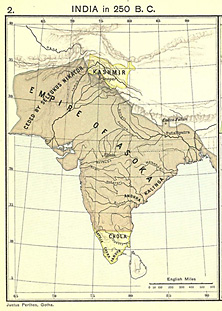
Without Kings Ashoka's conversion, the Buddha would just be a local hero on the plains of Ganga among hundred of other Buddhas. Asoka’s empire was vast. Here you can see a map of his empire:
 Buddhism was a social revolt against the caste system
This was a golden age in Indian history. Buddhism was at that time more than just a new religion. It was a social revolt against and their caste system. Buddhism did not recognize the supremacy of the Brahmins: Buddha and especially in the Ashkan contruction was against the caste system with its Brahmin power hegemony. In the Buddhist story about Angulimala we find an outspoken critic against the dictatorship of the Brahmins. The folk tales, the Jataka tales, we find almost in every story a more or less outspoken ridicule of the Brahmins. With the notion of the Buddhist ahimsa, non-violence, a concept taken from the Jain religion, Ashoka prohibited the Brahmin ritual slaughter of animals. Still today Brahmins in India are not slaughtering animals in the same
big style way as their relatives in Nepal, where King Ashoka did not rule.
The foundation for this revolt was laid by King Ahokas grandfather, the great Jain, Chandragupta Mauria. Chandragupta Mauria was an extremely talented dallit, a casteless that led the masses of India to a revolt against the Brahman caste.
Krishna Bhakti and Buddhism
What was the historical reasons for the rise of Buddhism? According to the newest historical information, Buddha was most probably not from 560 BC. He was most probably born around 480 BC. At that time another blow against the scholastic hegemony of the Brahmins happened. In around 400 BC the Bhakti movement arose. The bhakti movement advocated that you do not need to know anything to love God as Krishna. It is enough to love Krishna with your heart and just with that simple love shortcut your way to enlightenment and heaven. This was not good news for the Brahmins who claimed that only their knowledge was a safe way to heaven, a way to heaven only meant for them and not others.
In this way the two movements, Buddhism and Krishna Bhakti, came almost simultaneously to challenge the Brahmanic power. However, they did not come out of the blue! India had at that time experienced an agricultural blossoming, a long period of prosperity, that made the farmers and the tradesmen grow rich in power. A new urban culture arose and this urban culture did not go well along with the old Brahmin culture. This agricultural power was automatically translated into a new religious ideology that through the bhakti, the way of pure love, could shortcut the way to paradise, and in this way bypass the jnana yoga, the scholastic way of the Brahmins. The Krisna love movement in 400 BC is a religious farmers movement proclaiming indepedence of the Brahmin priests. Still in contemporary India there are conflicts between religious Jnana and Bhakti movements.
BUDDHISM - AN UMBRELLA FOR TRADERS AND LOWER CAST PEOPLE
Buddhism had another cast and class recruitment base. As Buddha himself was from the warrior cast with the family name Singh (Lion), before he went on the search for enligtenment the Buddhism appealed to the warrior cast. But the warrior cast was not alone. They made an aliance with the new urban middleclass. This alliance between Warrior Kings and urban middleclass is almost archetypical and can also be observed in European history as well.
The Urban Traders
There are many good spiritual reasons for the birth of Buddhism.
But there are also good economic and down to earth explanations for this phenomenon.
The Brahmins at that time were not urban and market ortiented in their outlook. As we in the west in the 18th century needed an ideological platform of equality, freedom and fraternity for the marketforces to develop, so did India in the prosporous sekels after the invasion of Alexander. The strong Brahmin division of society into casts was going well as a feudal system for ruling rural, agricultural independent states with relatively lesser ibteraction. The same system however was an obstacle to city life based trade, where cities with different languages and cultures were connected through caravanes over vast distances.
The Brahmanical caste system did not go along with the need for a business platform of equality, freedom and fraternity, where people from all cultures and social statas could do busines together. Buddhism on the other hand could promote peaceful trading societies through their caste free and universalistic social morality. In this way Buddhism as an ideology was a perfect back up for peaceful State government.
The outcasts
Some years ago I was talking to a higly educated married Indian couple.
They were from the lowest cast, but had managed to brake through their social stigma through education. They were very interested in how contemporary politics could be able to elevate the detitute people of India.
They were Hindus, but their absolute favorite historian role model was Ashoka the Great. Only the Buddhist Kings in India were able to do good they said.
What Buddhism meant for the down trodden of the Indian society cannot be underestimated. Buddhism was a blessing for the outcasts.
As Moslems in contemporary India often are casteless trying to avoid the social stigma of caste dominated India, so was Buddhism in ancient times a way out of social fixation and castesism. Sudras, the people on the button of the social pyramid found through Buddhism an escape route out of a Brahmanistic power grip, an extreme division of humanity, far beyond the class division we know from Europe. In this apartheid a Brahman was allowed to kill any castles man who came within the radius of 100 meter of him! If a sudra by accident had overheard the Brahmins reciting their slokas, he was punished by Brahmins by putting burning liquid led in the ears of the sudra!
In this way there were many good reasons for the outcasts to embrace Buddhism.
However they understood Buddhism in their own way. The destitute man's understanding of Buddhism was far away from the sophisticated de-constructive philosophy that was develloped in the new state financed Buddhist monastaries. The tribal version of Buddhism was spreading through folk tales.
The Jataka Tales
Again and again the Buddhist folk tales, the Jataka Tales, have stories about how the different incarnations of the Boddhisatvas help peace and love and foregivenes to win over violence and communal unrest. The moral values in the Jakata Tales are surprisingly close to Christian morality. This new morality was spread through these folk tales, but also on a more sophisticated level through the monks and monastaries, that 'produced an almost western scientific deconstructive kind of logic thinking as ammunition against the Brahmans illogical scholastic style of thinking.
The Jataka folk tales are not particular urban in their outlook. They are the indicators of the conversion of the castless and destitue people, the conversion of sudras into 'Buddha's'. The Jakata tales are the poor mans Buddhist oral 'bible'. They give an altogether different picture of Buddhism and the context in which it is understood and embraced. Inspite of the fact that the Buddhist resurrection of the castless and tribals only could take place in an affluent society on the rise the Jakata Tales is narrated in places where hunger and catastryphy lurks. They tell stories of how destitute people can survive through Bodhisatvic ideals and moral values that uges people to help each other. What contemporary India does not like to know is that India is one of the few civilizations that survived catastrophies through kanibalism. Disasterous famines were forcing the poor to eat each other to survive. In one of the Jakata tales (Ingratitude Punished) even the Boddhisatva of the story is forced to participate in eating one of his brothers wives. This 'Boddhisatva' is for sure not an urban trader! In contrast to the cruel settings of this story, we find a Boddhisatva hero that somehow finds a way for the 'good' to happen, inspite of the fact that he, as all other humans in extreme conditions, has to face and deal with the harsh realities of life. Even as an incarnation of Buddha he cannot escape the hard life in front of his nose through miracles or through Mediative escapist attitudes.
But still somehow love, tolerance and forgivenes finds a way where seemingly all ways are blocked.
The re-Bramanization and refeudalization of India
However the noble intentions of Buddhism could not last for long in the caste infested India. The beginning of the end of the golden Buddhist reign of India began when general Pusyamitra Sunga together with a Brahmin priest killed the politically weak Buddhist King Brhadrata 50 years after Ashokas death. The Sunga dynasty now reinstated the vedic sacrifices that Budha had prohibited, and a slow decline of Buddhism in India together with a harder surpression of the lowest casts followed. Buddhism was not eliminated in one go from India. Even as long as up to 1800 AD there were still Buddhist pockets in India.
The new rulers did not target the Buddhist monks directly. But the first thing the new Brahmin rulers did was to reinstate the Vedic rituals and the castedivison of man. This first blow to Buddhism in India was made in an alliance by a general from the warrior cast and a Brahmin from the priest cast. This alliance had profetic qualities. During and after the rule of the Sungas the Brahmins slowly updated their role in a move towards the power in goverment. State power became after Buddhism - opposite to to the secularisation in Europe - more and more a priestly affair.
Seen from a socio-economic level, what happened was that India was slowly refeudalized. Instead of the long trade routes connecting urben power centers through long distances, India was again as before Buddhism split in many independent agricultural based Hindu Kingsdoms with much less economic interaction between them. In such feudal kingdoms there was no need for an economic platform of equality, freedom and fraternity and hence the caste system made its reentrance in the social strata.
SO WHAT HAS ALL THIS TO DO WITH BEADS? The Brahmin-Vedic culture is not a stone bead culture
The political role of the Vedas can indirectly be read out of the story of stone beads. In the Vedas we find no particular emphasis on stone beads as amulets. The amulets of the Vedic times have more resemblance to the amulets worn by Tantric sadhus:
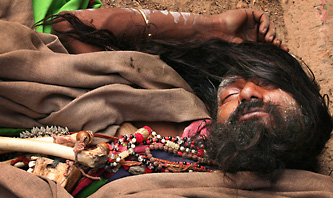
Tantric sadhu with amulets of organic materials In these amulets we find the extensive use of materials from the animal and vegetable kingdoms plus the use of pearls known as mani, jewel.
S. B. Deo writes in his book, 'Indian Beads' about what he calls 'Vedic amulets':
The striking feature about these (the vedic) amulets is the extensive use of articles from the vegetable and animal kingdom; it is surprising that so few should have been used which are not perishable. p.39 As previously mentioned the Indians are great traditionalist. Even today the Brahmins, the tantrics, the sadhus and 'common' Hindus prefer organic materials. The most used and sacred Hindu bead is the Rudraksha bead made from the seed of the Rudraksha tree: 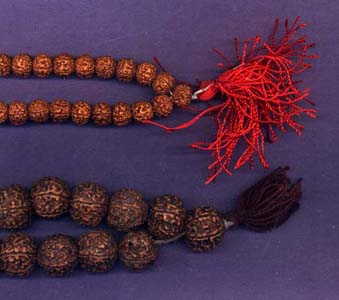
Rudraksha malas
Typical hindi beads are also made of sandal wood and tulsi: 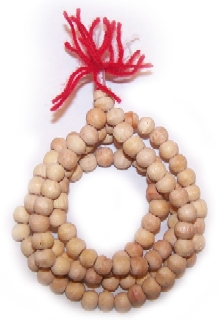 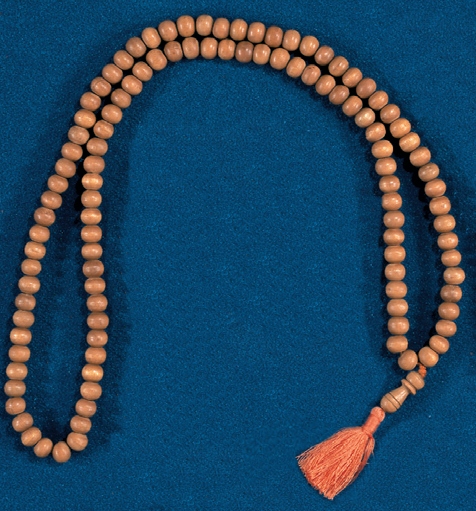
Tulsi mala Sandal wood mala
Along with the organic amulets, contemporary Hindu culture adores gold, silver and precious stones in any form. But not stone beads. If we string up the few beads of evidence we have until now, a pattern starts to become visible:
Nomads do not manufacture stone beads
The Vedic, Indo European people had no tradition for stone bead making. They were basically pastoral nomads. They made their amulets out of organic things they could collect on their way. They might have collected stone beads from other sources, but they were for sure not able to produce them.
The Indo European culture as represented in the Vedic scriptures were however primitive, at least when we compare it to the preceding culture, the Indus Valley culture.
The Indus Valley culture is a stone bead culture
Stone Bead making required a highly developed and stationary urban infrastructure. Only generations of continuous living at the same geographic location could bring out the infrastructure of stone mining and advanced artisan manufacturing of stone beads. This urban infrastructure was excatly what the Indus Valley people possesed. Seen in this light one could say that the Indian stone bead is a cultural messenger from an ancient civilization hidden in mystery. The Indus scripture is yet not decifered.
The Buddhists use stone beads, not the Hindus
In modern India the Hindu Brahman-Vedic culture is the dominating force. One of the indirect signs of this cultural hegemony is the lack of a stone bead culture. Only among destitute people, the castless and tribal people of India we still find some use of stone beads.
The statistics for Ancientbead.com shows that 90 percent of the visitors are from countries with strong Buddhist communities. If we look beyond the borders of India we find India surrounded by stone bead culture and Buddhism in all directions apart from the west.
Especially the Buddhist lineages of the big wheel have a stone bead culture even today - but not the Hindus.
Let us sum up:
Buddhism came from India. Buddhism is no more in India.
Stone beads came (and come) from India. They are no more a part of main stream Indian culture.
Two categories of etched beads
According to my experience the etched beads from the Mauryan period fall in two distinct categories:
There are the few etched beads with very nice and careful made design as you can observe in the beads displayed below:
 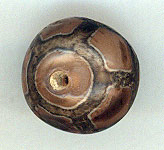
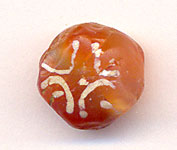
However most of the etched beads are clearly mass produced. They
are made in a sloppy and primitive way like the ones you can see below, where both the etched design and the making of the shape of the bead is done without care:
 The cast system and slavery was prohibited already in the beginning of the Mauryan era, but that did not implicate social equality. The Greek geographer Meghastenes who lived at the court of Chandra Gupta Maurya noted that it is but fair and reasonable to institute laws which binds all equally, but allow property to be unevenly distributed.
As we have previously seen, Buddhism became the religion of both the rich urban traders and the destitute tribal’s. The diversity of quality in the etched beads reflects this social dichotomy. The social heterogenic nature of the Buddhist culture in the Mauryan era resulted in an etched bead culture with more or less the same etched symbols, but with very great difference in quality. There are the poor man's etched beads and the rich man's.
It is interesting to compare the etched beads from this period with the previous bead cultures. Especially the Indus beads demonstrate a remarkable even quality. As you can see on this page the Indus beads are all of the same uniform high quality.
TTHE CROSS OF TAXILA
Displayed below you can see an etched bead with a pre Christian cross.

From Kevin Ball's website
The cross in exactly this design is a very common pattern on etched beads from around 300 BC and onwards.
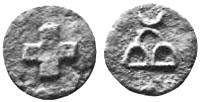
Coin from the Buddhist capital, Taxila On one hand one could easily argue that a cross is such a simple symbol that
it most probably could be invented anywhere at any time in cultures that
never had any interaction. That of course is true. However if a simple symbol is connected with another symbol, like the cross here is connected with the Triratnas on the backside of the coin, the symbol, no matter how simple it is, gets s specific meaning from its context. The cross is here connected with Buddhism and the Buddhist Trinity. 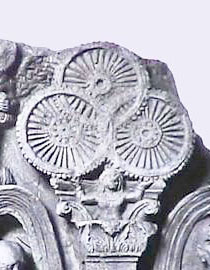
This Indian BC sculpture presents as the back side
of the above coin the Buddhist trinity, Tri-rat-nas:
The Buddha, the Sangha and the Dharma.
Ashoka's wheel is also visible.
Despite western efforts to Christianize the cross of Taxila, coins like the one displayed above were beyond doubt BC with at least 200 years. This cross was the official symbol of the famous main Buddhist capital of learning: Taxila. In the Buddhist Jataka tales, several stories have a standard formula line about the Bodhisattva hero of the story. It goes like this: Then he went to Taxila to study Buddhism.
Taxila had a kind of university center as long back as 700 BC, but from around 250 BC Asoka made it the spiritual capital of his Buddhist mission.
The cross of Taxila is often accompanied with four dots as you can see in the etched bead displayed below:
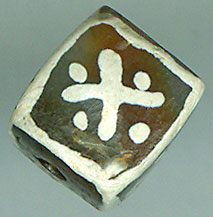 In the historical and cultural melting pot of modern Delhi I saw a very interesting thing. India is a time machine with living answers to all historical questions. I saw a tribal woman from the Bheel community with at tatoo with a pattern I have only seen on beads more than 2000 years old! She wore the cross with four dots as you can see on the bead displayed above! Since I saw this tatto I have observed several of the old etched stone bead patterns as tatoos on tribal people.
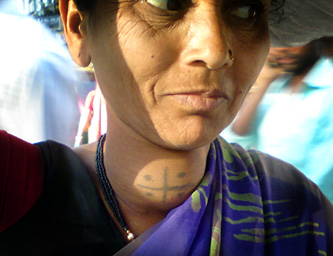
Indian tribal woman The ancient Indus culture is somehow still showing signs of life in the outcast communities of India. This symbol is one of the most commen patterns on etched beads from the classical period.
However, this cross was initially not a Buddhist symbol. Not even the cross with the four dots originated from Buddhism. It was an Indus Valley symbol. Displayed below is an Indus seal with excatcly the same cross with four dots:
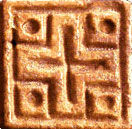
Indus Valley seal Most probably the link between this old Indus Valley symbol and the educational center of Buddhism, Taxila is shoving how new cultures reuse
'signs' from the previous cultures. The cross with the four dots simply followed an archetypical and common transformation where strong symbolic designs survive while the meaning of the symbols changes with the historic socio religious context.
The same phenomenon happened with a very similar symbol from the same Indus period:
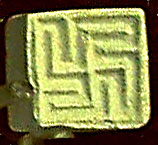
Indus Valley Swastika seal
British Museum
The Indus Valley swastika survived in 3 different religions: Jainism, Buddhism and Hinduism. In all these 3 religions it now has different symbolic meanings. Hitler's misuse of this symbolic design is an additional example of how strong old archetypical patterns can be used for new political agendas.
The Indus culture is still alive
I talked to a very educated and intelligent young man belonging to the Jain community. He said that the first of the 24 Jain Tirthankas was Lord Rishab Dev, another name for the Indus God called Pashupati, Lord of the Beast, today known as Shiva.
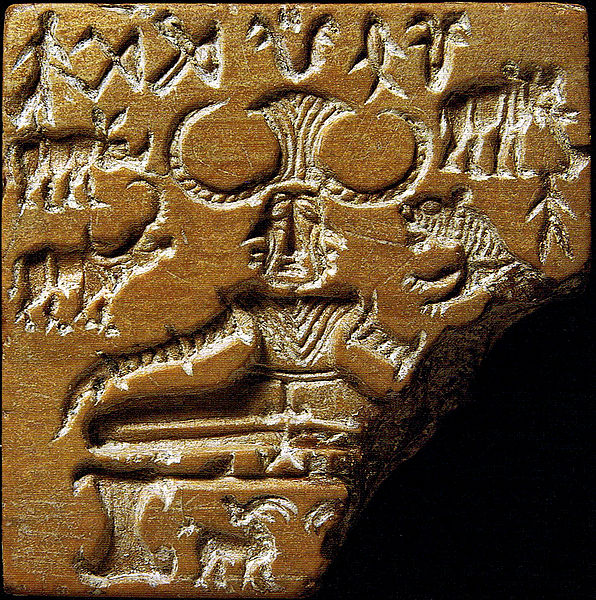
Pashupati - The Lord of the Beasts
The Indus culture is still alive in India today. India is a strange place where all cultures that have ever existed there somehow still are there in a living form.
It is as Socrates was still there in Athens. The only difference is that today Socrates has got a mobile phone.
So the Indus culture too has survived. The young Jain said that this was due to ahimsa, the Jain and later Buddhist notion of non violence. We have survived since the time of the Indus civilization, the young man said, because we were not violent. Violent cultures experience a peak and then a quick downfall. Non-violent cultures such as ours continue to exist, not in the front position, but behind the scene of power.
What he said is true. Until today, the only advanced mega culture in the world that somehow was able to solve its social conflicts without violence was the Indus culture. We find no signs of amour or weapons from this peaceful river culture, comprising more than 1,5 million km and consisting of
at that time the world’s largest population: more than 3 million people!
So the Indus non violent attitude has survived - at the button and the top of the Indian society; in the Jain culture and in the tribal outcast culture.
The dotted cross is today a tribal symbol
The reuse of signs can also indirectly tell stories of social change. Where the swastika in contemporary India has become one of the main symbols of Hinduism, a symbol 'owned' by the Brahmins and the Jains, the cross with the four dots is a symbol that is closely related to the destitute, tribal people of India. No upper cast people can be found with this symbol!
Therefore a line goes from the contemporary Dravidian tribals to the etched beads manufactured in the classic time right down to the Indus Valley Civilization.
It is now time to look closer at how the cross with the four dots could be reused in the 'new' Buddhist frame of understanding.
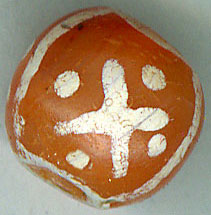 The cross in the center is pointing in four directions. Together with the dots
we come to the number eight. Both the number four and eight has deep significance in Buddhism. At Sarnath the Buddha's central teaching was centered on four noble Truths and the noble Eightfold Path.
That Buddhism is directly connected to the cross with the four dots becomes visible in this little Buddha figure from Norway:
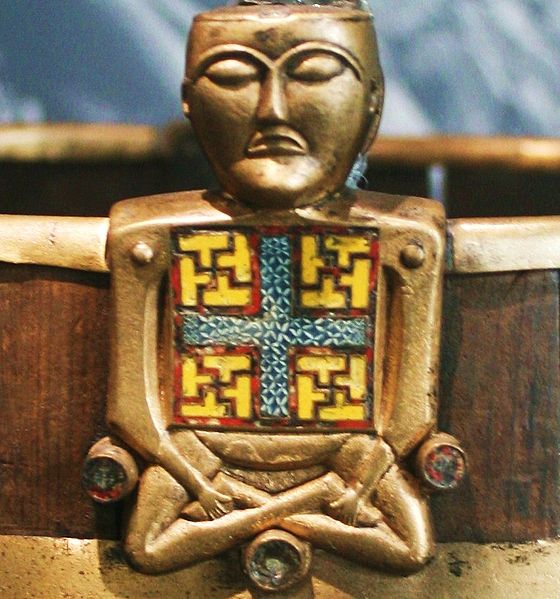
Oseberg Viking ship - Norway The Buddha from Oseberg also tells another story. For the Vikings to pick this little figure up it must at least have been traveling to the Middle East - maybe even much further!
Buddhism at that time was actually like later Christianity and contrary to Hinduism a preaching religion. The famous Buddhist Asoka’s lions tells us how Buddhism should be 'roared' out in all the four corners of the world:
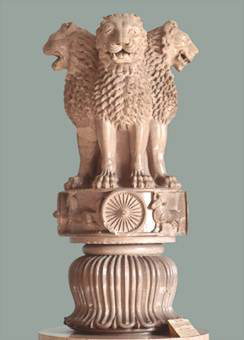
Ashoka's four lions - Museum in Sarnath
These Ashoka Lions were erected on 15 meter
tall pillars everywhere in Ashoka's vast Empire. The cross of Taxila as displayed on coins and beads showed in the simplest
design the Buddhist mission of Asoka’s Lions in symbolic form. Asoka the Great was the first to use Buddhism in his political agenda. The Buddhist ideology was used by the politically wise Asoka to unify and govern not only his Kingdom, but also to influence his neighbors by convincing them to peaceful coexistence.
Both coins and beads were designed to bring out the message of the Four Noble Truths and the Eightfold Path. These small messengers often went much further than the Buddhist missionaries. Some of them even ended up in Viking graves like the statue from Oseberg.
In this way the simple design of the cross tells us in the simplest possible way about the mission of Buddhism; that it should spread out in all the four directions and reach every corner of the world. What should go out? Of course the four noble truths and the eightfold path of the Buddha.
The back side of the bead displayed below gives a quite obvious illustration on how the Buddhist teaching was intended to spread. The four lions form a cross seen from above. It is easy to see the Buddhist missionary roar of these lions in symbolic form spreading like waves from the center:
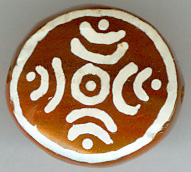
Back side The circle and the dot in the middle of the etched bead above is together with the balance and the symmetry of the design also hinting at the Buddha's Middle Way. This philosophy of the Middle Way went as far in time and space as influencing both Taoism to the east and the Philosophers of Enlightenment in the west in the 17th and 18th century.
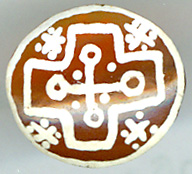
Front side
15 * 13 * 4,5 mm
Taxila, Pakistan around 200 BC Displayed above is a beautiful etched oval carnelian bead with the Buddhist Taxila cross. It would actually be hard to find a better pattern both being able to illustrate the Four Noble Truth and the Eightfold Path. It should now be clear that this bead, like most of the etched beads,
could be interpreted as a Buddhist Messenger. However it is only an intuitive theory backed up by logic thoughts. We cannot know for sure.
The reuse of the ancient Indus symbols
Asoka’s, and in a wider perspective the ancient Indian Buddhist culture's, re-use of the dotted cross could be seen as a political move to create political ties with the lower strata of society. These symbols were used by the tribal’s, particular the largest tribal community, the Bheels as they are today.
The Bheels in Gujarat still today manufacture stone beads the way they did it in the Indus Valley. The Bheels are most probably the original inhabitants of India, the original Indus valley people.
That also explains why the symbols on the etched beads and the symbols of coins, statues and architectural structures are so different. They have resemblance, but they are not identical. At the time of the Buddhist reign in India coins and architecture expressed the culture of the affluent. The etched beads, at that time so easy to manufacture was predominantly the religious amulets of the lower strata. Their world of signs and patterns were still rooted in their collective historical memory with its line back to the Indus Valley.
Here you can observe how the patterns of Indus Valley pottery and the patterns of the etched beads have similarity:
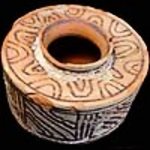
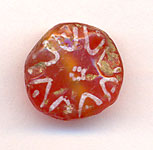 The hidden string between Buddhism and the Indus Valley culture
It is now time to make an attempt to string the whole bead story up.
India was quality wise at a stone bead producing peak in the late days of the Indus Valley era. The Indus Valley culture lived in India long after it had vanished in what now is Pakistan. Actually the newest scientific evidence suggests that the Indus Culture continued to exist in India even up to 1000 BC!
In the beginning of the Indus Valley culture it was most probably an upper class priviledge to wear beads. However as the improved technology made the bead production more and more easy, the bead culture slowly filtered down to the buttom of society. This is an archetypical movement. Art phenomenons all over the world at all times have demonstrated this tendency: First a centain art form expresses itself as an upper class phenomen, later it becomes popular in middle class and in the end it expresses itself in the lower strata of society.
So my point is here that at the time of Buddhism, the Indus Valleys bead- and artisan knowledge was still alive in the tribal Dravidian culture at the buttom society. The 600 years between the fall of the Indus culture and the rise of Buddhism is at that time really not a big time span. The historical waves of the ancient world were moving much slower than they do today.
The Buddhist culture did with its solid foundation in the lower strata of society actually continue the bead culture of the Indus valley! It did of not copy the Indus Valley culture, but it was rooted in the remains of the Indus culture's artisan traditions. And the production of stone beads is maybe the most visible sign of this survival and tranformation of cultural life from one culture to another.
That there should be a cultural stone bead life line between Buddhism and the Indus Valley culture is a present of course just a hypothesis. This theory needs a lot of evidential material to be validated, but almost all the stone bead lovers living in India I have talked to, have told me that this theory gives sense to a lot of data that otherwise have no meaning.
Let us sum up:
After the decay of the Indus Valley civilization the culture of using and manufacturing stone beads is transferred via the Tribal communities to the Buddhist culture.
The only people who missed out of the stone beads were the Brahmin- Hindus! In natural consequence of their nomad origin they were not familiar with a stone bead producing culture. Parallel to their arrival and settlement in India the original bead production in the country slowly started its journey down to the middle class and lower classes. At the time of Buddhism the habit of wearing stone beads was a common thing - from the middle class and downwards. Hence wearing stone beads never became attractive to the Brahmans.
And now its time to solve the horse bead mystery.
The horse was an unknown animal in the time of the Indus Valley culture.
Therefore there was of course no tradition for making horse beads.
The horse came to India with a heavy load. . a load of white skinned people who considered them selves superior to the darker ones.
And that is why there is no stone bead culture today in India.
burial This bead has the same cruciform patterns as the Pyu beads. You can find a lot of beads
along the trade routes of Buddhism with this pattern. As the simple sign language of the Buddha was able
to narrate the important event in the life of the Buddha over huge distances, to people with
different customs and languages, so the beads could tell the same story in a similar simple and
symbolic language and in this way unify the Buddhist cultures all along the enormous distances covered by
the trade routes. Buddhism was basically an urban religion sending the same humanistic message of
freedom, equality and brotherhood, so vital for the circulation of money and goods along the trade routes.
Without peace, without recognition of the Buddha in everyone, regardless of colour and culture, the
trade routes would collapse. (And they did collapse from around 500 AD in Northwest India and Afghanistan)
The philosophic and intellectual powerhouse of this Buddhism was situated in North
India. It went from Afghanistan/Pakistan with Taxila as its western frontier center for
higher Buddhist learning to Nalanda to the East in Bihar. These two places were the world’s first
Universities, Buddhist places of higher learning. Taxila became a fusion point where Greek kings after
Alexander’s unbelievable invasion had got converted into Buddhism by King Asoka and the later Buddhist
Kings in his line. Here at this place the Indian Ashokan Empire inspired and converted the Greeks into
Buddhism. In return the Greeks taught the Buddhist to reason, to use logic as a tool to deconstruct
the world into shoonyo, the empty void of Nirvana. The symbol of the cross was the famous, all over
the Buddhist Mauryan Empire. In the famous Buddhist folk tales, so abundant retold through generations even in
contemporary Burma, the Jataka tales, almost every second folk story has a comment
about the hero like this:
Then he went to study Buddhism in Taxila. When we on Pyu beads again and again find the cruciform pattern, this very cross
most probably indicates Buddhist learning.
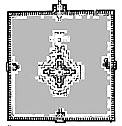
Cruciform stupa structure
of Somapura, Greater India
Litterature
Google, wikipedia,
Buddhism in North western India and eastern Afghanistan,
Sixt to Ninth Century AD - Giovanni Veradi
|