|
 |
|
|
|

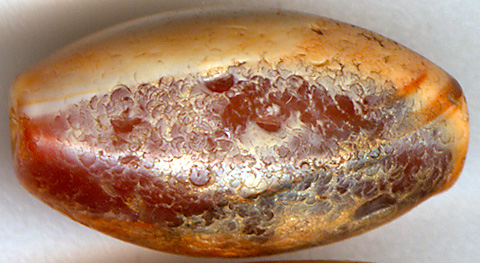
Bactrian Bead
|
BACTRIAN BEAD
Individuality in the Bactrian Melting Pot
The development of individuality and the invention of “my pain”
|
|
If we open early Buddhist texts looking
for the modern story of individual psychological trauma—the
autobiographical narrative of a wounded childhood—we won’t really find
it in the form we expect today. The experience of suffering is
everywhere, but the frame is different. The language is transpersonal:
craving and aversion, fear and grief, conditioning, attachment,
liberation. The “I” is not treated as a precious inner biography that
must be interpreted and healed, but as a construction to be understood,
softened, and ultimately seen through.
This difference is not a matter of emotional depth. It is a matter of
cultural optics. Some worlds train attention toward the collective weave
of life and the cosmic order; others train it toward the lone person
standing apart, arguing, choosing, becoming responsible for a unique
viewpoint. When a culture learns to say, with full weight, “I disagree,”
it also begins to say, “I am not you.”
|
And once the “I” gains gravity, a new kind
of pain appears: the pain of separation, the pain of being a self that
cannot fully merge back into belonging.
The Greeks were pivotal in shaping this Western sense of individuality.
Their passion for open dialogue, argument, classification, and secular
inquiry gradually displaced purely religious explanations with a
confidence in reason, observation, and persuasion. In a society that
prizes debate, authority shifts: it is not only divine command or
inherited hierarchy that rules, but the strength of a proposition and
the clarity of a mind. This creates horizontal relationships, and with
them, a vivid sense of distinct persons. A democracy is, among other
things, a factory for “I.”
And yet the birth of “I” is not a clean victory. It is also a wound.
Individuality is a threshold event in human consciousness: glorious,
costly, irreversible. |
|
|
|
|
|
|
|
|
|
|
|
|
|
|
|
|
|
|
|
|
|
|
|
|
|
|
|
|
|
|
|
|
|
|
|
|
|
|
|
|
|
|
|
The Development of
Trauma & Individuality
In ancient Buddhist texts, we will not find one
word about an individual with a traumatized childhood. The concept of individual human psychological pain
and the narratives in which this is expressed is
absent. The concept of individual human
psychological pain is noticeably absent in ancient
Eastern texts, including Buddhist scriptures. This may
stem from the fact that Eastern philosophical thought
has historically leaned towards a more collective or
societal view of identity, as opposed to the
individualistic perspective prevalent in Western
cultures.
The Greeks played a seminal role in the development of
the Western concept of individuality. Through their
rigorous philosophical inquiries, they invented the idea
of an independent human feeling entity. Their culture of
open dialogue, questioning, and classification led them
away from religious explanations towards a more secular,
logical, and scientific understanding of the world.
This shift was likely a consequence of the democratic
society they cultivated. In a democracy, individuals
engage in horizontal relationships, where it's not
divine authority but the strength of one's argument that
holds sway. This environment of open exchange and debate
naturally highlighted individuality in the diverse array
of viewpoints presented: "I" have a different opinion
than "you" - therefore, "I" am not "you".
This recognition of individuality, tied to the
development of logical reasoning and democracy, led to a
more secular and emotionally complex perspective on
life. It moved them away from the guidance and
protection of their Gods, who, in Greek mythology, were
often as unpredictable and capricious as humans
themselves.
This development highlights the critical role of
cultural context in shaping philosophical and
psychological perspectives, which then permeate every
aspect of how societies understand themselves and their
place in the world.
The impact of Alexander the Great
Alexander the
Great indeed left a significant mark on the
understanding of individuality and divine leadership.
His conception of the ruler as a divine figure is
well-documented and represents a departure from the
earlier Greek notion of rulership. The notion of
Alexander as an individual with divine attributes was
powerful and revolutionary, combining aspects of
personal narrative with divine status. His connections
with Bucephalus, his trusted steed, and his close friend
Hephaestion, are instances of this, adding a human
dimension to the divine king.
In contrast, Indian spiritual traditions at the time, as
represented in the Upanishads, emphasized a different
understanding of divinity. The
Upanishads,
ancient texts that form the basis of much of Hindu
philosophy, focus on the concept of Brahman, the
ultimate reality or supreme cosmic power in the
universe, and Atman, the soul or self within each
individual. According to these texts, the ultimate goal
of life is to realize the unity of Atman with Brahman.
This spiritual journey is a deeply personal and
introspective one, focusing on the individual's inner
spiritual development rather than external
accomplishments or status.
When Alexander and his Macedonian forces arrived in
India, they brought with them their own concepts of
divine rulership and individuality. These were quite
alien to the existing Indian philosophies. This meeting
of cultures led to an interesting interplay and exchange
of ideas, leaving a lasting legacy on both societies.
However, the stark differences in spiritual
understanding would have presented significant
challenges to mutual comprehension.
While Alexander's model of divine individuality was
highly influential in the Hellenistic world and beyond,
it did not fully assimilate into the Indian culture
which was more focused on inner spiritual development
and less on deifying individuals, especially rulers.
This example serves to illustrate the fascinating
diversity and complexity of human culture and
spirituality.
The hybrid empire of Seleucus Nicator
The
Seleucid
Empire , which
was established after the death of Alexander the Great
by his general
Seleucus Nicator,
is indeed an interesting and under-studied chapter of
Western and Eastern civilization. This empire, with its
capital in Babylon, stretched across an enormous area,
from modern-day Turkey to
the doorsteps of
Chandragupta Mauryas India
This vast empire was a melting pot of cultures,
languages, religions, and philosophies. One of its key
legacies was the blending of Greek and Eastern culture,
a process known as Hellenization. This had a profound
impact on everything from art, architecture, and
literature to philosophy, religion, and science.
The Seleucid Empire was succeeded by the
Greco-Bactrian Kingdom,
which had been a part of the Seleucid Empire but became
independent following the political turmoil in the
mid-3rd century BCE. The Greco-Bactrians continued to
uphold Hellenistic culture in the East and further
interacted with Indian culture when they expanded into
the Indian subcontinent, establishing what is known as
the Indo-Greek Kingdom.
The meeting of Greek and Indian cultures under these
Hellenistic kingdoms resulted in a rich synthesis of
art, philosophy, and religion. This fusion can be seen
in the development of Gandharan art, a style
characterized by a blend of Greek, Persian, and Indian
elements.
The Greco-Bactrian and
Indo-Greek kingdoms have left an indelible imprint
on the history of cultural exchange. They show how the
interaction of different cultures can lead to innovation
and creativity in various fields. While these kingdoms
have not received the same attention as other historical
empires, their significance in the history of East-West
cultural exchange is undeniable.
At that time East
Afghanistan was very fertile. It was full of rivers and
green meadows. Climate changes beginning a few hundred
years before the Muslim invasions transformed the
country into the barren regions we see there today.
However, in the day of the Seleucid Greek-Macedonian
rulers, it was one of the richest areas in the world. A
combination of silk route wealth, mineral mining and
fertile land was the foundation upon which a hybrid
melting pot of social construction could take place that
would bring human civilization to a peak. This openness
towards foreign cultures was a deliberate policy of
Alexander. However, the only General that did not
divorce from the foreign princess that Alexander had
forced his general to marry was Seleucus Nicator. He was
the only post-Alexander King to continue the policy of
cultural openness and exchange. Hence the Seleucid
Empire, especially towards the east became the ideal
place for ideas of east and west to meet. They met on a
platform of free Greek dialogue and fructified into new
forms of life. Since the days of Alexander the area had
been flooded with Greek philosophers, artisans and
people in general with entirely different outlooks on
life than the area they were now were living in. This
influx of popuation, especially from Macedonia continued
for several hundred years. Population rise had stained
resources in both Greece and Macedonia. The new settlers
did not colonize their new lands by spreading over vast
territories. Instead they in accordance with the
traditional Greek business oriented culture created
replica cities, not entirely in the old fashioned Greek
style, but also fashioned as political and military
powerhouses, first named, from Kandahar in Afghanistan
to Alexandria in Egypt after Alexander, later named
after Seleucus or his Wife Apama. The Greek way of life
was the
polis
life. The city was the state and the state was the city
and especially Seleucos Nicator was using the foundation
of new cities as a mean to get political control over
his vast Empire. These new cities became concentrated
copy forms of Greek-Macedonian customs and culture and
they strung themselves together in communication and
business the whole way from the Hindu Kush to Syria and
Greece via the many caravan routes. Here, far far away
from their motherlands, the new settlers made copies of
Greek cities with Greek houses and temples, but also
temples where caravan people with other religions from
far away regions openly could worship their own gods. We
must imagine a multicultural polis-life where Greek was
the administrative language, but where the surrounding
farmland area did not know much about Zeus.
|

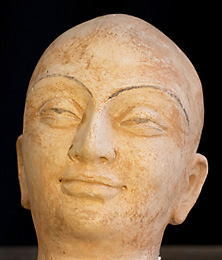
Greek stucco of a
Buddhist monk
in individualized bliss
Greco-Bactria 100 B.C.
|

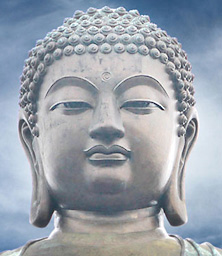
Typical Buddhist
iconography
Buddha in transpersonal bliss
Japan 1100 A.D.
|
The exceptional piece of stucco art you can see above to the left was created in such an
environment. It depicts an Indian Buddhist monk with an
Archaic Greek smile entirely different from the
transpersonal smile you see on the face of the Buddha to
the right. This stucco head was created in
Bactria
around 2000 years ago. With a little art historical
knowledge, one can here observe a unique expression of
human individuality, which rivals the best
pieces from the 1500 years later Italian Renaissance
period.
The Greco-Bactrians never really got friends with the
Hindu culture:
The Brahmans are always too proud to
borrow their science from the Greeks, Arabs
or any nation of the Mlechchas as they call those who
are ignorant of the Vedas.
Sir William Jones
However, The Greeks and the Indian
Buddhist seemed to go well together. This friendship
began with Seleucus Nicators peace alliance and later
friendship with Chandragupta Maurya. Mauryan Jain and
later Buddhist India was
an open urban trading culture like the Greek, very
unlike the feudal and exclusive Hindu societies.
Many of the Greeks in the later Seleucid
Empire got converted to Buddhism
by Mauryan Ashoka the Great,
The stucco head above left is a child born out of this
extraordinary meeting. The post-democratic area in Greece
was not surprising followed by a decline in the quality
of their art. In Bactria, the environment for creativity
and art at the same time seemed to peak. Both the
Bactrian coin making and the making of stucco art
surpassed in quality and creativity their
Greek/Macedonian motherland and reached a level in art
making that according to my view rivals that of the
Renaissance. My guess is that the Mauryan Buddhism
softened the otherwise war-oriented and
Alexander-authoritarian Indo-Greeks, at least so that
the Greek and Indian elites had sufficient free and open
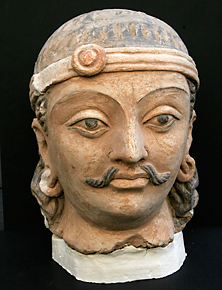
space to inter-create art and ideas. Below you will see
a Bactrian stucco head of an Indian King, most probably
King Ashoka himself.
|

|
You might now ask...
What has all this to do with scarred ancient beads?
Please give me a few more lines to string all these different
worlds together. I must admit that the bead I am putting
on the string here is almost too heavy, but I guess many
lovers of ancient beads also are lovers of history and
psychology, so I dare to use this site as a forum for lofty visions.
To create a concept and a society of individuals
requires an extraordinary amount of economic energy.
Today we in the West all more or less have the
subjective feeling of being out-standing. Only when a
society reaches a point of no return in affluent
production capacity, it can afford to construct the
notion of "I" in each individual. Before only
Chieftains
and Kings had been bestowed with the power of "I". In
the Greek Macedonian culture, the birth of 'I' of course
did not happen for all. It was still a slave and servant
culture and even more so in the eastern colonies, but
maybe 20% of the elite population had the necessary
material and psychological surplus combined with
horizontal lines of communication for
individualization to take place.
However, nothing new comes without a price. Let me in
this context quote,
Whitehead:
It is the business of the future to be
dangerous.
The major advances in civilization are processes that
all but wreck the societies in which they occur.
The creation of the
Individual in societies with an accelerating surplus was
a major advance that at the same time broke up our sense
of unity and belonging. To be an individual is great but
is
at the same time to live
in the pain of being separated from other individuals.
Let me here quote
Meister Eckhart:
All creatures
contain one reflection:
one, that is the denial of its being the other;
the highest of the angels denies he is the lowest.
God is the denial of denials
You don't need to be religious or do any
meditation practice to follow this line of logic. To
understand Eckhart's God as a metaphor for the always
unknown sum total of existence, the whole, is
enough.
The denial is the root cause of the psychological
pain of the modern individual. To be out-standing is to
be alienated. We all in a way get traumatized in the
process of being "I". To be bestowed with the power of I
is at the same time a curse. To bring this
dialectic challenge to a new and higher level of harmony,
we have to heal the scars created by separation. Let us
for a moment return to silent contemplation by watching
the face of this Bactrian construction of a Buddhist monk:
|
 |
An individual representation of the Universal
I dare to say that this monk smiles
because he has solved the riddle of being introverted alone,
all.one and extroverted at the same time. He carries
this knowledge as a secret in his sensual
asymmetric, yet Greek
archaic smile. His serene blissful but fragile face is the
face of an individual in spite of the oceanic transhuman
feelings it transmits. He is, at least in my field of
perceptive projections, full of human essence, an
essence ignited as the spark of celestial light coming
from beyond his human nature, or maybe more correct, a
transcendent glow of presence in a highly humanized form.
The monk is both universal in the eastern sense and
individual in a western way. He
and therefore the culture that created him seems to have
solved the riddle of being a separate I, yet
still in harmony and unity with the whole. I dare to
conclude so radically on the foundation of this single
stucco head out of one simple reason: Either a culture
can make such a socio-spiritual construction or they can
not. You have to make a historical scroll more than 1500
years to the Renaissance to see a Mona Lisa smile like
this monk, and yet her smile is far from being oceanic.
Here in my view, a unique Greek understanding of Buddhism
constructed a counterweight to the Shonyo, the
emptiness of the East, striking a delicate balance, a fragile synthesis between
being an Individual and being a part of Gods denial of
denials. I dare to say that this monk's face holds the key
to this understanding - of course only for exalted souls
that already are the truth they observe in front of
them. I am deeply reminded by C.G. Jung's
controversial book,
Answer to Job, where he states that God wants to
be a Human being more than vice versa. I am also
reminded of the statement that leads to the judgment of
Meister Eckhart by the Inquisition. This statement was:
What is true about Jesus is true about every good
human being.
Can we take up the heritage from the Greco-Bactrians?
Now the question is. How to reach or regain that
delicate balance
between the individual drop and the transpersonal ocean, where the little drop of
soul captured in the "I" is not merging with the ocean,
because it realizes that the ocean already is within
the drop.
As far as I can see with 40 years as a meditation
practitioner, we in the west are still fumbling in the
darks as compared to the Indo-Greek monk above. In our
blind copying of eastern meditation philosophy, we are in
danger of bypassing our human nature. Instead of
cultivating a transpersonal consciousness within the
frames of individuality and humanness we are in danger
of getting de-personalized in our spiritual quest.
Modern man cannot reach this fragile point of synthesis
between I and All by blindly
following and copying the Eastern Buddhist traditions.
Like we in the west don't have a clue about how to
cultivate pure consciousness, the Eastern traditions
don't have a clue about what it means to be an individual.
Of course there in the east is the notion of Ego, but in my perspective,
this ego is just a separation of unity as a consequence of
mere biological survival. To be individualized as a
human I is so much more profound and delicate.
This is the basic challenge of Buddhist traditions
practiced in the west. They are in danger of bypassing
the existential pain of being an individual
by de-personalisation. If we blindly use the eastern
spiritual mind software we are at risk of reducing the
notion of human individuality to the concept of ego. This is too
primitive and reductionistic. It simply does not function
every time you have a problem with your girlfriend or
your loved ones to say to yourself: The root cause
of my pain is desire. Let me seek refuge in
Nirvana.
The tide is turning. At the time of the Buddha, it was a
good survival strategy to avoid suffering by ignoring
the human side of ourselves and to strive for impersonal
existence as a Nirvanic Zero.
The difference between survival ego and human
individuality
Most probably the Evolution of Individuality at the time
of the Buddha yet was so insignificant, that there
hardly was any distinction possible between ego and
humanness and this so even more in the east.
However, we are now finally able to take up the
outstanding and overlooked heritage from the Buddhist
Bactrian Greeks. They were able to take advantage of
their unique geographical position and make a synthesis
of the best from the east and the west. The
Greco-Bactrian Kingdom had as an extreme eastern
frontier of western mindset the exact and only
geographic location for this hybrid to happen. Today we
are luckier. Any kind of
socio-religious synthesis is now possible
everywhere due to cheap airfare and the sharing of
information on the location-less location called the
internet, which makes it possible for mindsets once
divided by distance to meet and fructify into new
spiritual software newer seen before.
Why the Greco-Bactrians?
Why taking in something so odd as the Greco-Bactrian culture and expressions of art in this
discourse? It seems the Greco-Bactrians were able to facilitate a
socio-spiritual
construction making it possible for a human to be a
sacred individual representation of the Universal truth.
To take up and further 'evolutionize' this human
spiritual construct we have to follow an entirely new
path, inspired by the Buddha's teachings, but as well
inspired by the most outstanding personalities from our
western world.
Now I would like to return to C.G. Jung:

Carl Gustav Jung was a
visionary. He advocates as you can observe in the above
quotation, to embrace pain instead of running away from
it in order to
Individuate. It is very simple. If you
want to be an individual you cannot avoid pain.
If we as modern individualists wants to smile the smile
of the Indo-Greek monk above, to see the ocean within
our tiny droplet-soul, we have to face our scars first of all.
However, meditation or not. The point is that in order
to reach the higher synthesis level of being both
alone, all.one and yet an I in
dialogue with a you, there are no short cuts
leaving our human existence behind. I have seen too many
individuals bypassing their personal life in an attempt
to 'Buddhafy' their existence. One way or the other
- we have to deal with what Jung calls legitimate
suffering:
The foundation of all mental illness is
the unwillingness to experience legitimate suffering.
To face pain as a cure for pain
I can from a personal life long Meditative experience
state that it is possible to realize that the tiny
starlight of human existence contains the holographic
information of the cosmos. This Meditation was never
in a rush to find the shortest route to Nirvana. Instead,
it focused on facing the pain inside the body, not
spinning it into a narrative of thoughts but 'pixellating' it into pure psychic
energy beyond notions of good or bad and pain and
pleasure. You have to face your pain as a cure for pain.
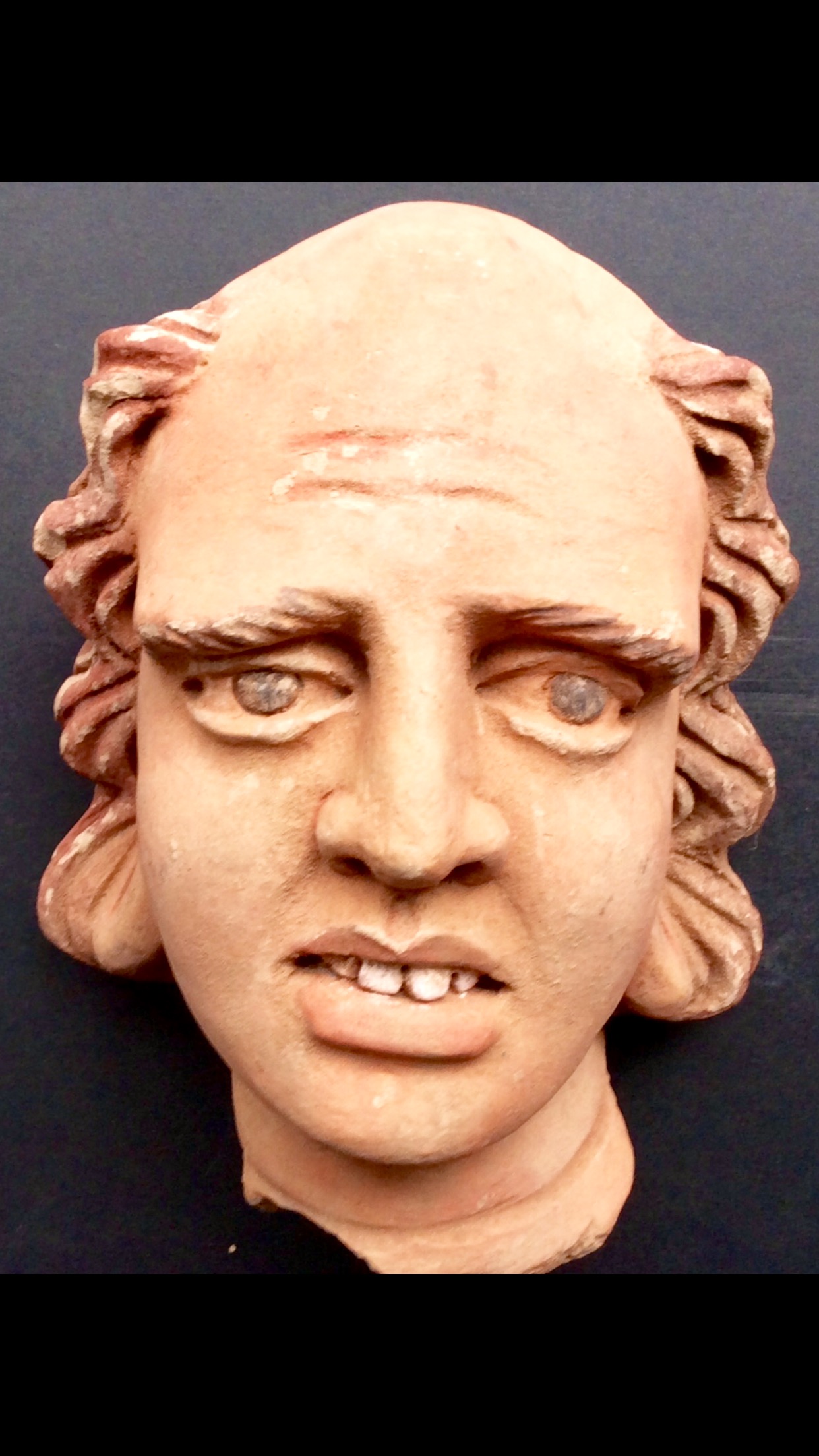
However, you might not see much pain in the stucco
head of the blissful monk. Let me, therefore, show you
another stucco head from the same place, period and culture.
Note the elongated earlobes indicating that the peculiar expression of suffering in this
imperfect asymmetric face is noble and
sanctifying. This face is sublime because of
its lack of beauty.
|
 |
Sources
Seleukos Nikator, Constructing a Hellenistic Kingdom
- John D. Grainger
The Greek Kingdoms of Central Asia - P. Bernard
Mes Aynak - An Ancient City at the meeting point of
civilizations - Tibor Paluch
Buddhism in North-western India and Eastern Afghanistan,
Sixth to Ninth Century AD - Giovanni Veradi
Hellenism in ancient India - Bannerjee, Gauranga
Nath
The Art and Architecture of
India - 1996. B.
Rowland
The Buddha Statue - Leonhard Adam - 1925
Buddha in Indien - Kunsthistorisches Museum in
Wien - 1995
Alexander the Great - Robin Lane Fox
A History of Christianity - Diarmaid Mc Culloch
The Story of Civilization (II til V) - Will
Durant
Works of C. G. Jung
Wikipedia.com
|

|
SOME THOUGHTS ON THE POWER OF DZI
In this little essay I will take the
opposite stand and praise the perfect bead. I
deliberately do this to sabotage my own tendency to make
a religion out of a thought produced insight. yes, we
use narratives, but we are so much greater than them. So
it is better ultimately to play with narrative in a meta
narrative that does not believe in narratives. |
|
|
|

Click on picture for larger image
|
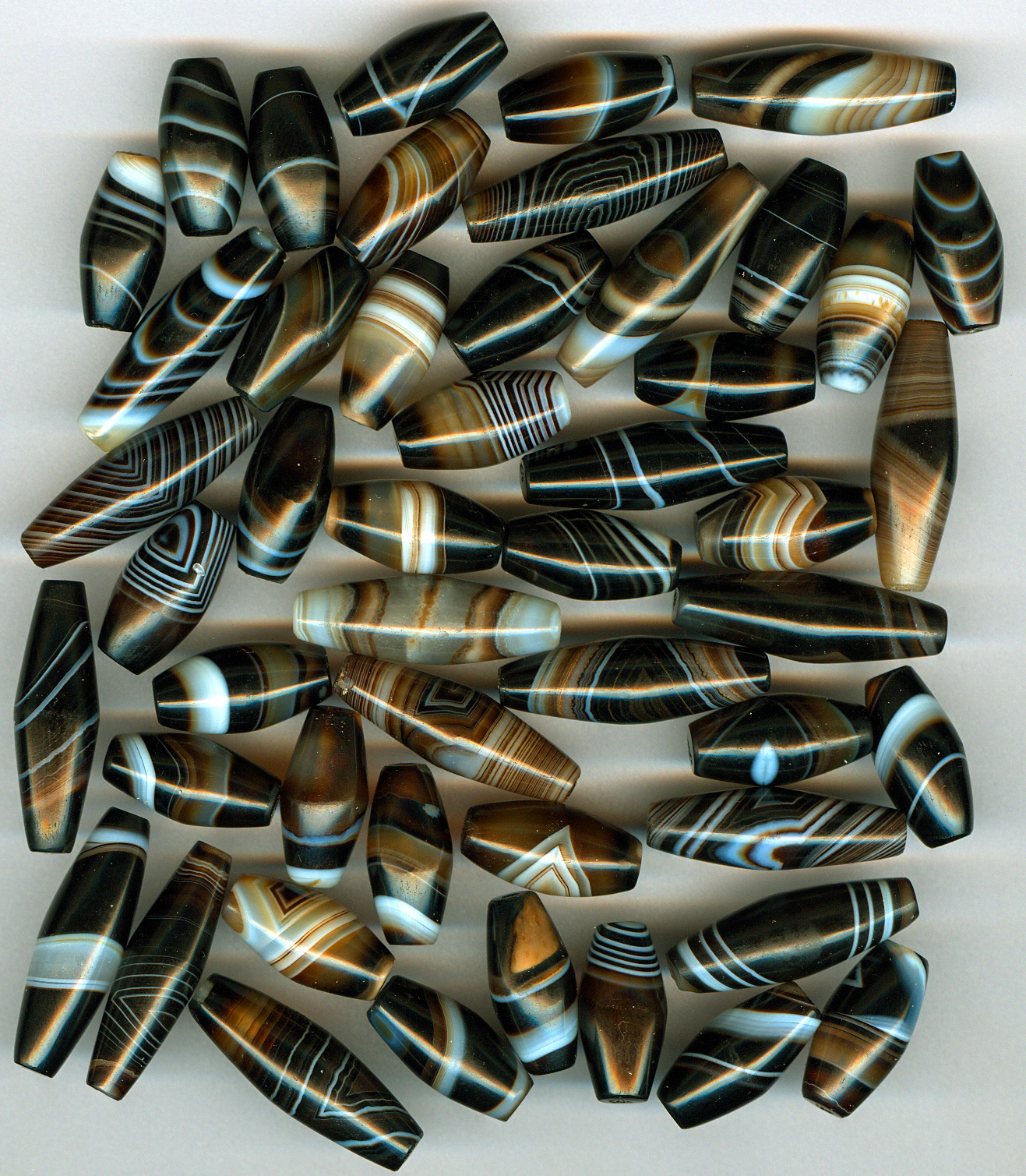
New or not? Take a look on the wonderful Burmese Beads displayed above. If one looks at the line of light the aged patina produces across these beads, it has exactly the right softness of shine and is uniform across all the beads. This soft patina is impossible to reproduce in modern faking. A new bead has after polishing a hard shine. When fakers try to hide this hard shine, they often tend to make the surface of the bead look 'dusty'.
Faked beads often come in a lot and they all look alike. Here all the beads are different in shape, making, and patterns. If one observes the beads under a magnifying glass, all the small marks where the beads were sanded with extremely fine emery paper or something similar are still visible. Kevin Ball, a friend of mine and a bead expert is of the opinion that these beads are new. He states:
If they had been buried for thousands of years, I don't think the marks would be as clearly defined if visible at all, as natural acids present in the soil slowly etch the beads over millennia, and marks that fine would long have disappeared. I went back to the bead people in Myanmar with this valuable information from Kevin. The bead diggers then told me that these beads were found in PH-neutral, sandy ground, and that is the reason for their seemingly new surface.
Burial beads in neutral chemical environment
The chemical composition of the earth also changes the air
surrounding the beads. If the air and earth is neutral it can be
very difficult to distinguish between burial beads and new beads. The bead sellers offered me to take the beads back, but summing up all the evidence I so far had got, I chose to keep the beads. On my next trip, I encountered a lot of fake beads made by contemporary Burmese bead makers, and they were all of altogether a lower quality seen from the level of craftsmanship.
As passionate bead collectors, we will often come across beads where there is doubt concerning their age. 90% of the ancient beads we encounter, we can see within a split second if the beads are ancient or not. In the case of the remaining 10%, there will always be a doubt. We have to live with that doubt. In the case of the beads displayed above I chose to believe in the beads, but I can not be sure.
Furthermore fake new beads tend to be mass produced in larger
quantity and over flood the hungry bead market from all corners.
This has not been the case here. I have not come across beads like
the unique beauties anywhere else. If you dear reader have done so,
please give me a note.
The price matters Additional we always have to consider the cost price of the beads. If the price is low, it is a good indication of the absence of fraud. No one would bother to work hard to produce an extraordinary beautiful fake ancient bead and then sell it for
3 USD.
|
|
|
|

|
|
Alone seen from the level of artistic skill, it would be
quite costly to produce the wonderful beads displayed
above today. To select out of tons of raw material the
right piece of agate and then call out the particular artistic and/or divine patterns would be a challenging job for a contemporary bead maker.
Only a few people today master the art of 'invoking the divine patterns' out of
the stone chosen to become a bead.
Generally, fake beads are made in a lot where they all look mass produced and identical.
To make a high quality ancient fake bead is a rather costly affair.
The insane prices for DZI beads and to a lesser extent etched beads have
done the trade and collection of this type of beads vulnerable to high-tech copy production, especially from Taiwan.
The exquisite fakes are made only for these types of beads and primarily in the price range of 20.000 USD and above.
However, it is still impossible to make a perfect fake DZI-bead that can elude a real Tibetan DZI-dealer or a professional western collector. (Maybe one day the cheaters will succeed, and that will be the day when DZI-bead
owners will lose billions of dollars.) To produce a
contemporary bead with the right excavation patina is
even more challenging.
When the fake-makers produce DZI-beads,
they try to copy the patina of wear and tear made by
generations of use. They do not bother about making
'new' excavation beads. I dare here to say that it is
harder to recreate excavation patina than to simulate patina from wear and tear. Furthermore, potential new collectors and buyers with lesser experience will look at the beads displayed above and think that they are new. They will tend to prefer the old dusty and worn out look of the fake bead.
There will be more excavation beads in the future
My guess is that the global community of bead collectors
will encounter more and more of newly excavated beads in
the future. The number of passionate bead collectors is
increasing worldwide, and the number of beads that have been in permanent circulation and hence have marks and patina made from constant use is more or less constant. When the increasing demand for ancient beads drives up prices, it becomes more and more interesting for unauthorized diggers to excavate ancient sites to look for beads. Here they will find a lot of beads who were never used, but rather stored away as treasures or just kept in the home as animistic protections against evil eyes and bad spirits.
Whether this new kind of digging is either a good or a bad development, I leave to people who think that this world can be understood, captured and controlled with strong unison opinions.
Beads are the perfect dialogue partners for having philosophic thoughts. It is amazing to watch how the biggest and most self-blind egos often can hide in the smallest of bead holes. I could in this context easily mention some names in the global bead community. However, I will start with myself. When I look into a bead hole, I peep into my own nature. |
|
|
|
|
|
To know that one does not know is essential in life and in Bead collecting too.
Bead greed That is why I can say about myself that I can only truly SEE a new bead arrival in my collection after a time span of minimum 6 months. Before that time my evaluation is colored by the excitement of the hunt and even greed. I WANT to believe that this new trophy is a genuine ancient catch. After half a year it becomes evident that is was NOT an ancient treasure, but the patina of 'Maya'.
So, let’s return to the newly excavated 'new-ancient' beads we are going to encounter in the future from all kind of shady sources. Is it bad? Is it good?
There are many
examples where former colonial countries have been
collecting old or ancient artifacts outside their borders, especially in third world countries.
Was it bad or was it good?
Bad things can pave the way for good things to happen Had we not in the nineteen century done this 'looting', many ancient artifacts would have been lost today.
When Denmark 'stole' the ancient saga scriptures from Iceland, they saved these scriptures from annihilation. Some of the sagas written on leather were at that time transformed into boots by the local population. They did not at all appreciate their own cultural heritage.
The Acropolis in Athens is deteriorating due to air pollution. Only the statues and frescos that were 'looted' from there are spared from this sad destiny.
In Afghanistan, even
at this moment, the Taliban is actively destroying the country’s abundant Grecco- Buddhist art heritage. If they come across a Buddha statue so far hidden in the sand, they will repeat the story from Bamiyan.
I recently went to the National Museum in Rangoon in Burma. All rooms in the museum were covered in darkness. There were no light bulbs to display the sad fact that there was nothing there worth looking at, at least not compared to the living pagodas of the country. At least they shine full of light, gold and devotion and have continuously done so since ancient times.
Private versus public collections Around 90% of the world’s ancient art is on the hand of private collectors.
Only 10% of the world’s ancient artifacts are displayed in museums. Many of these museums, especially in third world countries, are not capable of taking proper care of these precious
objects. They are far better off in the hands of private collectors.
The possibility of having private collections of old and ancient art is also an important factor in the cultivation of the interest in global history. Collectors go to museums. They write books about their interest. They read history books. They make websites with a lot of information. In this way, they generate a field of historic awareness that resonates into the media and internet world too. They make ancient art valuable and history an interesting subject for even the lower middle class. Furthermore, due to the hype it makes when enormous sums of money are offered for ancient art, a ring of preservation and protection is created around it.
One could argue that all collecting of ancient art should be open and legal, so that scientists, archeologists, public and private institutions and museums could collaborate with private collectors in gathering maximum information about our global world heritage past. The archeologists tend to view their subject as a 'private-public' affair, not for the common man to participate in. However, these people cannot exist without a general public interest in ancient history and their work as such. If people collect antiques, they create awareness, also political. They influence governments to fund more money to museums and historical and archeological institutions.
In my case, I am only talking about old beads. Nobody seems to bother about these small insignificant stones...
Good things pave the road for bad things to come and vice versa. On these roads of silk and robbery, beads have always traveled, even if they had a stopover for a thousand years one meter below the molded surface of the obvious, politically correct and fixed opinions.
So here is 'my opinion', written on a fleeting globe as my desk: Beads were meant to travel... from generation to generation as visual ambassadors, as a relay handed over from generation to generation, reminding us of something we have in common since the days we lived in caves: When we look at an ancient crafted stone bead, we, here in the oldest human art form, can recognize beauty!
That is why I have made
www.ancientbead.com
My joy of collecting made me interested in ancient history, and my website make others interested too. I guess it worked the same way for Kevin Ball too. This is our way to walk the talk.
Actually, we don't own these beads. We are their custodians in the sense that they will outlive us by far. We will disappear, and they will travel on. Yes, beads are great travelers!
Let me here give a good tip to the western collector. At the same time, it can serve as a warning to the eastern collector: 'Board the train before it is too late once again!'
Collecting mainstream beads or beads of beauty It is still possible to purchase ancient unetched beads of unheard esthetic beauty in Asia and the east for reasonable prices. The rising third world middle class collectors have yet not cultivated an eye that makes them able to recognize the refined artistic skills of their ancestors. The nouveau riche middle-class man of the
East will, with a little over generalization, go for the etched bead, the black bead and the big bead, no matter how it looks seen from an artistic point of view.
Furthermore, this new type of first-generation middle-class collector is parroting the trend of Tibetan Buddhist traditions, but without the deeper knowledge, these traditions incorporate.
Let me here make a related comment. Most bead collectors are as mentioned, primarily collecting etched beads. However, in my view, the making of etched beads marked a fall from the peak of artistic bead production.
As evidence for this 'opinion' or fleeting viewpoint, I refer to the late Indus beads on ancientbead.com
Most etched beads, thank god not all, are NOT as beautiful as the older ones without etching. The etching was substituting the original bead maker’s hunt for the right stone so he here with the right technique could bring forth the original, almost
Platonistic idea so far hidden in the stone. When etching became the main trend, the bead maker could take almost every 'Tom, Harry and Dick stone' and make the desired patterns with a little etching. They did not any longer have to search through literally tons of stone to find the right piece.
This etching trend of
not manifesting the inner stone beauty, but cultivating
it by superimposing 'divine meaning' on the stone only
managed to reach an acceptable artistic level in the Tibetan DZI- and the Burmese Pyu-beads.
Most of the ancient Indian made etched beads are not made with loving care.
Still, they are interesting seen from a historical point of view.
They point at a growing, most probably Buddhist, middle class and lower class demand for mass-produced stone beads with divine protective powers. Bead etching became mainstream hand in hand with King Asoka’s successful transformation of India into a Buddhist empire. In the late Indus and early classical Indian time, skillfully crafted beads without etching were still dominant as jewels for the few.
That is why I elsewhere on Ancientbead.com advocate for the hypothesis that the stone bead culture is linked particular to the Buddhist culture and its predecessor, the Indus culture. Stone beads are not an integral part of the Arian Hindu culture.
Because of the craze for etched beads I have chosen another strategy for the last ten years: Hunting the beauty no one seemed to see in their crave for main stream tokens of social convergence and accept.
The above-mentioned trend has polarized beads into two distinct groups. We have got a group of uniform and easily identifyable beads that have reached insanely high prices in opposition to all the huge variety of beads outside this small banded category. The Tibetans have had the honor of defining these two categories. What does not fit into the Tibetan sphere of interest has remained relatively cheap. Today you can get a beautiful non-etched ancient bead for the lower or same price as a low quality etched bead.
Beads as money - big money!
The reason for this division is also that beads have again become what they already were in ancient time: money... Big money! Some types of beads have increased their value by a hundredfold within the last ten years!!
In the modern trend of beads again becoming money, it is confusing with too many types of currency. Hence a huge variation of beads is left in the dark and only a small bandwidth of beads are defined and within some circles almost accepted as equal to hard cash currency.
The Tibetan culture is the only
continuously living bead culture One of the
reasons for that the Tibetans got the honor of defining
what is a valuable stone bead or not, is that they are
the living custodians of the world’s only continuous living stone bead culture.
Another reason is that the same Tibetans got their country robbed away by the Chinese.
If the Chinese had read global history, they would maybe have noted a curious tendency repeating itself all over in all places in history. They may have been more cautious in their handling with Tibet and Tibetan culture. It is the old tale of the conquers getting conquered by the culture they conquer.
This happened for the victorious Normans in Sicily. It happened for the moguls, especially under the glorious reign of Akbar.
The Kushans It happened for the Kushans, once called the Yuezhi people from China when they entered into what is now Pakistan and Afghanistan and defeated the Grecco-Buddhist kings who were the rulers at that time. And what happened to the Kushan people? They converted to Buddhism and became the greatest mass producers of Buddhist artifacts ever. The ancient art called 'Gandhara' is made by the Kushan's!
So when you conquer someone... take care that you might not be defeated your self! In world history, only the stiff English upper lip was too resistant to get under the sway of Indian gurus or any other foreign culture they occupied.
Now, what is happening with the old Tibetan Buddhist culture of compassion?
At the time being it has like a virus been laying dormant waiting for its chance to infect the stone bead hard Chinese bureaucrat hart with love and compassion. However, this hart is nowadays only in tune with greed. So compassion has taken the form of stone to attract this stone heart in the form of some small beads.
The power of DZI Therefore this new kind of old DZI-money is particular in demand in China where corruption among the leaders of the
Communist party has become an increasingly risky task.
You cannot any longer present your local party leader with a gift in the form of a suitcase with one million dollars inside. This kind of bribe is far too obvious and hence dangerous. If you want green political light today for your Chinese project, you discretely hand over a little piece of stone. You give the party boss an ancient DZI-bead.
It is a truly beautiful example of the irony and humor of history: The ultimate spiritual and vibrational token of Tibetan Buddhism arrives as a virus in the very heart core of the rotten Chinese corruption apparatus. These so-called socialist and atheist
'corruptocrats' make an animistic dance of greed around the golden calf, a new dance, but as old and empty as the hole in a DZI-bead.
Again, lets us have a peep into this small bead hole. This time we can see the most fantastic mega-ego in the form of greed. DZI-beads have become D.ZI.RE-beads. Hence they absorb the evil spirits of the corruptocratic animal nature into their 'shoonyo' and thus pave the way for a new ancient China.
Here comes my second prediction in this essay. China will again rise to what it once was: A glorious and highly cultivated Buddhist civilization under the guidance of the spiritual masters of Tibet.
Yes... Dzi are secret Tibetan
'nano' weapons with a mission impossible: to transform greed and power into love and kindness.
Seen in this light nobody can deny the spiritual powers of the DZI.
Just ask Madonna who has recently followed the Chinese party line and have become an ardent collector and devotee of DZI. Maybe the small black DZI-holes can even swallow up the megalomaniac stars of Hollywood!
By the way .... Bead
money has modern advantages. This will be my second
advice to bead collectors, but only to the people living
in the matrix of Beverly Hills. Beads are, as beads
always have been, great travelers. They also like to
fly. As I have mentioned earlier, no one seems to bother about small insignificant stones ... also not governments...
I know persons who have traveled all over the world with an innocent chain of stone beads... so at least it must have looked in the eyes of the customs officers. However, the necklace was made of ancient DZI beads. In this way, you can easily have 10 million dollars hanging around your neck. Imagine that you transfer the same amount of money in your hand luggage through the airport security and no one stops you to ask questions.
You do not need to be a rich DZI-hunter to get beauty
Here at the end of this stream of words in consciousness I feel obliged to tie up all the loose ends in this essay about almost everything. Hence I go back the beginning where I was talking about excavation beads. Collecting and hunting for DZI
and etched beads is a sport only for the filthy rich. Seen from the angle of income, I am a solid representative of the world’s middle class. My third and last advice is: Middle-class collectors and lovers of beads. Widen your search to all kind of beads, glass beads, terracotta beads, odd beads and especially excavation beads... Look for any bead that has not (yet) become a part of the pyramid money game.
SOME FINAL THOUGHTS ON ANCIENT BEADS AND THE MAINLAND
CHINESE
Let it not be a secret. I had the chance on several
occasions to observe the Chinese newly rich culture in
its one dimensional bead greed. I did not at all like
what I saw. The worst Western prejudices about Chinese
stereotypes seemed to fit here: Robot people on the hunt
for wealth.
However, the last time I met with the mainland Chinese
bead people, I had to make a 180 degree turn!
There is an old English saying: It takes three
generations to make a gentleman.
After meeting the new generation of bead people from
China I must to my own big surprise admit that the
majority of them were gentlemen and women!
It seems that the cultural evolution in mainland China
is accelerating at such a pace that some of the Chinese
I met in many ways seemed to have overtaken us in the
West on most of the parameters that makes us truly
human.
In a rapidly changing world, where the leader of the
West has changed color from black to redneck, it gives
me hope to see that mainland China, as a candidate for
being the next world leading country, is a able to
'produce' such kind people as the one I met recently.
Is it so that truth always wins?
Satyam - Shivam - Sundaram
|

|
|
|
|
|
|
|
|