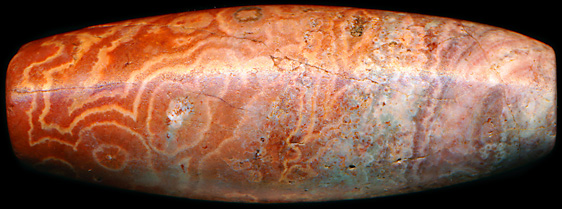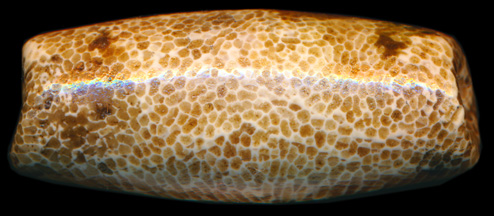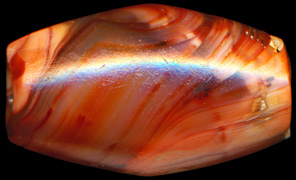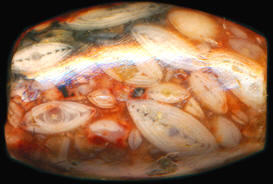
 |
 |
|
|
|
|
|
ANCIENT FOSSIL BEADS
Beads Made from
Fossil-Rich Stone Materials
This remarkable group of ancient beads, meticulously
shaped from fossiliferous stone, represents one of the earliest
known traditions of bead-making in South Asia. Most originate
from protohistoric
cultures in Balochistan - such as Mehrgarh, Nal, and Kulli;
dating back as far as 6,000–4,000 BCE, well before the rise of
the urban Indus Valley Civilization. These early societies
demonstrated a sophisticated appreciation for unusual and
visually complex materials, long before industrial lapidary
techniques emerged in places like Gujarat.
Among the most striking materials used were fossil-rich
limestones and iron-bearing sedimentary stones, often what the
modern market refers to as 'Calligraphy Stone' or 'Mariam
Jasper.' These stones, rich in plant or shell fossils, were
likely valued for their natural, script-like patterns and
symbolic appearance. Their selection suggests not only aesthetic
taste but also an early symbolic or ritual appreciation of the
rare and patterned.
It’s likely that these early
agricultural communities still carried a hunter-gatherer mindset
when it came to materials, actively seeking out the unusual in
their environment. In that sense, their approach to bead-making
was both artistic and exploratory, deeply tied to their local
geology and evolving cultural identity.
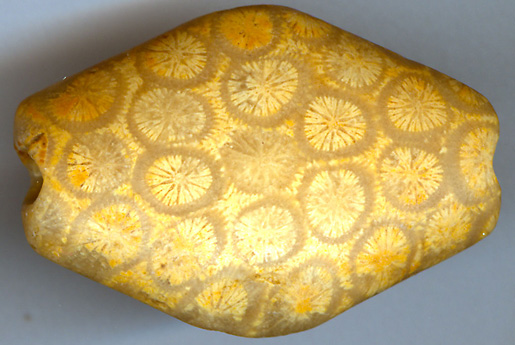
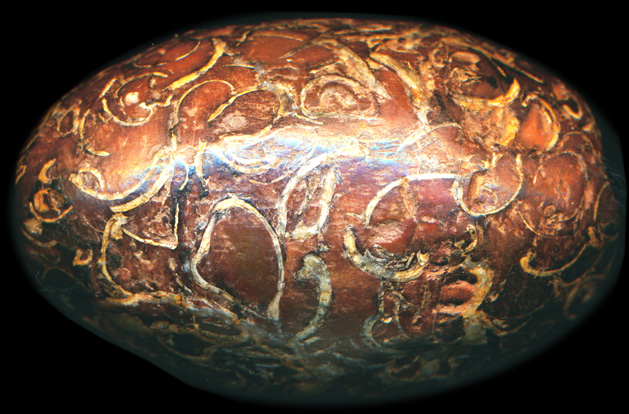
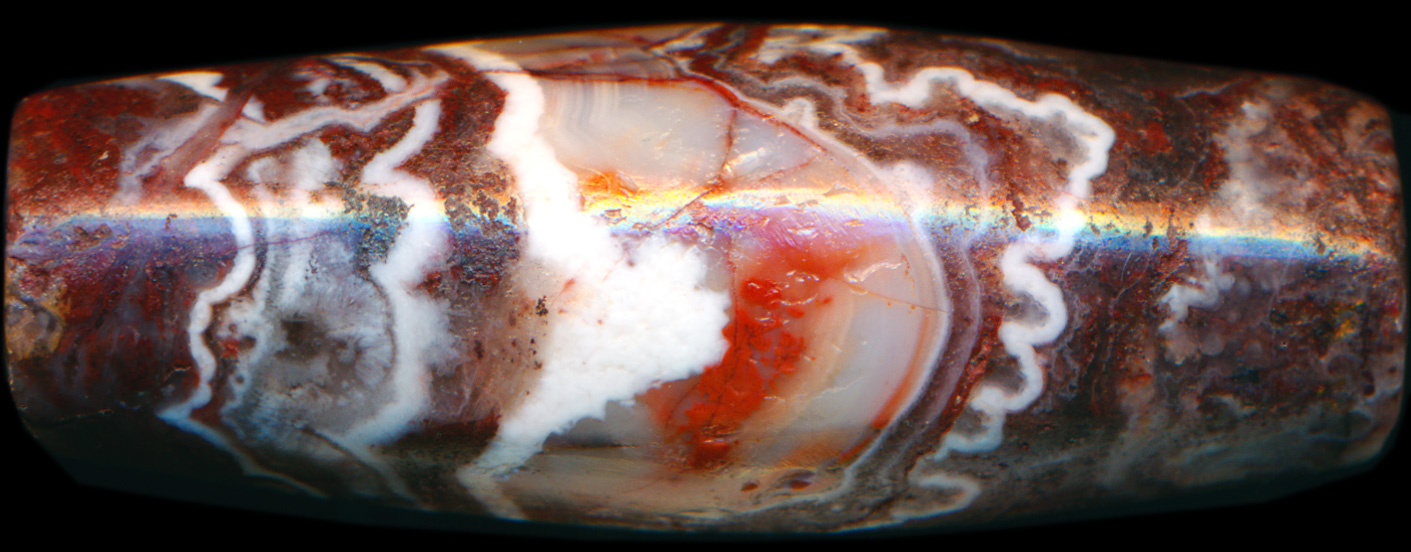
The large bead pictured below, from Mehrgarh, is made of
agatized fossil coral: a material formed when ancient coral
skeletons were replaced by silica over millennia. Sourced from
the fossil-rich landscapes of Balochistan, it reflects a legacy
of craftsmanship rooted in deep time.

Fossil bead from Balochistan

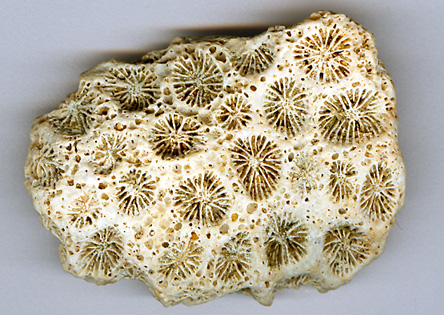
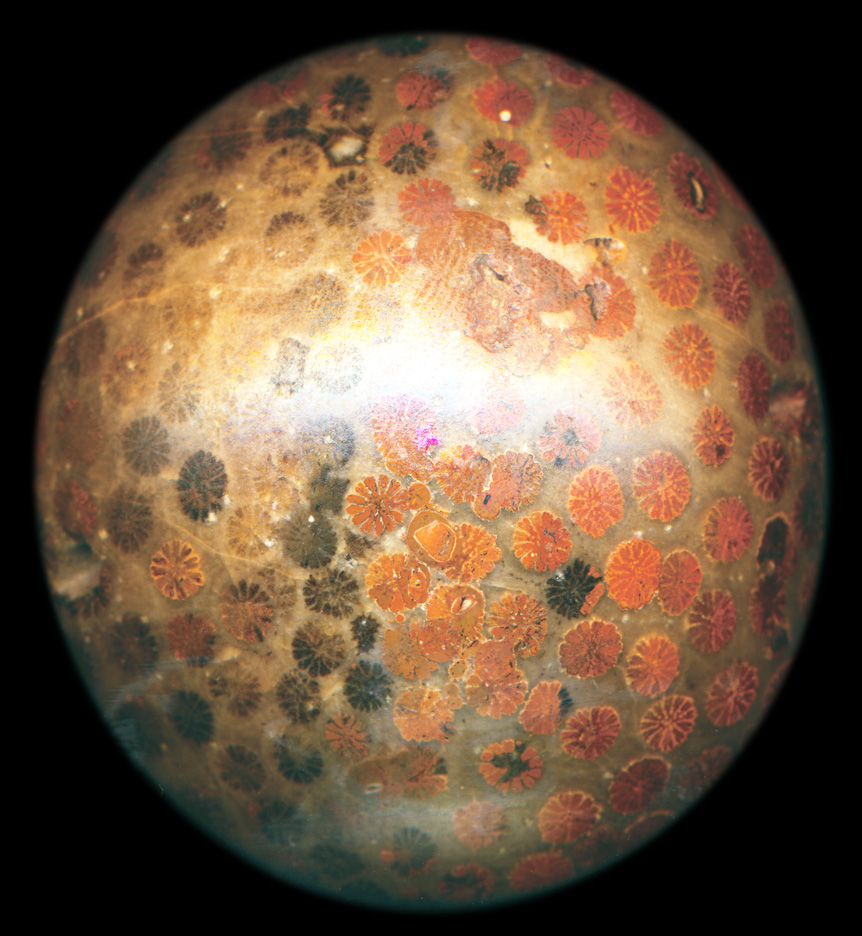
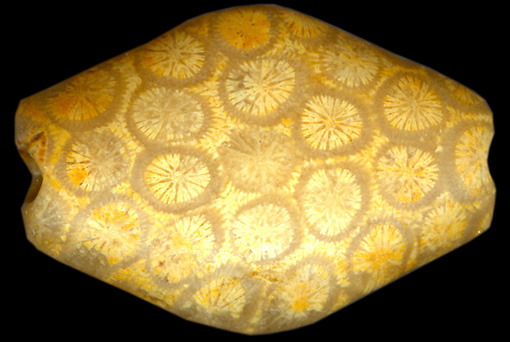
Fossilized coral from Sri Lanka
|
A remarkable instance of
synchronicity,
as defined by
C.G. Jung,
occurred a fortnight after I acquired these magnificent
proto-historic
beads in Thailand. As I strolled along a beach in Sri Lanka,
bathed in the glow of the setting sun, my eye was drawn to a
certain coral among the multitude scattered across the sand. It
was as if my gaze was conditioned to seek out synchronicities:
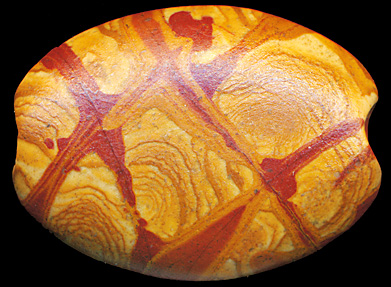
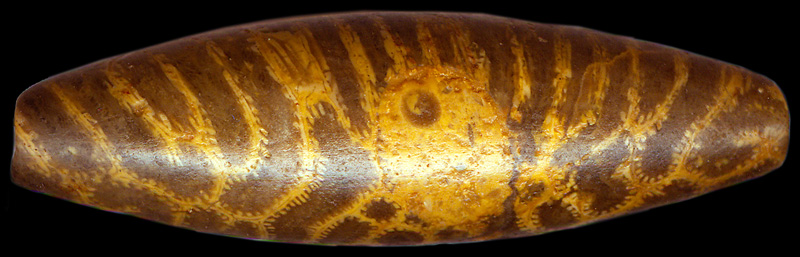
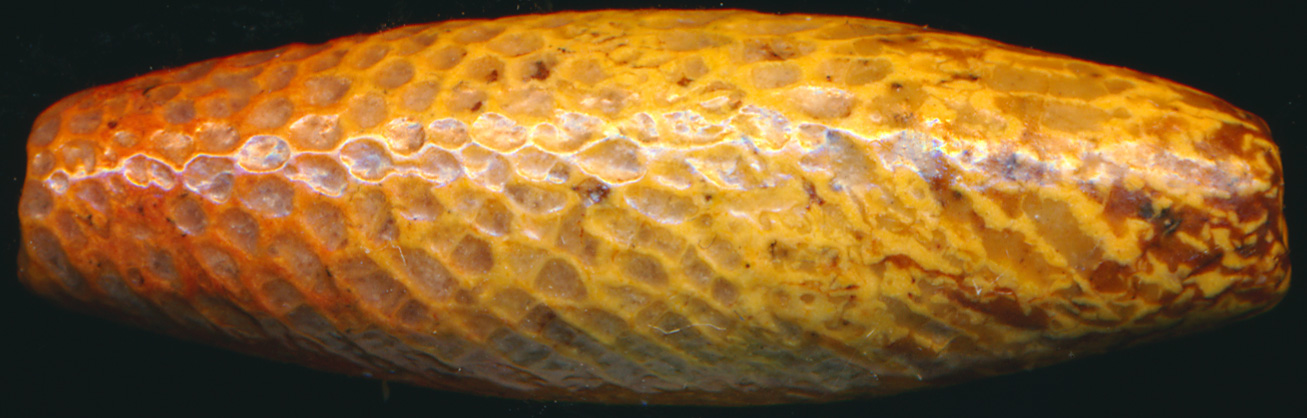
the fossil patterns in the large yellow Indus bead above bore an
uncanny resemblance to those in the coral I chanced upon.
This
specimen is a piece of fossil coral, likely from the genus Porites or Favia, both common in Indo-Pacific reef systems. It
dates to the Holocene epoch (within the last 10,000 years) and
displays colonial corallite structures, with radial symmetry
characteristic of stony corals from shallow, warm marine
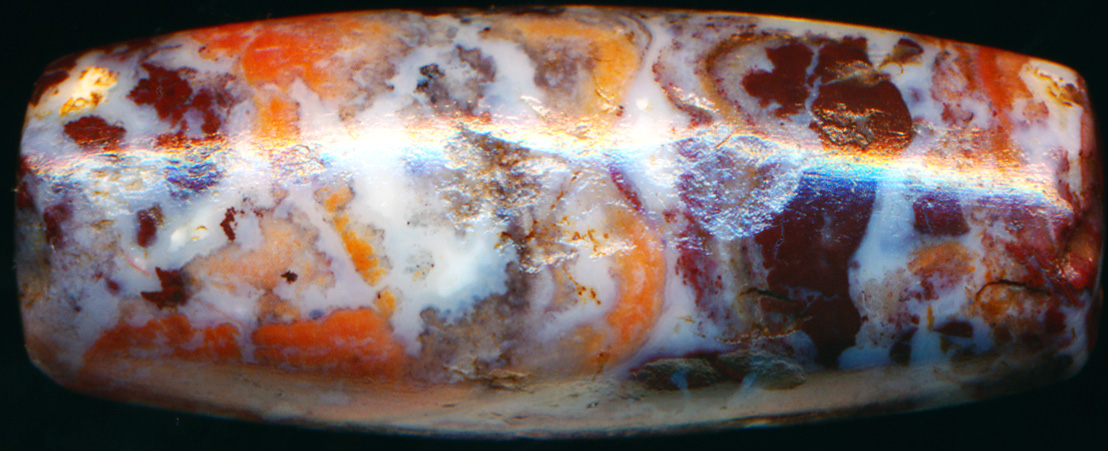
environments. Below, another enormous soft stone bead from the pre Indus
period showcases similar fossilized patterns. It is not as
outstanding as the bead above but it is still a testament to the
ancient people's skill in capturing the intricate beauty of
nature in their beadwork, and their keen eye for unique and rare
materials. Due to impressions of fossil
prints – this in itself simple stone has got its own 'wow factor'.

38,5 * 30.5 * 11 mm
|
|
|
*
The Sandstoned |
|
AFB 1
- 30 *11 mm -
Aprox. age: 5.500+ years |
|
FOSSILIZED STONE BEADS
The fossilized beads displayed here,
many composed of
sandstone and related materials, offer a rare glimpse into
bead-making traditions that predate the Indus Valley itself.
Their survival is remarkable, since such soft stones were
especially vulnerable to damage and decay over time.
These early beads reflect a moment when communities were
shifting from egalitarian hunter-gatherer groups toward more
structured agricultural societies. The choice of softer,
workable stones suited the simpler tools available, while still
providing ornamentation that carried social meaning.
As societies became more stratified, bead-making too evolved.
Harder materials such as agate and jasper, much more demanding
to drill and polish, increasingly came to dominate. The skill
and time invested in producing these hard stone beads made them
natural symbols of prestige, reinforcing emerging hierarchies.
|
Still, softer stones never disappeared entirely. They retained a
place in adornment when they possessed distinctive beauty,
especially fossilized sandstones with striking inclusions or
patterns. These beads could visually compete with the natural
richness of agate and jasper, offering an alternative that was
both unique and appealing.
Because of their fragility, very few sandstone beads have
survived. The specimens displayed here therefore represent an
uncommon legacy, alongside the more enduring fossilized agate
and jasper beads. |
|
|
*
The Sandman |
|
AFB 2 -
62 - 36,5 * 11 mm
|
|
In an intriguing continuation of this trend, it seems that the tradition
of valuing fossilized materials highest persevered into the hard stone
bead-making period. If this hypothesis holds true, then one could
conjecture that beads made from fossilized agate and jasper would have
been considered the apex of prestige, occupying the pinnacle of the
societal hierarchy mirrored in the world of ancient bead-making.
|
We find a lot of marvelous beads made of fossilized material
especially in the early Indus period.
Such a bead is the one you can observe below! |
|
|

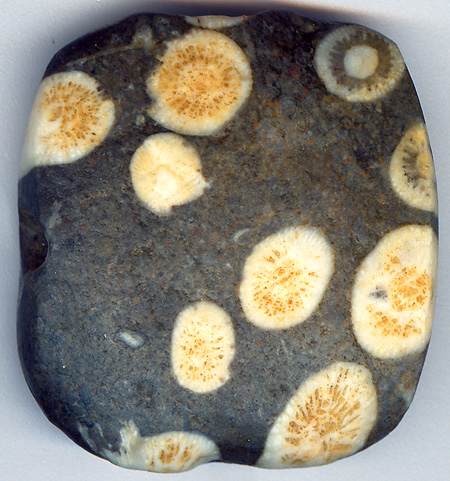
Petrified Coral Canvas
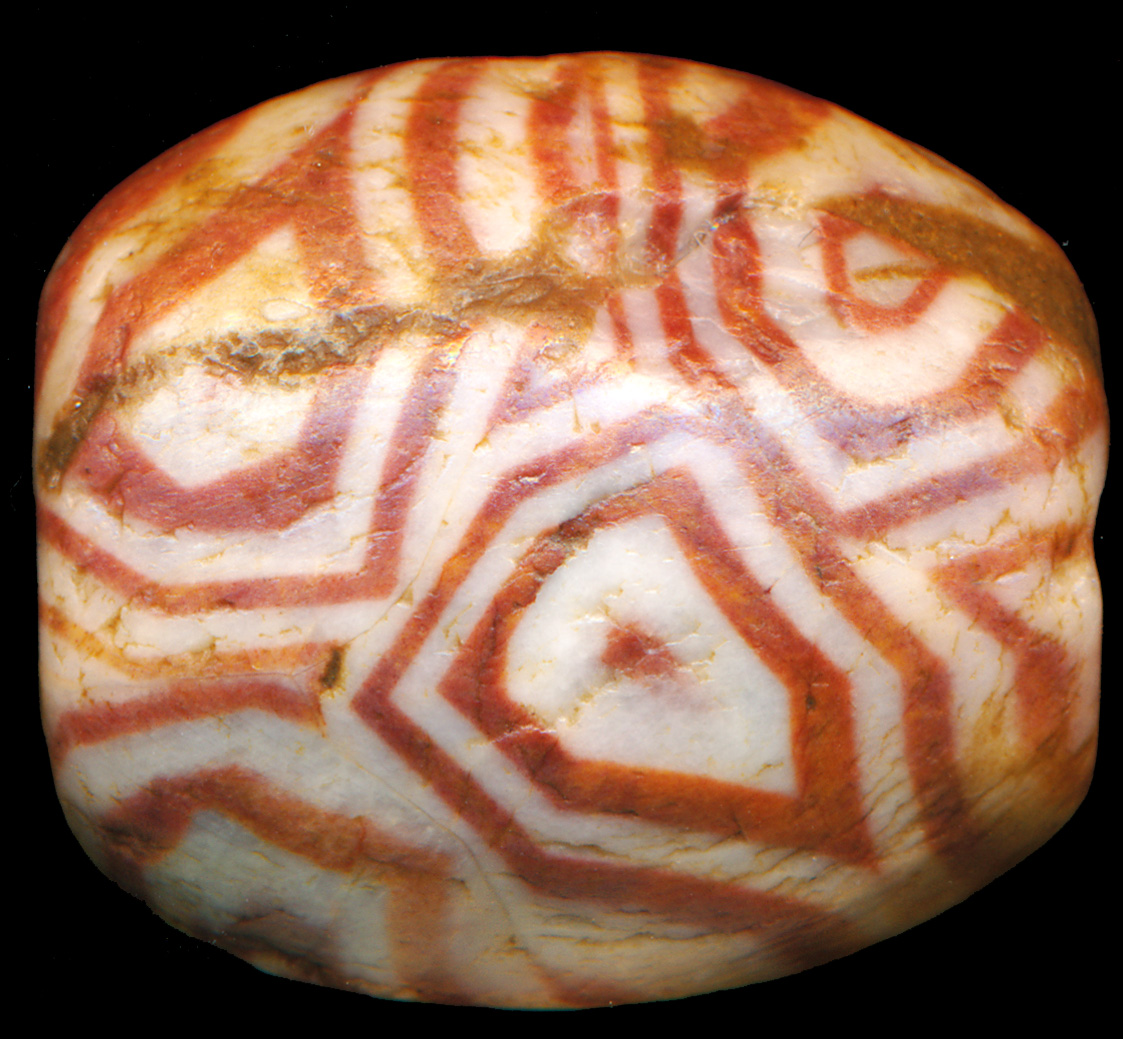
What strikes the observer is not merely the presence of these
agathized corals, but their near-symmetrical arrangement on the bead's
surface, a testament to the ancient artisan's keen eye for balance and
aesthetics. Each coral, with its unique structure and pattern,
contributes to an overall harmonious design, creating an intricate
mosaic of natural artistry.
Their placement appears deliberate, suggesting that the bead's creator
had a deep appreciation for the inherent beauty of these fossils. The
symmetrical layout enhances the visual appeal of the bead, transforming
it into a miniature canvas showcasing the elegance of the natural world.
The existence of such a bead is an eloquent reminder of the deep
connections between human culture and nature. It underscores our
enduring fascination with the organic world and our desire to capture
and carry its beauty with us, no matter how much time passes.
Not for sale
|
|
AFB 3 - 41 * 28 * 11 mm |
|
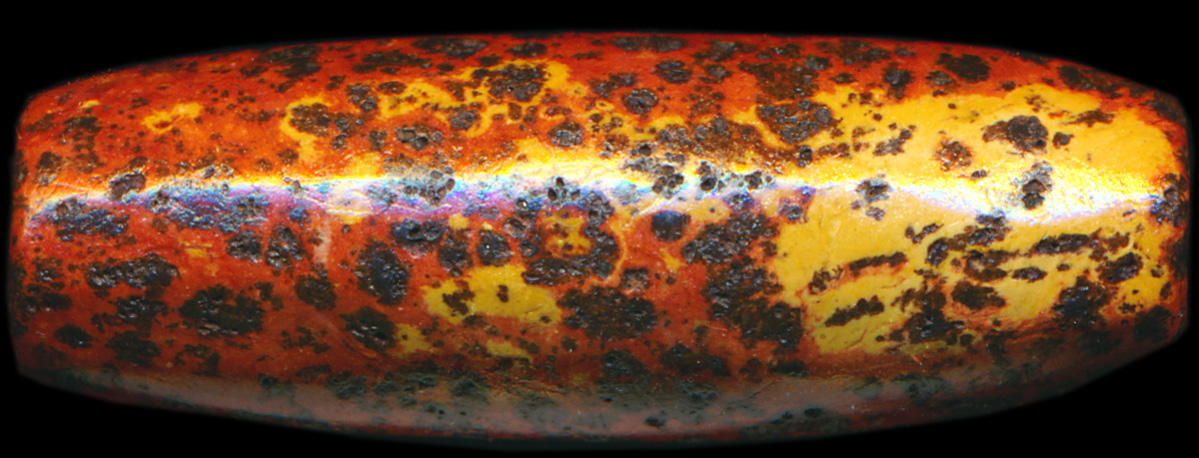
Interestingly, the magnificent
yellow sandstone bead showcased above inspired me to
formulate a unique, yet intuitive, definition of a pre Indus
bead. The defining feature lies within its hole:
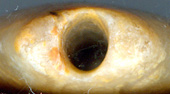
If you can draw a comfortable
breath through the hole, it's likely a pre-Indus or an Indus
Valley bead. A Mauryan bead, however, would make the process
slightly challenging, leaving you feeling slightly breathless.
As for a Gupta bead, its diminutive hole would render the task
nearly impossible. This metaphor perhaps serves as a commentary
on the trajectory of Indian bead-making. Starting from the Gupta
period and onwards, it seems to me that the craftsmanship and
artistry that once defined Indian bead-making began to lose its
breath. But, of course, this is a personal perspective.
|
'SILLIFIED' FOSSILS
The fascinating fossil beads showcased below fall under a
specialized category known as "silicified" fossils. This term is
derived from the intricate process that these fossils undergo,
where their original forms, and occasionally even their
intricate internal structures, are gradually replaced by
"silica" (SiO2), transmuting the organic into the inorganic. The
transformative process results in the creation of a fossil
that's essentially an exact silica replica of the original
organic material, immortalizing it in stone.
This transformation occurs in one of two possible forms. In some
instances, the silica takes on the form of granular quartz,
which is coarsely crystalline and offers an interesting texture.
In other cases, it manifests as a variety of cryptocrystalline
quartz and moganite known as chalcedony, which is translucent
and imparts a captivating charm to the fossil. |
|
|

|
|

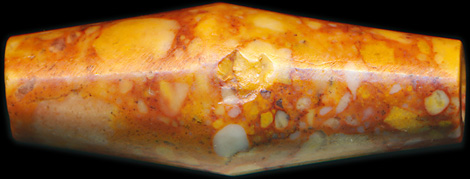
Petrified Poetry
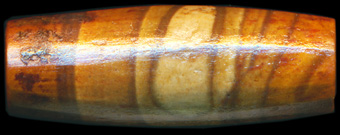
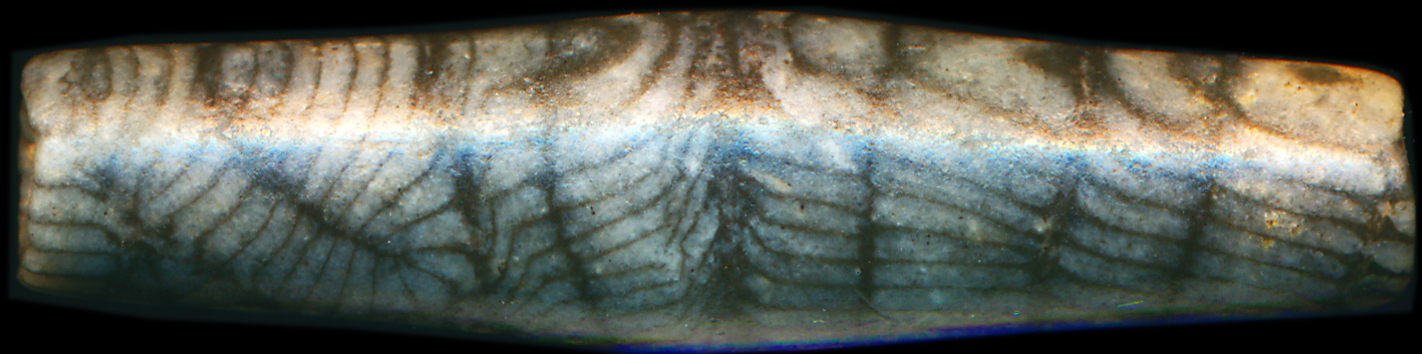
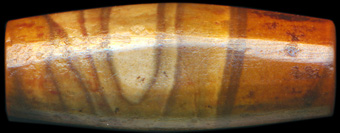
The photographic scan
above unveils the unique texture and irregular surface characteristics
of these beads made out of jasperized wood. It's an intriguing artifact
of the more 'primitive' polishing technique employed by their ancient
creators, clearly diverging from later standard practices in the Indus
Period.
In this process, rather than opting for finer
abrasives
that would have yielded a smoother, more uniform finish, the artisans
used coarser materials. This choice has imparted a distinctive,
roughened texture onto the beads, where the lines in the original wood
become more visible.
Not for sale
|
|
AFB 2 - 22 * 8 mm |
|
|
|
Rustic
Resonance

Rustic
Resonance
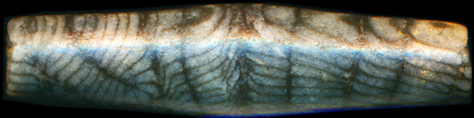
An elongated, gently
waisted barrel bead, likely carved from a fossil-bearing silica stone,
presents intricate, branching inclusions that read as organic traces.
The surface holds a quiet satin polish with small pits and softened
edges, suggesting long handling. Along the upper ridge, milky cream
tones blend into cool grey-blue, while dendritic vein-like networks
spread outward from a central line, recalling fronds or algae mats
captured during silicification.
The patterning is mineral, its tendrils embedded within the stone.
Translucence is subdued, and the internal features look feathered, not
sharply banded, a look consistent with chalcedony or agatized limestone.
The shaping is restrained and competent: ends taper evenly, the waist is
slight, and the silhouette remains poised.
Wear likely arose from cord movement and skin contact; there is no
glassy glare, only a matte glow. The visual grammar: branching
repetition and near-symmetry, fits a protohistoric taste for nature
abstracted into ornament. In use, the piece could serve as a focal in a
strand, rewarding close inspection rather than distant display.
Not for sale
|
|
AFB
3
- 30 * 7 mm |
|
|
|
*

Fossilized
Fantasia
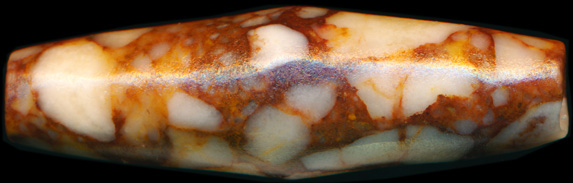
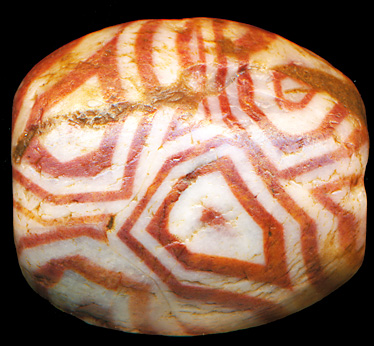
This prehistoric bead from Balochistan is carved from
fossiliferous agate/variegated jasper and likely belongs to the
Neolithic–Chalcolithic sequence of the region
(Mehrgarh–Nal–Kulli, ca.4000 to 2500 BC). The piece shows an elongated, slightly biconvex profile
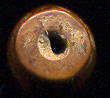
with a bi-directionally drilled, conical perforation; the mouth is
widened and smoothed by wear, consistent with long use. Surface banding
in brown-cream tones and fossil inclusions are visible around the bore.
The repetitive geometric patterns on this variegated jasper Indus-bead
speaks for itself. The bead is a bit scarred, but it still manages to
pass on the ancient message of beauty understood as order in chaos.
Critically, the strong natural banding and fossil textures in stones
like this may have inspired later etched-bead traditions in the Indus
sphere: artisans who saw ringed fossils and rhythmic agate layers could
have translated those readymade motifs into incised/bleached lines on
carnelian and jasper, amplifying patterns already present in the raw
material.
Comparable beads are documented from grave goods, habitation layers, and
bead-making debris across Balochistan and the Indus basin. Diagnostic
features to record for confirmation include maximum length/width, bore
angle and taper, peck-and-grind striations, and use-wear polishing at
the perforation. Taken together, the material, drilling style, and wear
place this bead within the regional prehistoric lapidary toolkit and
attest to local quarrying and exchange with larger Indus centers.
|
|
AFB 4
- 23 * 20 * 9 mm |
|
|
|
*
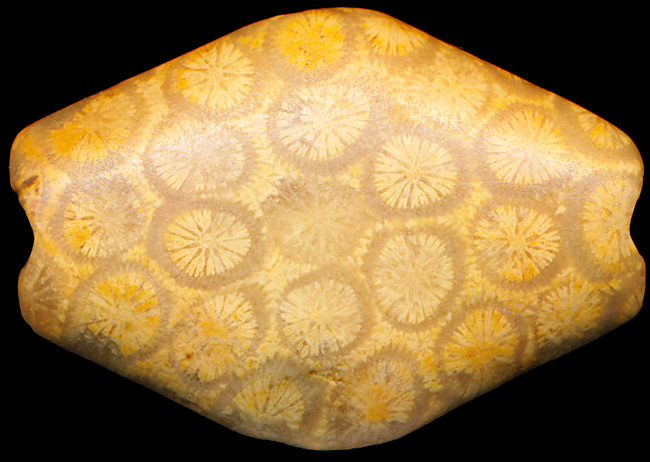
Coral's
Journey
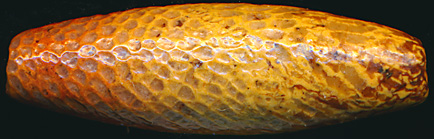
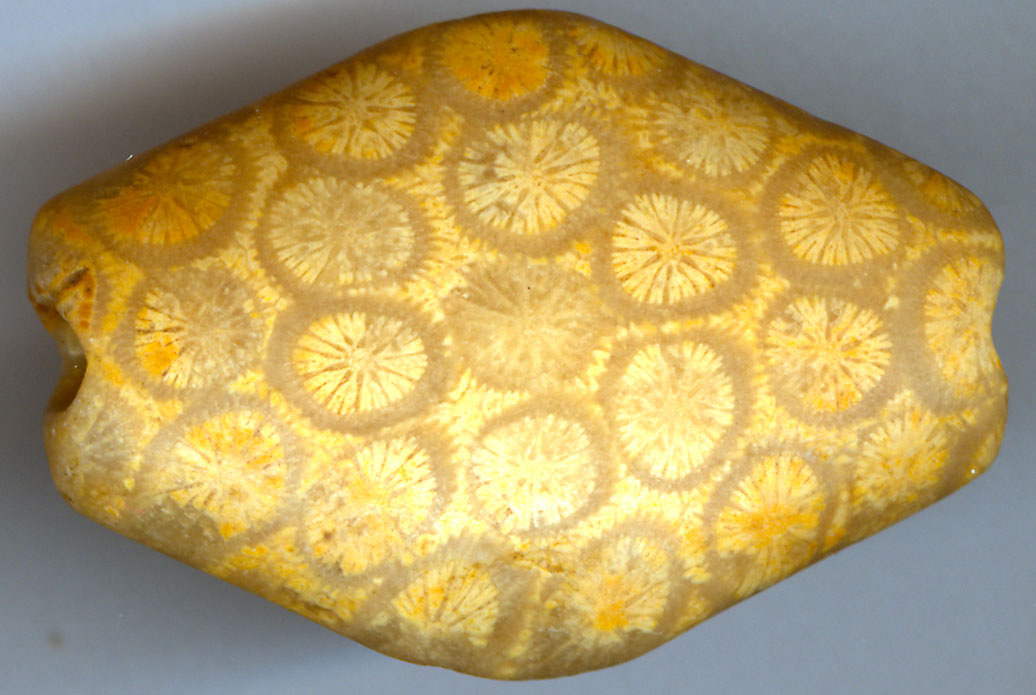
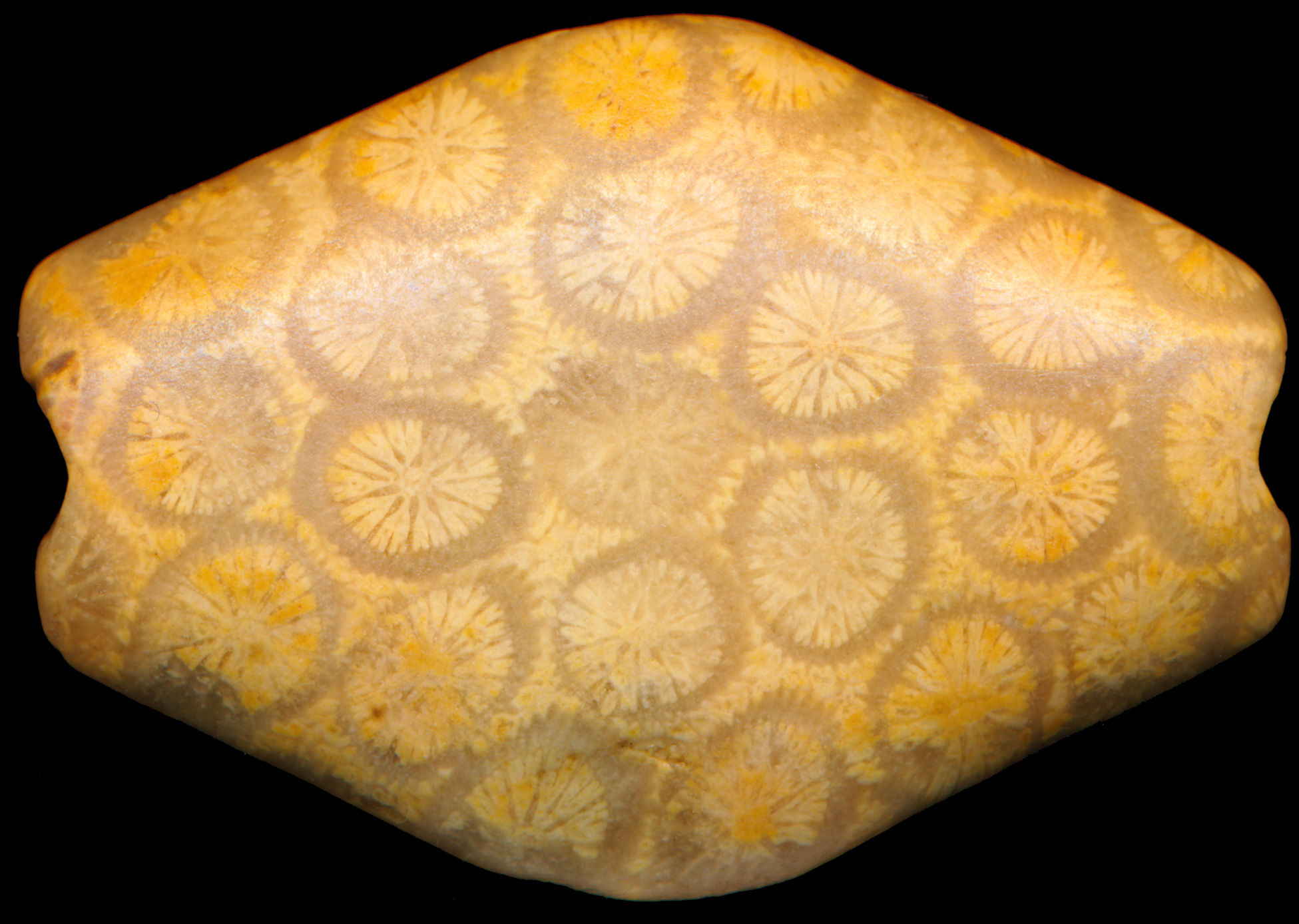
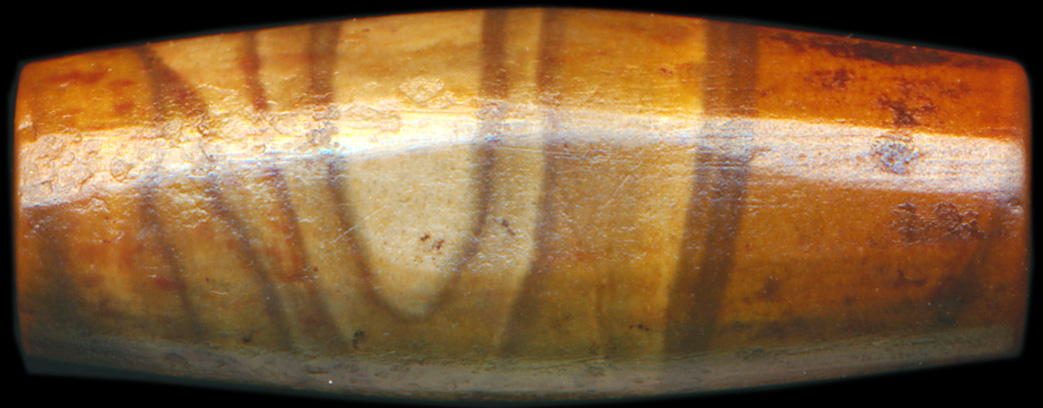
An elongated,
biconical bead carved from fossiliferous silica - very likely agatized
coral - shows a striking honey-amber body with a natural, reticulated
surface that reads like tightly packed scales. Each polygonal 'cell'
corresponds to fossil calices; their relief has been softened by long
polishing and subsequent wear. Toward one end the tone warms to burnt
orange; the opposite end holds lighter ochres with scattered dark
inclusions and tiny pits consistent with ancient material rather than
modern surface texturing.
The overall shaping is careful and balanced: shoulders are full,
tapering evenly to rounded tips, with a gentle waist that keeps the
silhouette lively. The luster is not glassy but wet-wax, suggesting
traditional abrasion and slurry polishing. Micro-chipping at high spots
and minute stress lines within the fossil pattern indicate real age and
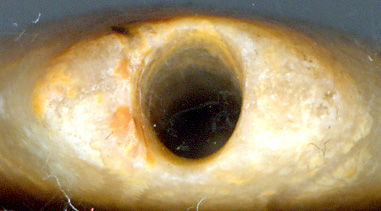
use. Although the perforation is not shown, the longitudinal ridge
implies cord movement along the axis.
As a protohistoric ornament, the bead marries biological memory and
human craft: coral colony geometry frozen in stone, turned into a
tactile amulet.
|
|
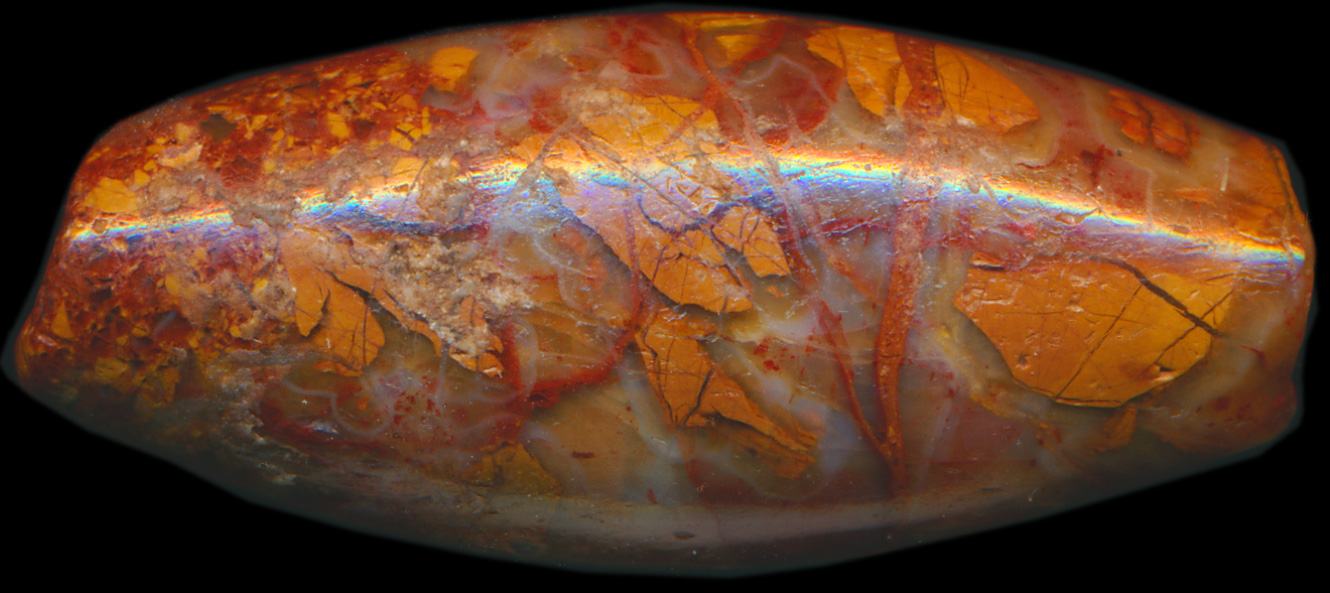
AFB 7
- 28,5, 8 mm
|
|
|
|
*
Agate Lake
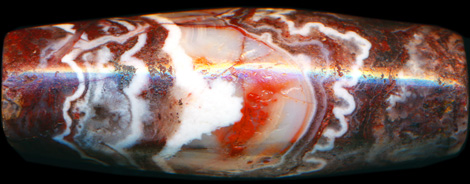
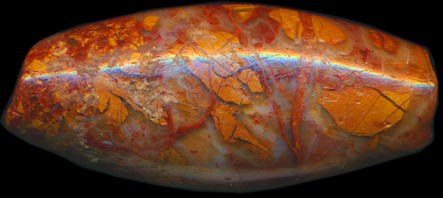
An elongated,
biconical bead cut from agatized plant material, most plausibly
silicified wood or root, displays a warm palette of amber-orange shot
through with smoky greys and iron-red filaments. The internal
architecture reads as nature rather than pigment: irregular plates and
healed fractures are laced with translucent chalcedony, while thin,
branching red lines suggest mineralized vascular channels. In several
zones the surface breaks reveal granular pockets where softer tissues
once were, since filled by silica and stained by iron oxides.
Shaping is controlled and symmetrical, with gently tapered tips and a
full mid-section. A narrow longitudinal crest has taken a brighter
polish, consistent with cord rub and long handling; elsewhere the luster
is a soft wet-wax sheen, not the sharp glare of modern rotary buffing.
Minute bruises on high points and scattered pits at old voids reinforce
age and use. The stone's translucence blooms under raking light, giving
depth to the internal mosaic and emphasizing the natural 'breccia'
effect characteristic of some agatized botanicals.
As an ornament it captures a double time scale: once-living tissue
turned to stone, then shaped and worn by human hands. The result is a
compact landscape - plant memory stabilized in chalcedony - quietly
dramatic and perfectly suited as a focal bead or amulet.
|
|
AFB 9
- 28 * 12 * 11 mm - |
|
|
|
*
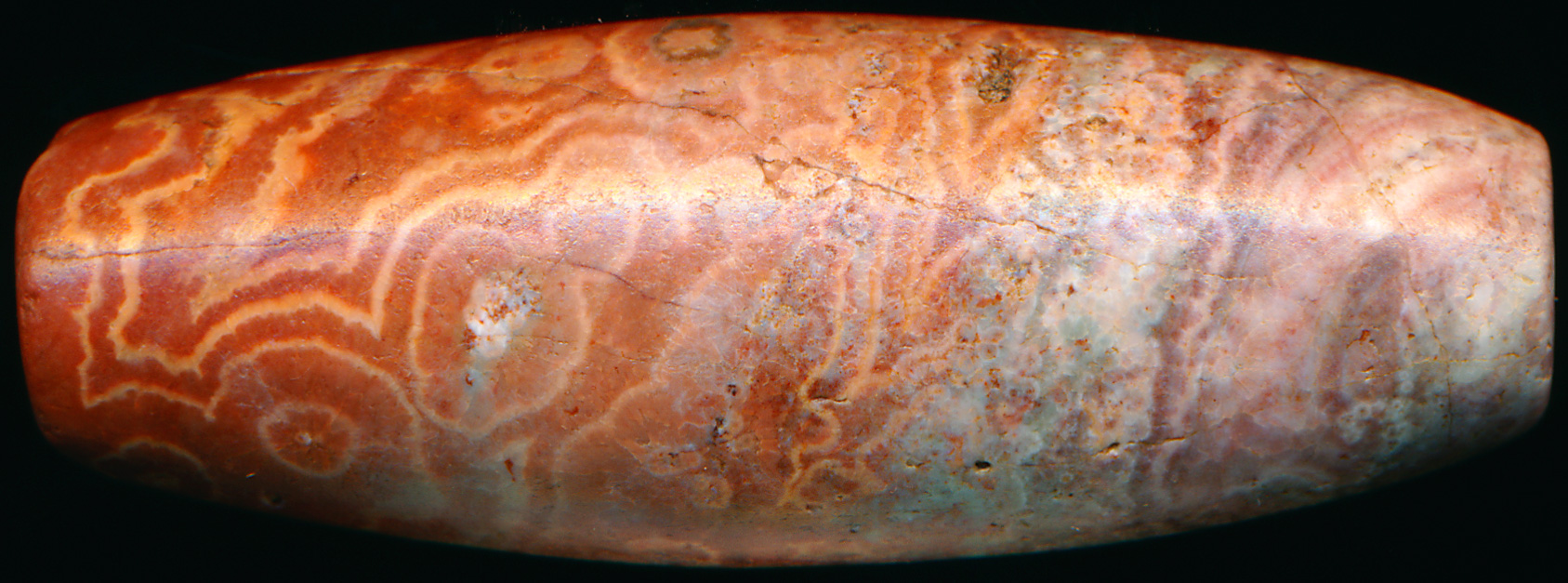
Jasperized
Poetry
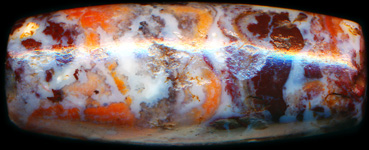
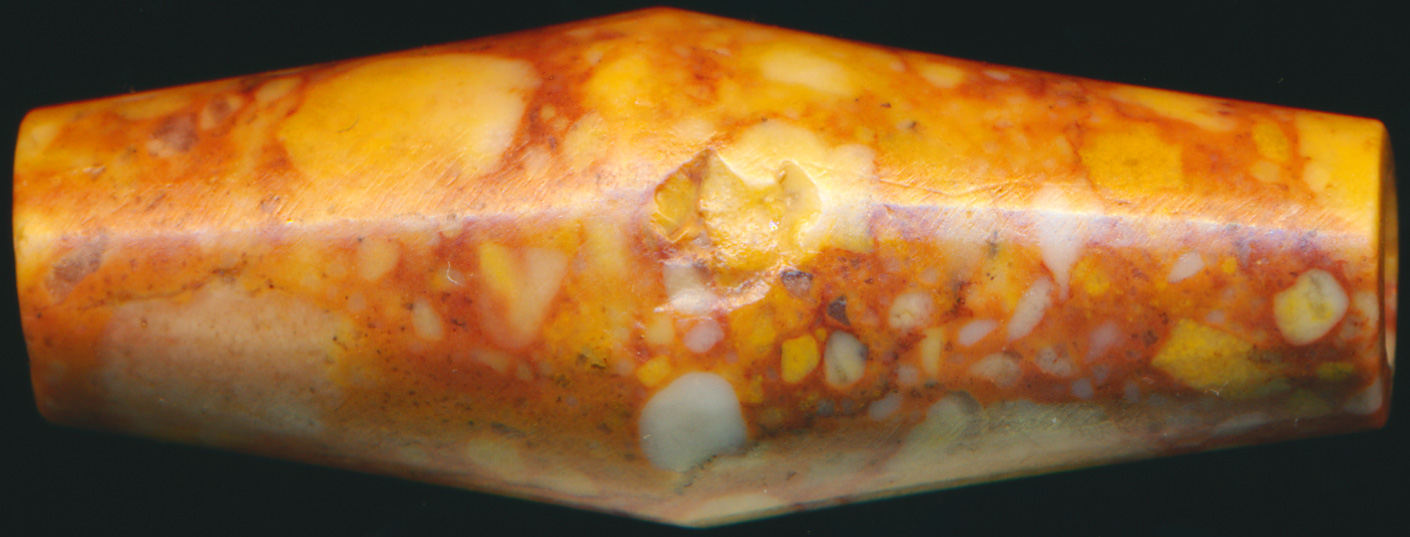
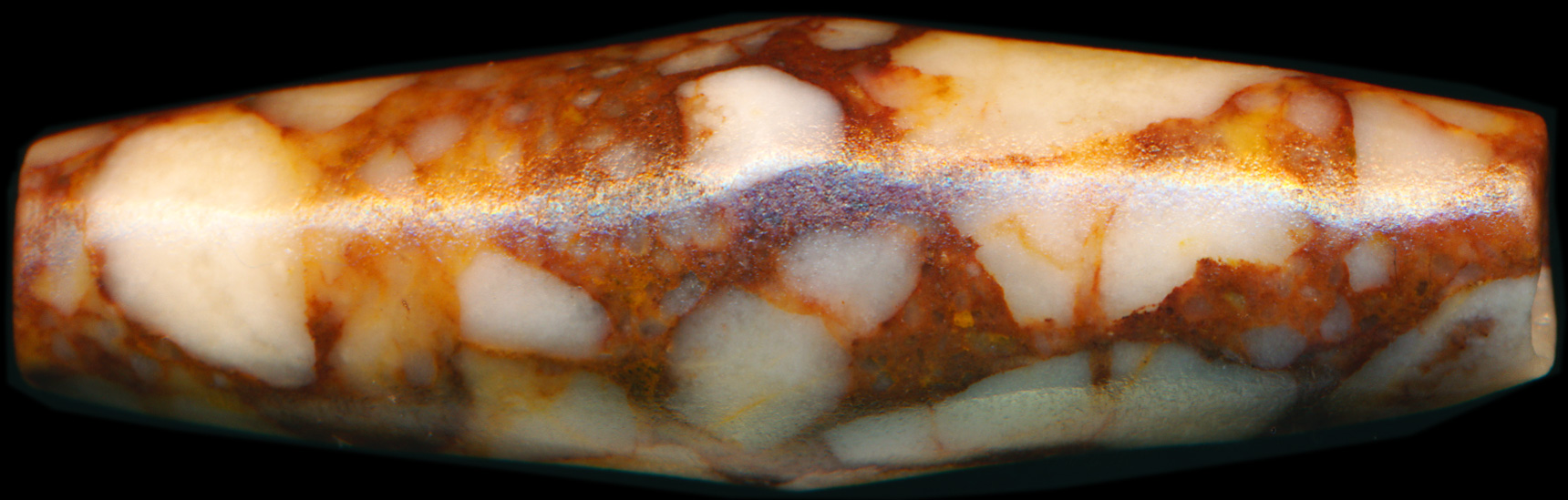
An elongated,
protohistoric biconical bead cut from jasperized coral. The surface
preserves the ghost geometry of tightly packed corallites: small,
polygonal cells that merge into wave-like, lacey fans. Silicification
here is jasper-dominant rather than chalcedonic; mostly opaque with a
wet-wax luster, not a glassy shine. Warm brick and salmon reds
concentrate toward one end, fading across the midsection into cooler
grey-blue and lavender tones. Iron-oxide freckles and short, healed
hairlines traverse the field, consistent with ancient stress and burial.
Scattered pinholes mark former voids in the coral fabric, now smoothed
by age and string wear.
The shaping is disciplined: a quiet waist, rounded tips, and balanced
shoulders. High points along the longitudinal crest show extra gloss
from prolonged handling and cord rub. Under strong light the stone
admits only slight translucence at thin edges, another pointer to
jasperization. Viewed with a loupe, the microstructure is a granular
quartz mosaic rather than fibrous chalcedony.
As an ornament, the bead carries two intertwined histories: a reef
colony fixed into stone, and a human maker refining that fossil memory
into a stable, tactile form. Its restrained polish, earthy palette, and
living geometry give it authority as a protohistoric focal: quietly
complex, durable, and rewarding at close range.
|
|
AFB 10 -
35,5 * 12,5 mm
|
|
|
|

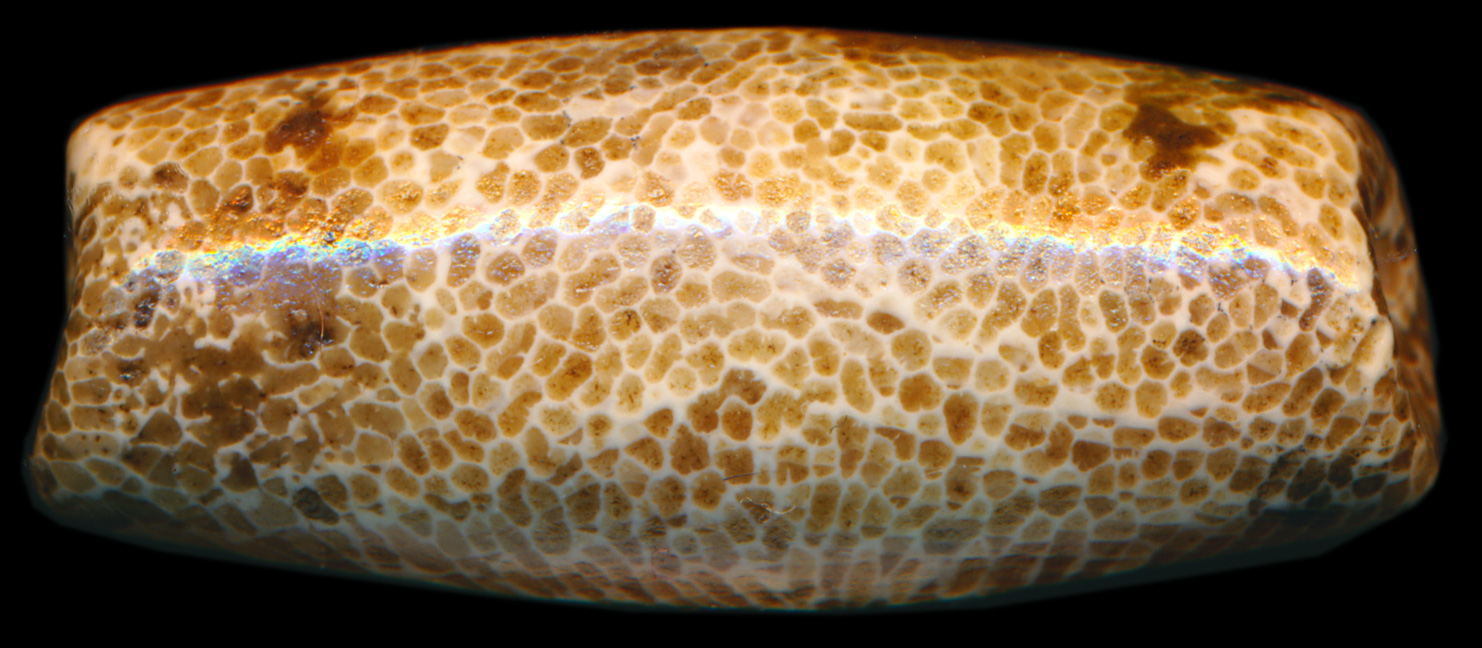
Fossilized
Fragments
An elongated,
cushion-barrel bead carved from agatized (jasperized) coral, showing a
dense honeycomb of corallites across the entire surface. Each small,
polygonal cell is sharply outlined in milky quartz, with interiors
stained warm caramel to ochre; the result is a crisp, scale-like
tessellation that reads immediately as fossil structure rather than
painted pattern. A bright longitudinal crest holds the highest polish -
evidence of hand wear and cord rub - while the flanks glow with a quiet,
wet-wax luster instead of a glassy shine. Subtle color zoning moves from
pale cream at the edges to deeper amber toward the mid-field,
interrupted by a few darker 'islands' where iron oxides pooled in former
cavities.
The shaping is careful and balanced: slightly flattened sides, soft
shoulders, and short, rounded tips that keep the silhouette stable on a
strand. Under strong light, translucence is modest and limited to thin
quartz rims around the cells, typical of jasper-dominant silicification.
Loupe inspection would show a granular micro-quartz mosaic.
|
|
AFB 11
- 30,5 * 12 mm |
|
|
|
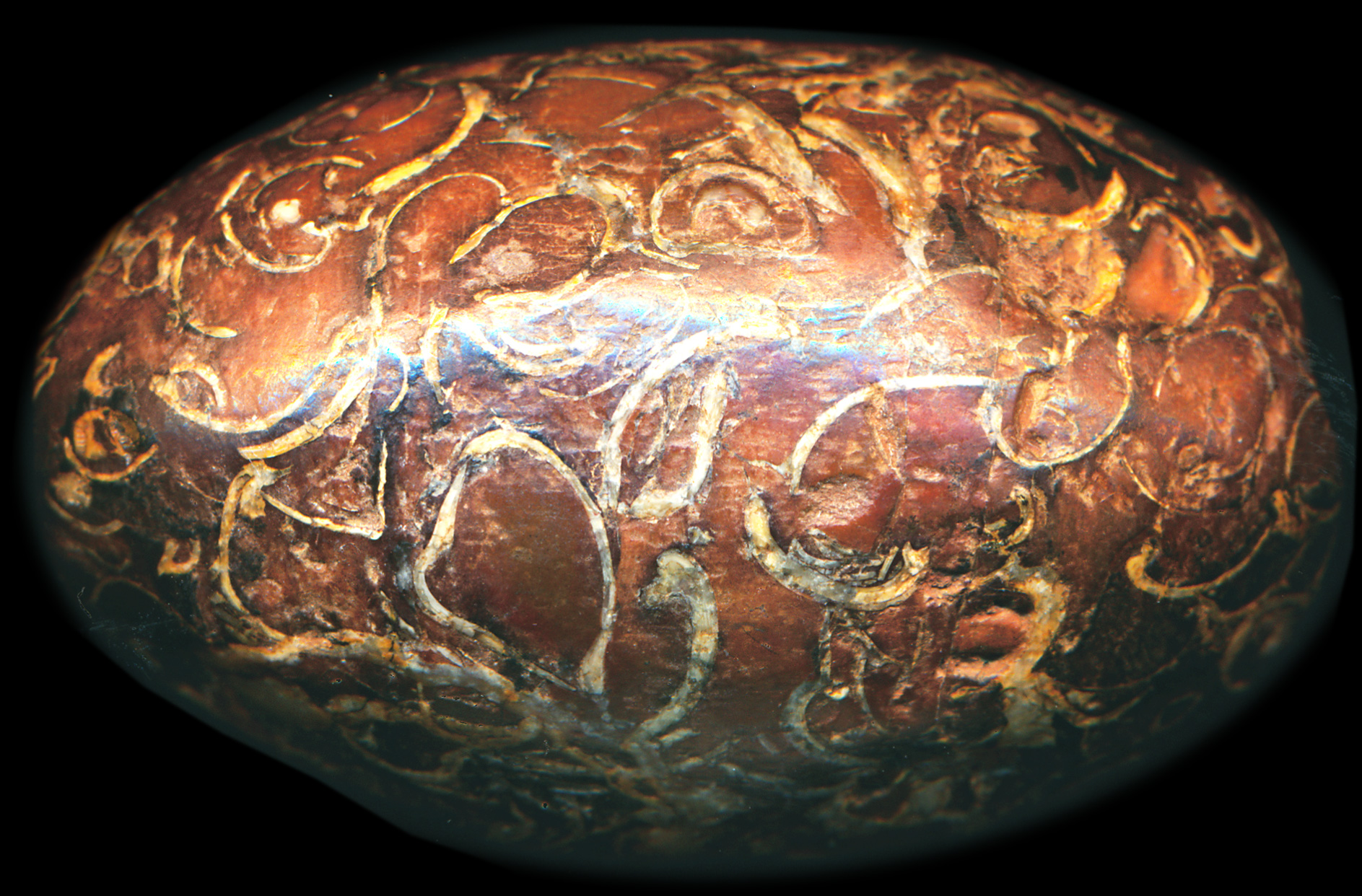
*
Petrified Ufos
1
|
|
AFB 13 - 17 * 11,5 mm - SOLD |
|
|
|
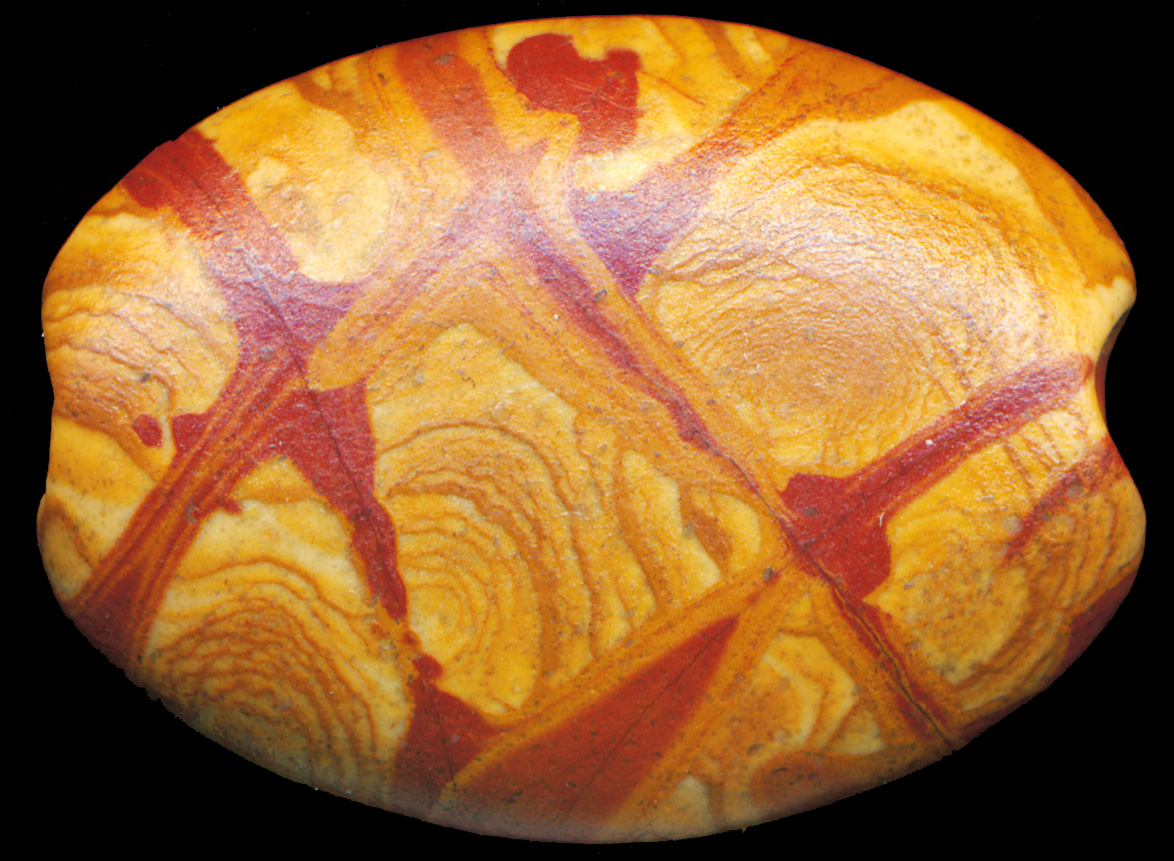
*
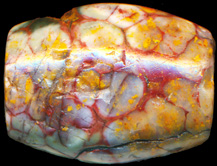
Petrified Ufos
2
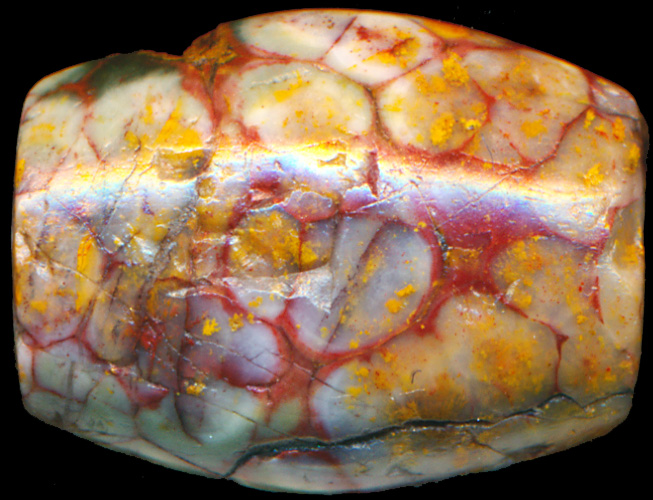
An oval,
short-barrel bead cut from agatized plant material. The surface shows
large, cell-like compartments outlined by crimson silica seams, a
pattern consistent with mineralized plant tissues rather than coral
cups. Interiors are infilled with translucent grey to milky chalcedony,
mottled by warm ochre patches from iron oxides. A bright longitudinal
crest carries the highest polish from cord rub, while shallow healed
fractures cross the field without disturbing the cellular layout. Luster
is a soft wet-wax glow, not a mirror buff. Pinpoint pits mark former
voids. The overall impression is of botanical structure stabilized in
chalcedony: bold polygonal cells, clean shaping, and seasoned, tactile
wear.
|
|
AFB 16
-
14 * 10 * 7,5 mm |
|
|
|
*
The Mammoth Twins

Fossil mammoth tooth
A compact pair of
protohistoric/neolithic Balochistan beads cut from fossilized proboscidean,
mammoth molar tooth. The material shows classic
laminated stripes: pale cream enamel plates separated by tan-brown
dentine, giving a ribbed, piano-key rhythm across the surface. Luster is
satin rather than glassy, with small pores and pin-pricks where dentine
opens. Each piece has a shallow central cleft, echoing the valley
between enamel ridges; edges are rounded and lightly worn. Hardness is
modest, so the surfaces take a soft polish and bruise easily. Such
fossil tooth often needs stabilization and should be kept dry and cool.
A tactile relic, organic architecture preserved, then shaped into
ornament.
|
|
AFB 17 -
25,5 * 19 * 5,7 mm (Lowest) |
|
|
|
*

Neolithic
Sentinels 1
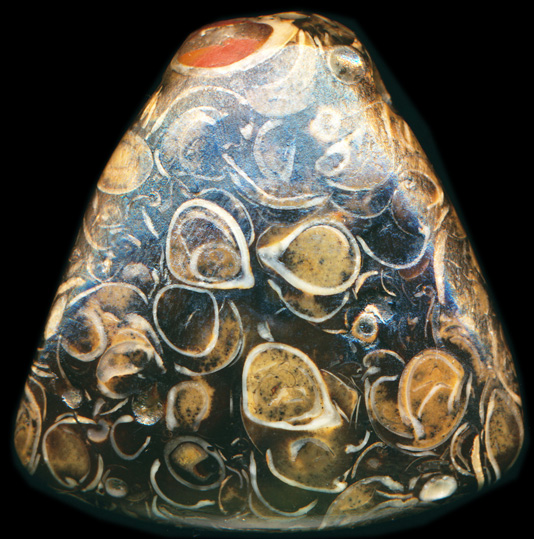
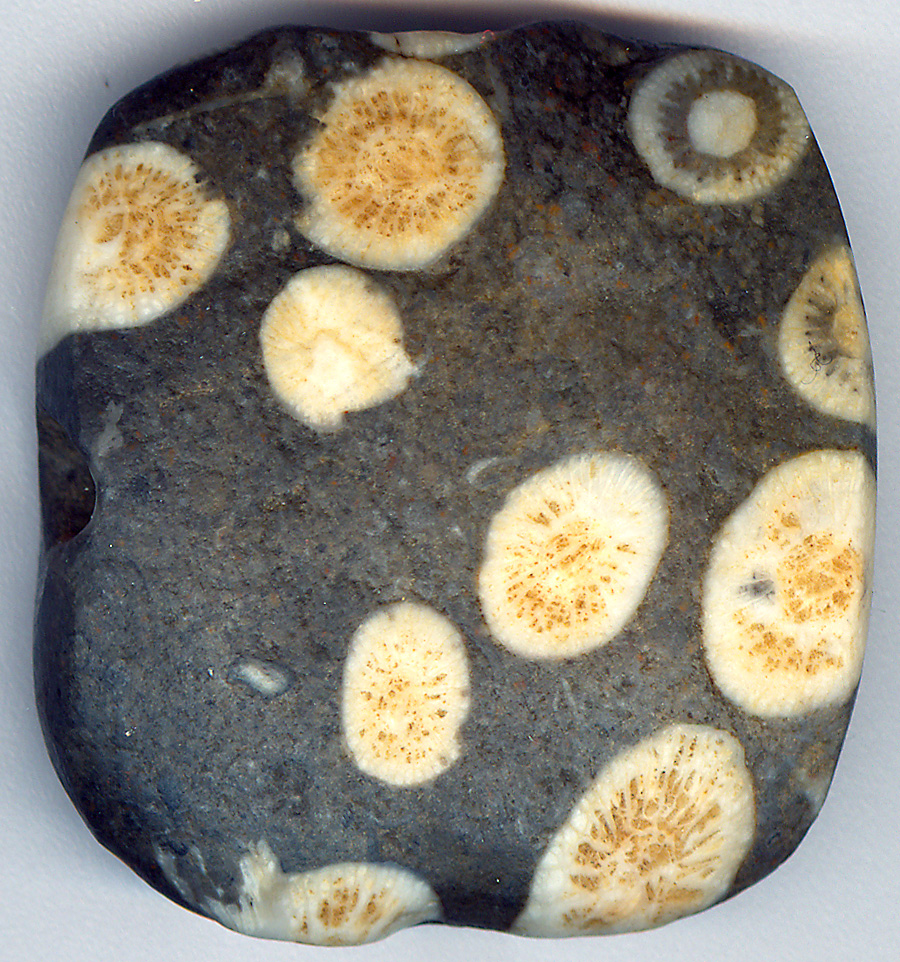
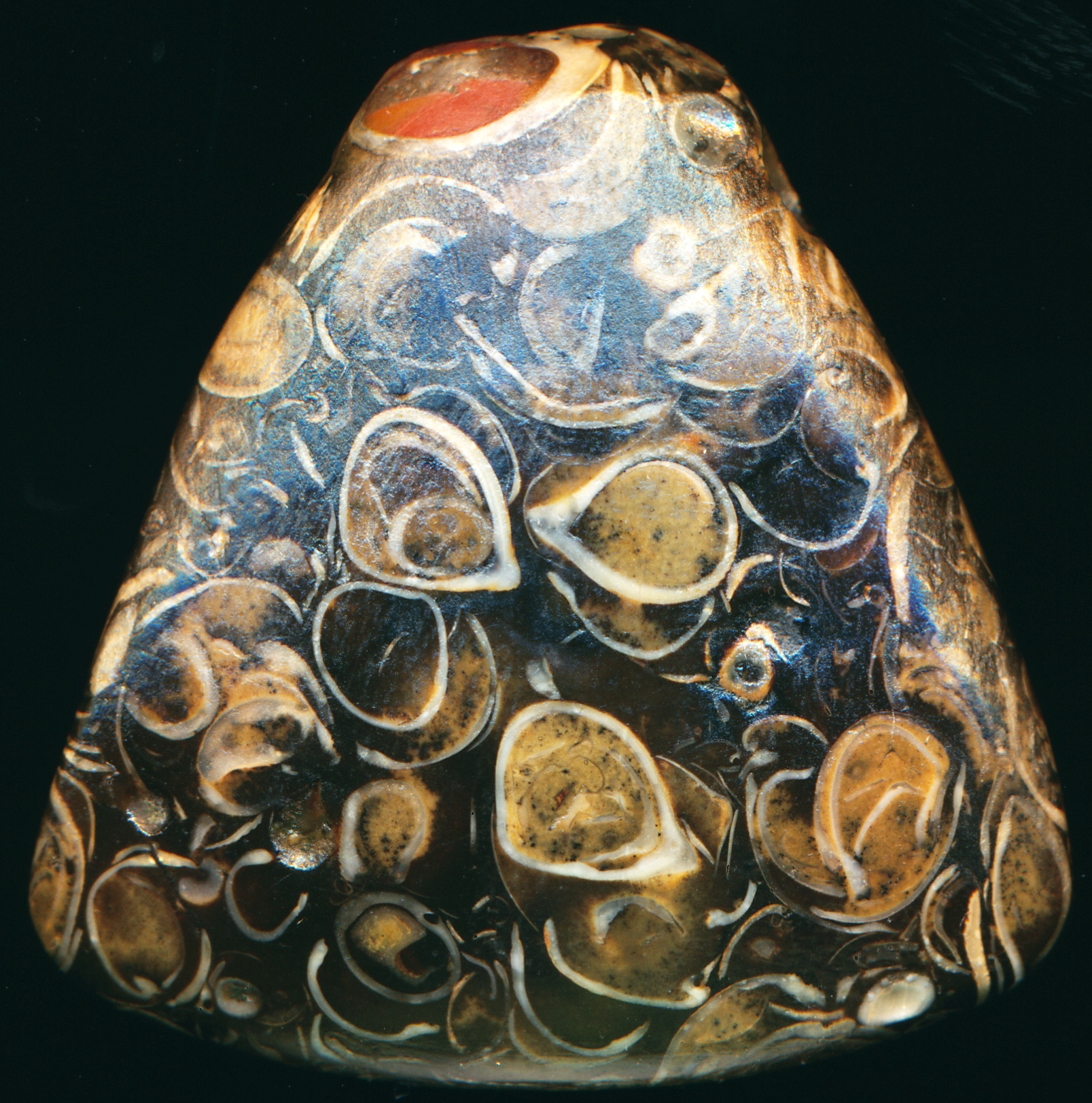
A conical,
bell-shaped protohistoric or neolothic bead cut from fossiliferous,
silicified limestone densely packed with tiny shell cross-sections.
Across the dark chocolate-to-ink matrix, crisp ivory outlines describe
ovals and teardrop forms, sections through small gastropods and/or
bivalves, some showing double lips and nested interiors where chambers
filled at different times. The fossils are not applied decoration; they
are the rock itself, sliced and polished so the natural congregation of
shells becomes pattern. Near the apex, a warm reddish lens sits like an
'eye,' probably an iron-stained pocket of chalcedony/carnelian revealed
by the grind.
The polish is high but not glassy; worn high points carry a subtle wax
glow and show minute pits where coarser grains or shell voids intersect
the surface. Light scuffs and healed hairlines thread the field without
disturbing the fossil geometry, consistent with a robust, stabilized
material. The silhouette widens from a rounded tip to a broad base,
giving the piece presence and stability on a cord. Under raking light,
the fossils lift with gentle relief while the dark matrix recedes,
producing a lively, swirling sea-bed effect.
|
|
AFB 18 -
33 * 33 * 11
mm |
|
|
|

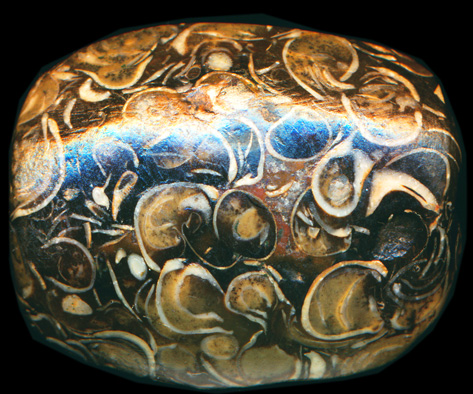
*Neolithic
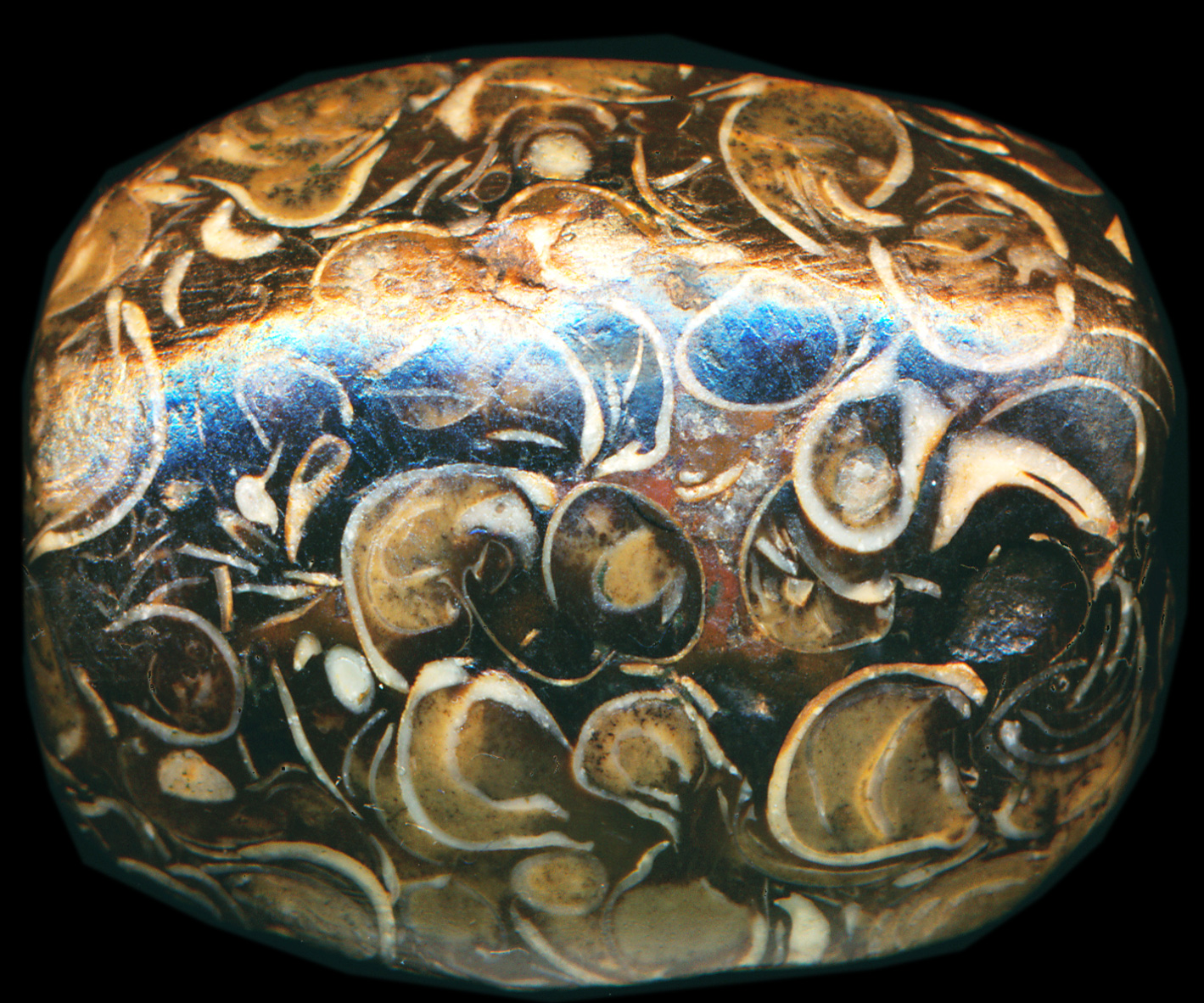
Sentinels 2
Same as above
|
|
AFB 19 -
29 * 28 *
12,5 mm |
|
|
|
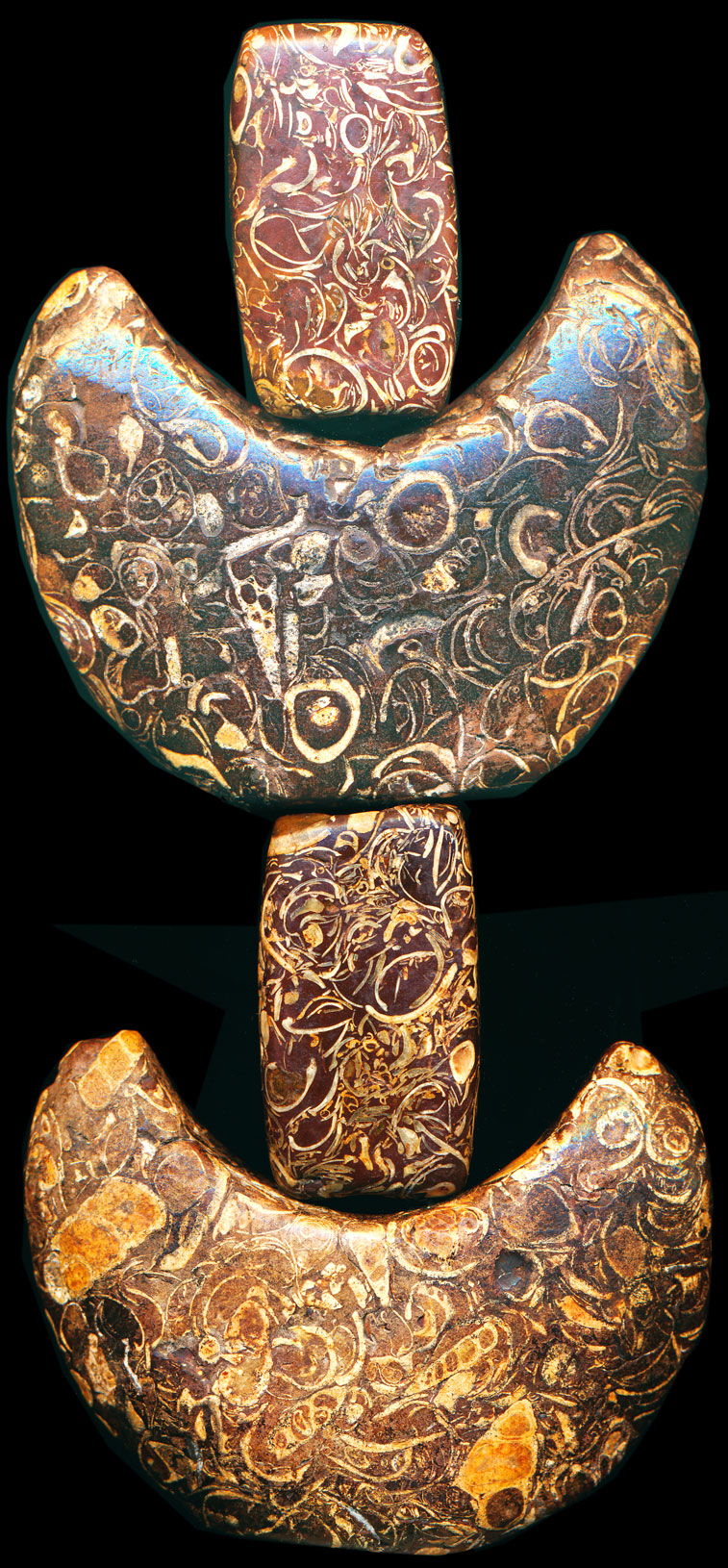
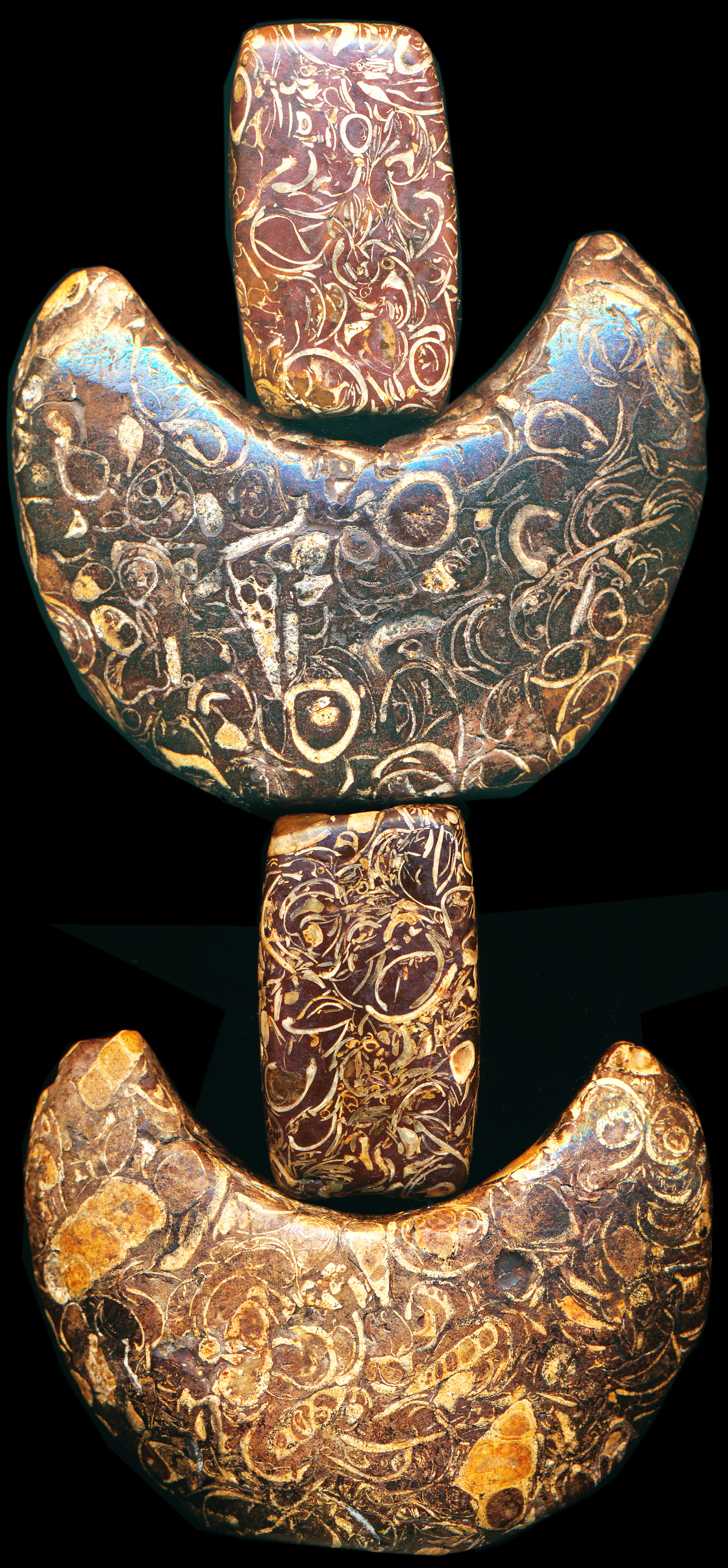
Stone Henge
*
Stone Henge
A matched huge
protohistoric or neolithic set in fossiliferous, silicified limestone:
two crescent pendants flanking a pair of rectangular spacers. The
material is densely packed with tiny shell cross-sections: ovals,
teardrops, and spirals, outlined in crisp ivory against a chocolate to
plum matrix. These are natural fossils revealed by grinding and polish;
some show concentric lips and nested chambers where different infills
occurred during diagenesis. Subtle iron-oxide lenses warm the surface
with honey and ochre notes.
Both crescents are broad-shouldered with softly bevelled rims and
rounded tips, giving a generous, protective curve on the chest. The
spacers are neatly proportioned tablets with slightly domed faces that
echo the same shell tapestry at smaller scale. Luster is a quiet wet-wax
sheen rather than a mirror gloss; high points carry gentle smoothing
from wear, and minute pits mark where shell voids intersect the surface.
A few short, healed hairlines thread the field without breaking the
fossils’ geometry - typical of robust, stabilized material.
Perforations are transverse and generous, allowing leather or plant
fiber. Assembled, this amazing group reads as a unified suite: reef
memory turned ornament. Here deep time forms the decoration and careful
shaping supplies balance, weight, and a calm, ceremonial presence.
|
|
AFB 20 -
100 * 48 *
14 mm |
|
|
|
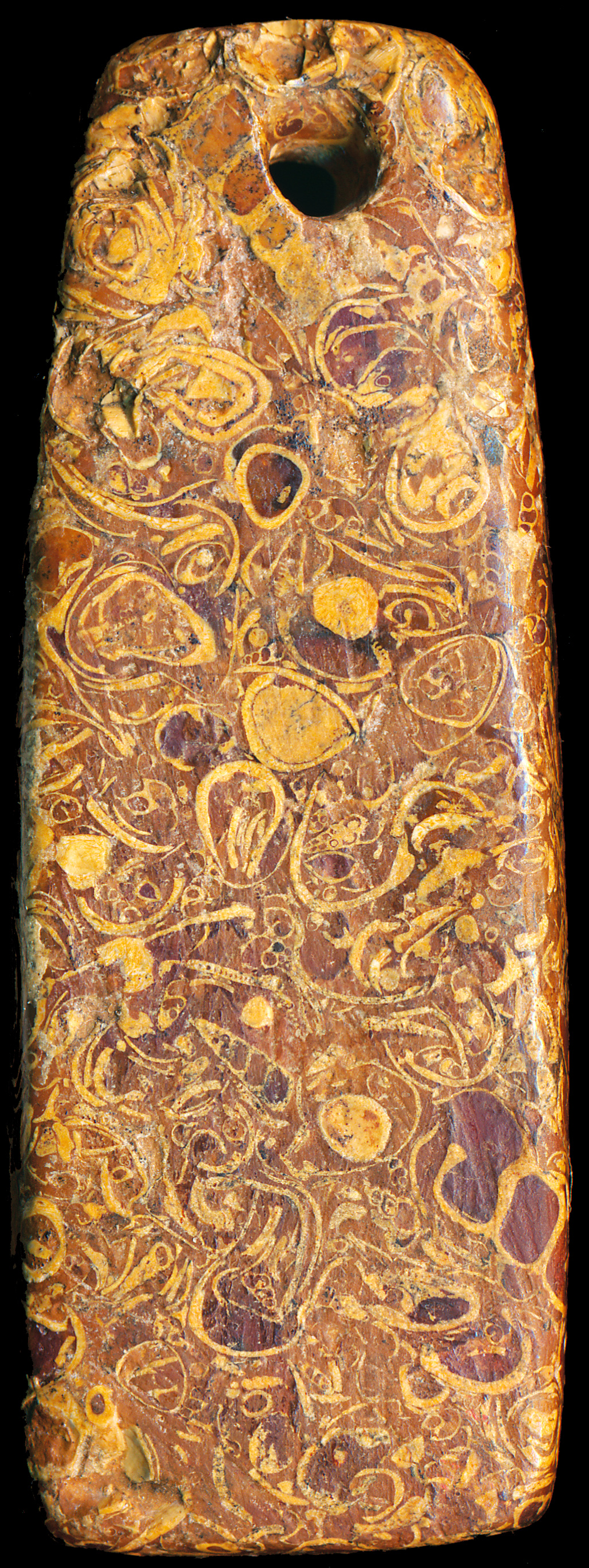
*

Fossilized
Coral Tapestry
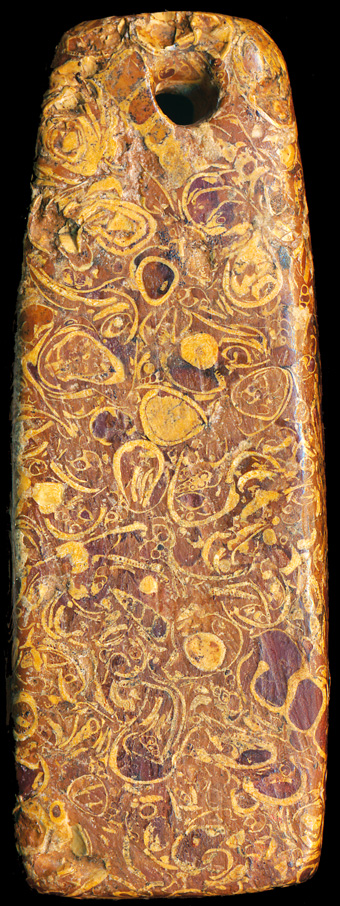
A tall,
tablet-shaped protohistoric or neolithic pendant sawn from fossiliferous,
silicified limestone. The surface is a busy reef collage: cream to honey
fossils float in a plum-brown matrix, their outlines lifted by polish.
Several forms can be tentatively identified. Most abundant are tiny
gastropods seen in cross-section - planispiral whorls that appear as
concentric rings or comma/teardrop shapes with a thin outer lip (likely
juvenile turritellids or other micro-gastropods). Scattered among them
are bivalve chips: lenticular plates with paired, mirror-like curves and
a thicker hinge side. Small tubular curls and horseshoe fragments may be
serpulid worm tubes cut obliquely. Minute round grains with simple rims
could be foraminifera or peloids reworked into the sediment before
lithification. In a few places, concentric coated grains suggest
incipient oncoids/ooids later fused into the rock.
The warm ochre tones reflect iron-oxide staining during diagenesis;
silica has replaced much of the original carbonate, giving a tough,
wax-gloss finish. A tapered suspension hole is drilled from the front
and lightly countersunk, with bruising that matches age and use. Edges
are rounded, carrying small pits where shell voids intersect the
surface.
|
|
AFB 21 -
58 * 21 *
9,5 mm |
|
|
|
*
Seabed Symphony
Same as above
|
|
AFB 22 -
40 * 24 mm |
|
|
|
*
|
|
AFB 23
- 24 * 18 * 7,5 mm - SOLD
(And I regret it) |
|
|
|


Maritime
Pre-Cambric Memory
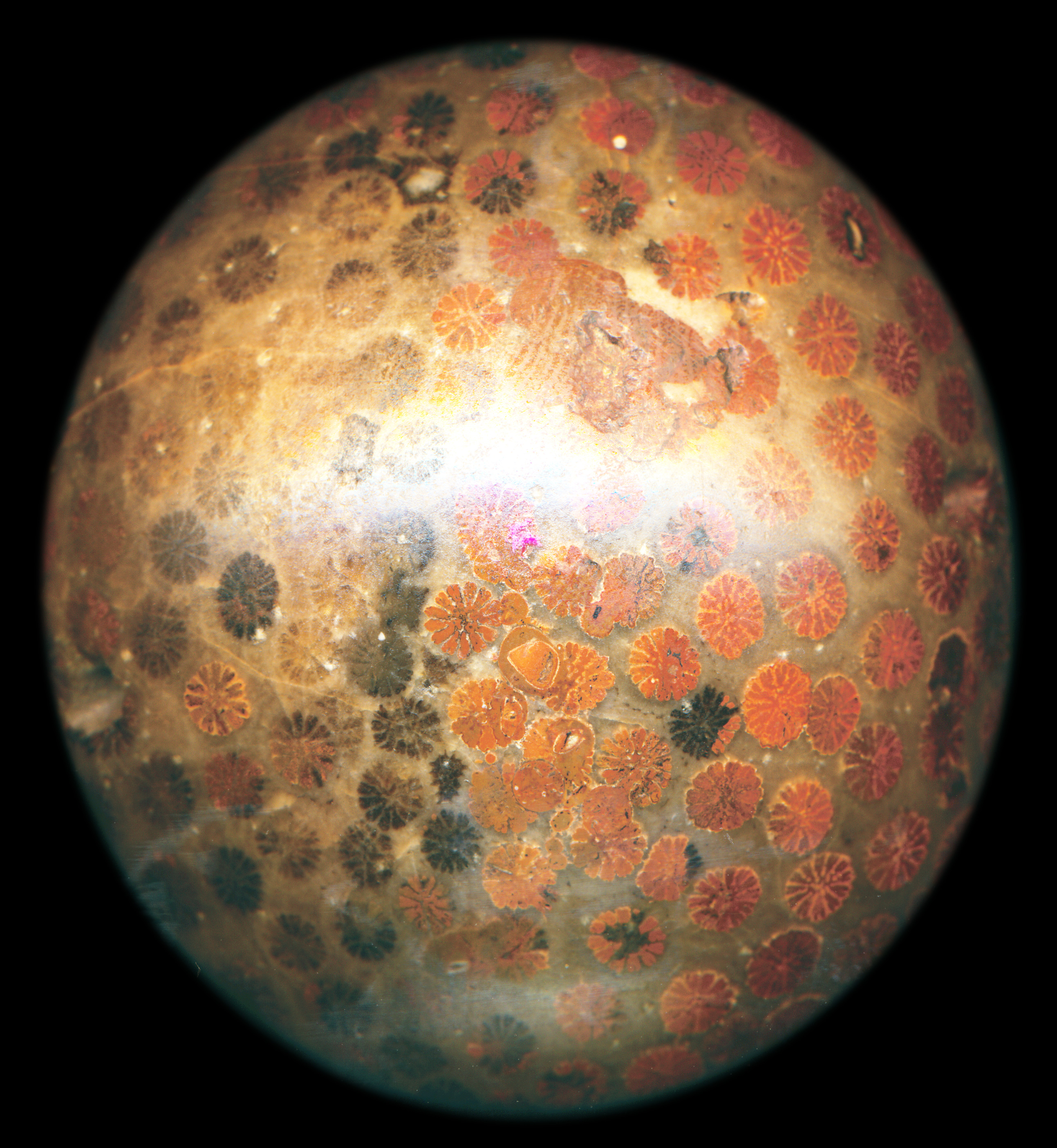
Oval, domed 'top' in
agatized fossil coral. The surface is a field of tightly packed
corallites: radial rosettes with fine spokes (septa) around tiny central
pits. preserved in translucent chalcedony. Most rosettes are smoke-brown
to umber; a clustered quadrant shows warm brick-to-rust tones where iron
oxides stained the silicified skeleton during diagenesis. Between
colonies, pale silica infill gives a soft, aqueous depth; under raking
light the rosette relief lifts while the matrix recedes. A shallow
natural cavity and a few minute pinholes mark former voids where organic
tissue or aragonite dissolved before silica replacement.
Polish is high but not glassy, reading as wet-wax; faint scuffs and tiny
drag lines are consistent with handling rather than modern mirror
buffing. The oval outline is regular, edges neatly eased, and the dome
has an even rise, making it comfortable as a pendant or inlay. With a
loupe, each corallite shows crisp radial septa and polygonal packing,
clear indicators of coral rather than plant or stromatolite fabric.
Overall: a classic agatized coral protohistorian cabochon that balances
biological order and geological time.
Not for sale
|
|
AFB
24 -
56
* 20 mm |
|
|
|
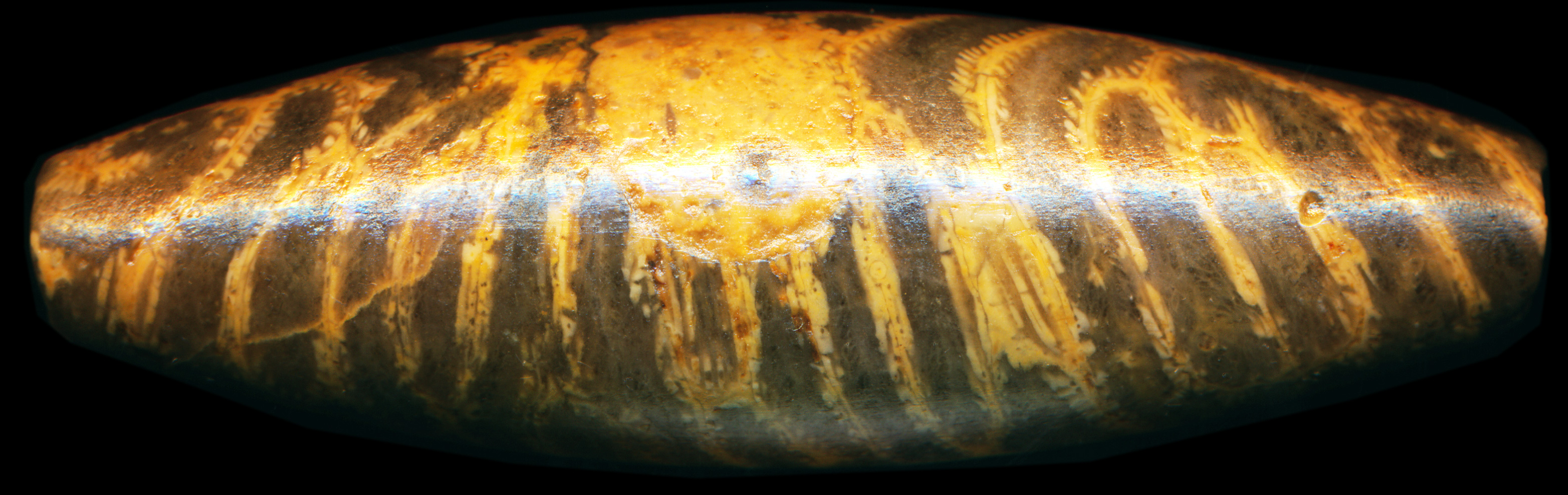
The
Tiger Bead

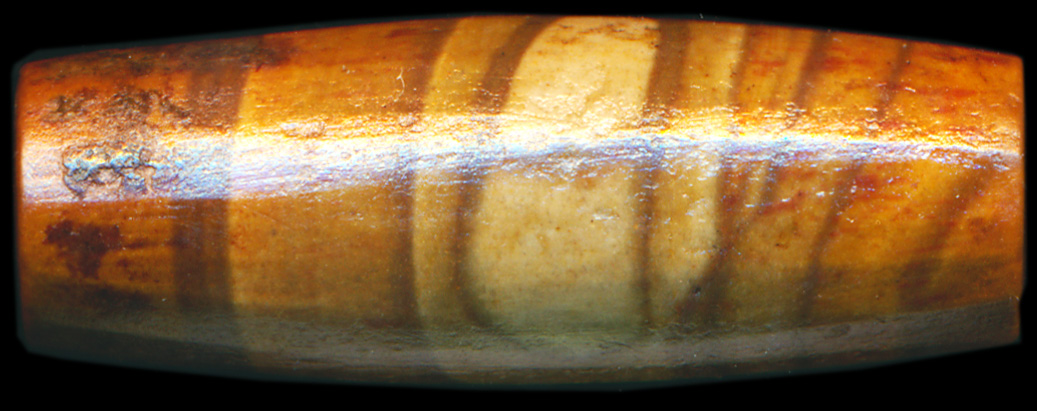
A large elongated,
finely biconical protohistoric bead carved from fossiliferous stone:
most plausibly crinoidal limestone that has been partially silicified.
Across the warm caramel ground runs a vivid fossil script: ladder-like
ribs in oblique bands and, near center, a bold circular 'eye' where a
crinoid columnal is cut close to cross-section, its crenulated rim
reading like tiny gear teeth. Between ossicles the texture softens into
honeyed chalcedony with minute pores and pin-prick voids where original
calcite dissolved before silica replacement. The palette shifts from
golden amber at the waist to cocoa browns toward the tips, emphasizing
the rhythmic, stem-like striations.
Polish is a quiet wet-wax sheen rather than mirror bright. High points
along the axial crest show extra gloss from handling and cord rub; the
flanks retain gentle matte, with a few healed hairlines that do not
interrupt the fossil geometry. Tips are evenly tapered and softly
rounded, giving a poised silhouette on a strand. There are no engraving
or pigment is present. The patterning is inherent to the Paleozoic
sea-floor fabric. Overall, the bead is a compact amulet of deep time:
crinoid stems and columnals stabilized in silica, then shaped with
restraint to produce a tactile, quietly authoritative focal.
|
|
AFB 25 -
66,5 * 19,5 mm |
|
|
|
*
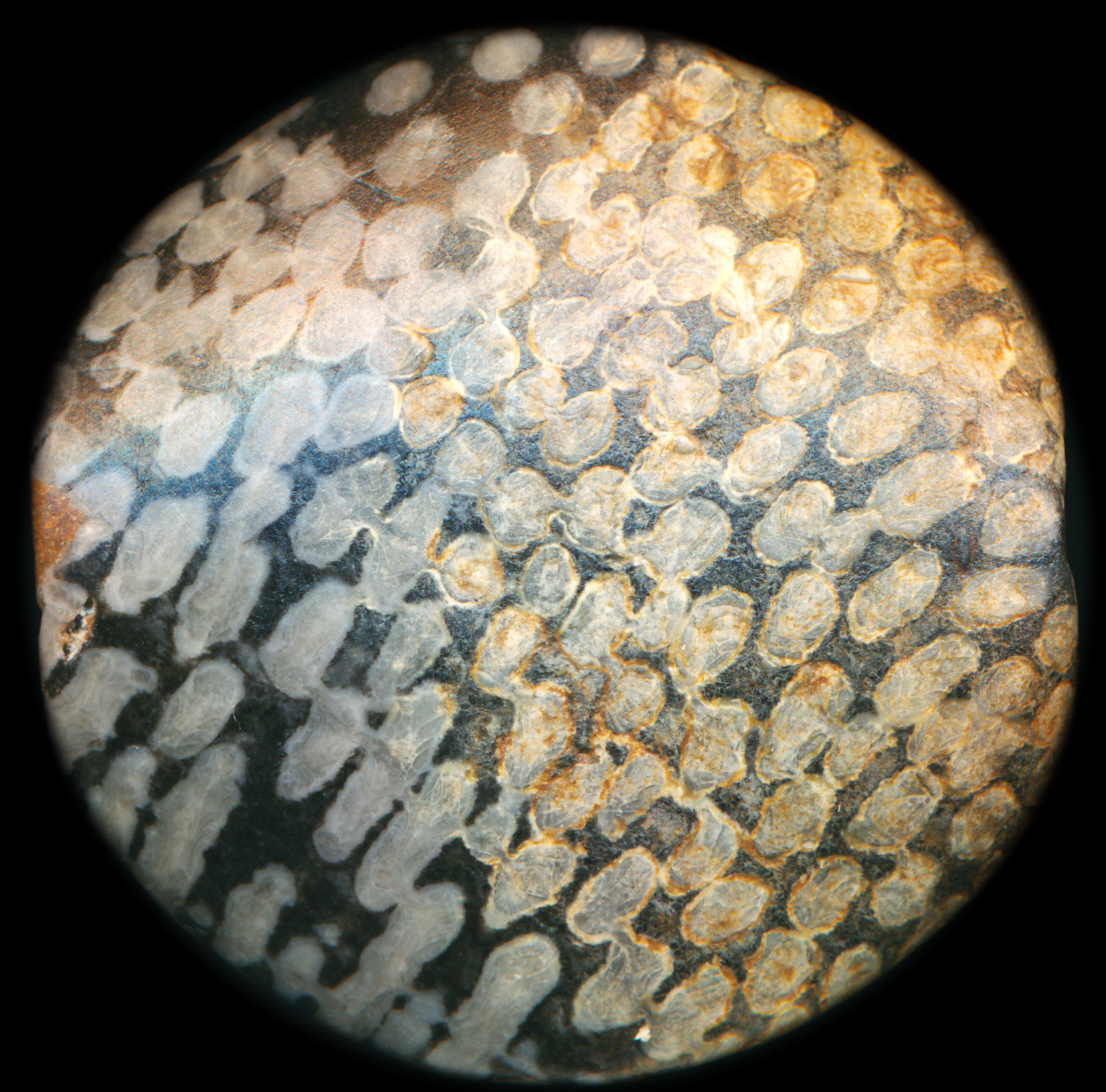
Oceanic Opus
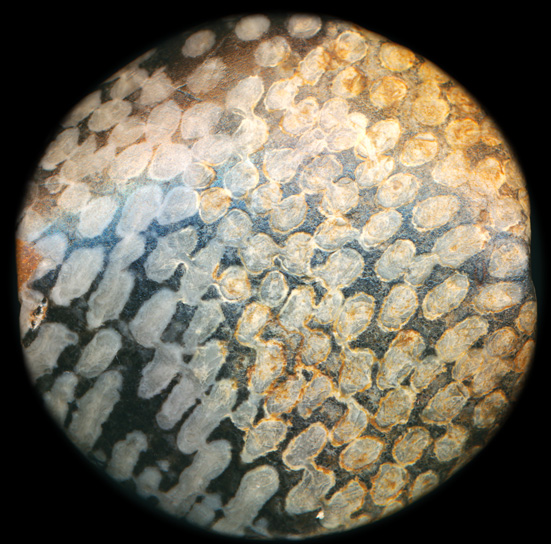
A macro view of
agatized fossil coral showing tightly packed corallites in oblique
section. Each unit appears as an oval to pill-shaped cell with a thin,
milky chalcedony rim and a slightly darker, iron-tinted interior. Toward
the left the cells elongate into short 'finger' forms where the cut
meets the colony at a shallow angle; to the right the ovals become
rounder and more discrete, suggesting a change in section through the
same polyp field. The overall palette shifts from cool blue-grey through
smoke to warm ochres, a diagenetic zoning common in silica-replaced
carbonate.
Between corallites, silica infill gives a faint watery depth; under
raking light, rims lift while the matrix recedes, producing a scale-like
shimmer. Minute pits and hairline seams mark former voids and settlement
lines in the coral skeleton before silicification. The polish is a quiet
wet-wax sheen rather than a glassy buff, with gentle drag lines from
wear. No pigment or engraving is present. The pattern is pure fossil
architecture.
This texture is typical of colonial rugose/tabulate-type coral preserved
in chalcedony: reef geometry frozen in micro-quartz, its living order
now reading as a dense, tactile mosaic.
|
|
AFB 26 -
33,5 * 11 mm |
|
|
|
*

Tide's
Testament
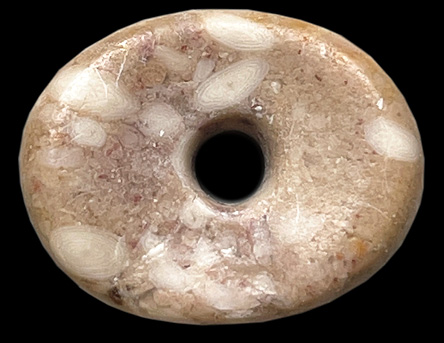
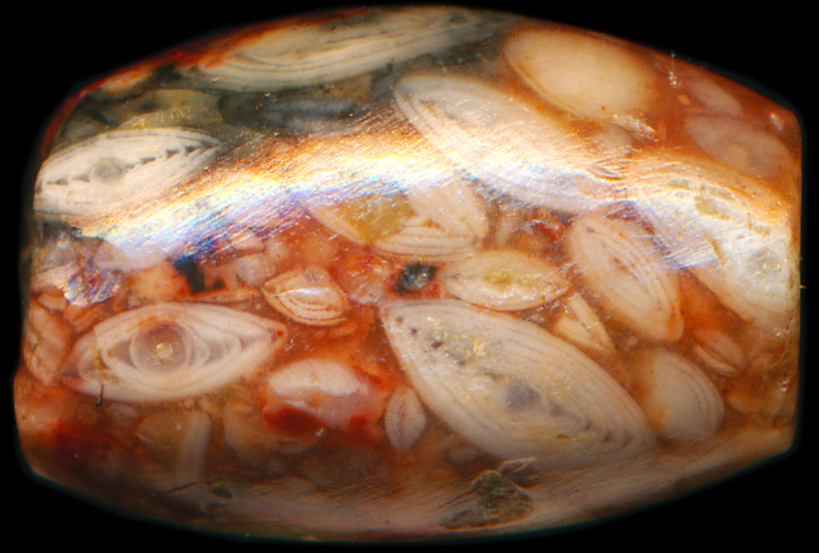
A small neolithic
ring bead in pale cream to blush beige, cut from oolitic, fossiliferous
limestone. The face shows scattered white to ivory ovals with fine,
onion-ring banding: classic ooids/oncoids (coated grains) formed in
shallow, agitated seas. Between them the matrix is a sugary mix of
microfossil debris: shell flour, tiny foraminifera chips, and sparry
calcite cement. Several ovals are clipped by the surface, revealing
concentric cortices around darker nuclei; others appear as elongated
'pills,' where the cut meets them obliquely.
The perforation is neat and slightly biconical, its rim rounded by wear;
interior smoothing suggests prolonged cord movement. Luster is a quiet
wet-wax sheen rather than glassy, consistent with carbonate rather than
chalcedony. Minute pores and faint crystalline flashes (spar cement) dot
the ground, and two small healed hairlines radiate from the aperture
without threatening integrity.
No pigment or engraving is present. The pattern is entirely
depositional. As an ornament it reads soft and tactile, a calm sea-sand
memory stabilized in stone. Care note: oolitic limestone is
comparatively soft and reactive; avoid acids and long immersion, and
store dry. A gentle, authentic piece where coastal wave energy became
geometry, then wearable time.
|
|
AFB 27 -
17,5
* 14 * 6 mm |
|
|
|
*
Caligraphic Memories
These striking beads, sourced from Balochistan,
are crafted from a distinctive patterned stone widely known today as
Calligraphy Stone, Mariam Jasper, or Arabic Script Stone. Characterized
by swirling, script-like ochre and brown patterns, the material is a
fossiliferous, iron-rich sedimentary stone containing traces of ancient
organic matter, likely plant fossils or mineralized debris, that form
natural markings reminiscent of calligraphy. While in contemporary
gemstone markets these stones are often associated with metaphysical
symbolism, their use in antiquity is now well established, especially in
protohistoric bead-making traditions of South Asia.
This particular collection showcases a variety of shapes: discoidal,
barrel, bicone, and square cushion forms: all indicative of skilled
lapidary work. Such shapes were common in the Mehrgarh, Nal, and Kulli
cultural spheres of Balochistan, where beads functioned as both
adornment and markers of status or trade.
Though the stone is commonly associated today with India, Afghan and
Pakistani bead dealers recognize this material as native to Balochistan
and sometimes collected along the sand shores of Gujarat, highlighting
its regional spread and enduring popularity. The natural visual
complexity of the material may have been prized not only for its beauty
but also for symbolic or spiritual connotations, as ancient cultures
often attributed meaning to stones with unusual natural markings. This
set represents a rare and culturally rich bead tradition, rooted deeply
in South Asia’s ancient lapidary heritage.
|
|
AFB 28 -
Biggest Center Bead: 22 * 18 mm |
|
|
|
*


Fossil Awe
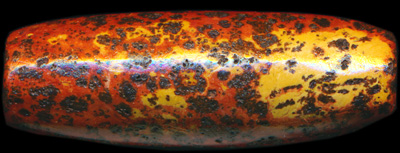
This stunning
protohistoric bead is made from fossiliferous jasper, also known as fossil
jasper or fossilized jasper. What sets it apart is its complex and
organic appearance, marked by dark, high-contrast inclusions embedded
within a reddish to ochre matrix. These irregular, blotchy patterns
resemble the shapes of mineralized plant matter, algae, or possibly even
microscopic coral structures, all of which are hallmarks of
fossiliferous jasper.
The texture of the bead further supports this identification. Around the
dark patches, the surface is subtly rougher and less polished,
suggesting that the mineral replacement process was uneven; typical of
fossil-rich jasper, where organic material has been gradually
transformed by silica.
Its color palette, a blend of deep red, tan, black, and rusty orange,
aligns with fossiliferous types more than with variegated jasper, which
tends to show swirls or banding. Instead, this bead’s structure presents
a clustered, patchy character, as if it carries the fossil memory of
ancient life within.
While it might initially be mistaken for variegated jasper, the
inclusion patterns, texture, and coloration point clearly toward
fossiliferous jasper. It’s a bead that embeds the deep biological past,
making it a natural archive of ancient organic life.
|
|
AFB 29 - 25,5 * 9 mm |
|
|
|
*


Worship of the Golden Calf
This awesome protohistoric Balochistan bead is carved in the stylized shape of a
bull, executed in a fossil-rich stone. likely fossiliferous chert/jasperoid,
judging by the ladder-like, segmented textures across the surface. Those
repeating pale ribs read like mineralized organic structures, giving the
piece a living grain. The body is compact and slightly flared, with a
clean transverse perforation placed high for suspension; the bore shows
rotary wear and a softly bevelled lip from long handling.
Most striking is the single horn. The asymmetry appears intentional: a
practical design choice to avoid the structural weakness that two
projecting horns would create in daily use. By sacrificing strict
realism, the maker achieved a tougher, wearable amulet that still
communicates the bull's power, fertility, and protection: themes deeply
rooted in greater Indus/Balochistan imagery.
Polish on the high points and micro-nicks at the edges suggest age and
circulation. It is a thoughtful fusion of symbol, material, and
engineering, distilled into a finger-tip sized protector.
|
|
AFB 30 -
22 * 16 * 5,5 mm |
|
|
|
*


Barrel Indus bead
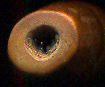
cut from fossiliferous stone showing ammonitic sutures. The side
displays bold, sinuous dark arcs - suture lines - framing tight, ribbed
lamellae where chamber walls and infills were sliced obliquely. Warm
honey-tan ground with coffee-brown seams reads natural, not engraved.
Luster is a quiet wet-wax sheen; tiny pits and softened ridges suggest
age and handling. The end view shows a clean through-drill with slight
countersink and interior polish from cord movement. Overall, a compact
amulet of deep time: a marine cephalopod’s spiral shell abstracted into
graphic pattern, then shaped into a durable, tactile bead that rewards
close inspection.
|
|
AFB 31 -
16,5 * 7,5 mm |
|
|
|
*


Rectangular tablet
Indus bead shaped from fossiliferous crinoidal limestone that has been
partly silicified. The face shows a bold, radial motif: ladder-like ribs
arranged in arcs and semi-circles, consistent with crinoid columnals and
plates sliced obliquely. Between the ribs, paler silica infill softens
into a honey–caramel ground; darker coffee seams outline the fossil
geometry. The polish is a quiet wet-wax sheen rather than a mirror
gloss, with tiny pinholes and softened ridges that suggest age and
handling.
Edges are gently rounded and the corners eased, giving the piece a
smooth, tactile profile. The perforation (end view) is clean and
slightly biconical, with interior smoothing from cord movement and a
small countersink at the entry. No pigment or engraving is present. The
patterning is entirely natural to the fossil fabric.
|
|
AFB 32 -
16,5 * 8,5 * 5 mm |
|
|
|
|